
Join Our JEE Preparation Group
Prep with like-minded aspirants; Get access to free daily tests and study material.
Sign in
Please select an account to continue using cracku.in
↓ →
Join Our JEE Preparation Group
Prep with like-minded aspirants; Get access to free daily tests and study material.
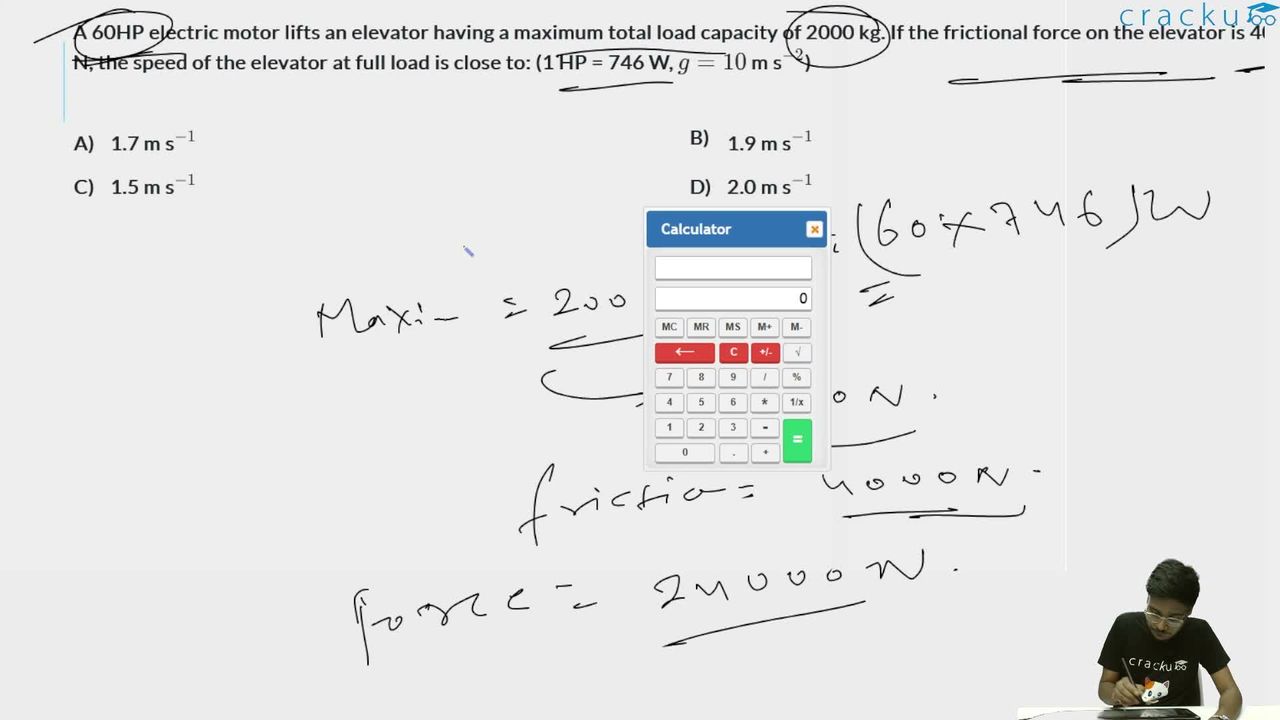
A 60HP electric motor lifts an elevator having a maximum total load capacity of 2000 kg. If the frictional force on the elevator is 4000 N, the speed of the elevator at full load is close to: (1 HP = 746 W, $$g = 10$$ m s$$^{-2}$$)
First, we translate the given horse‐power of the motor into the standard SI unit of power, the watt. The relation stated in the question is $$1\text{ HP}=746\text{ W}.$$ We have a $$60\text{ HP}$$ motor, so the available mechanical power is $$P = 60 \times 746\ \text{W}.$$
Carrying out the multiplication step by step, $$60 \times 700 = 42000,$$ $$60 \times 40 = 2400,$$ $$60 \times 6 = 360,$$ and adding these partial products, $$42000 + 2400 + 360 = 44760.$$ So, $$P = 44760\ \text{W}.$$
Next we examine all the forces that the motor must overcome while lifting the elevator at steady speed. There are two such forces:
1. The gravitational weight of the fully loaded elevator. With a maximum mass $$m = 2000\ \text{kg}$$ and taking the acceleration due to gravity as $$g = 10\ \text{m s}^{-2},$$ the weight is $$W = m g = 2000 \times 10 = 20000\ \text{N}.$$
2. The additional constant frictional force acting downward, given directly as $$F_{\text{fr}} = 4000\ \text{N}.$$
Since both forces oppose the upward motion, the motor must supply enough power to counter their combined effect. Therefore the total opposing or effective force is $$F_{\text{total}} = W + F_{\text{fr}} = 20000 + 4000 = 24000\ \text{N}.$$
For uniform upward motion, the mechanical power needed is related to force and speed by the general formula $$P = F v,$$ where $$v$$ is the (constant) speed of the elevator. Solving this formula for speed gives $$v = \frac{P}{F}.$$
Substituting the numerical values we have determined, $$v = \frac{44760\ \text{W}}{24000\ \text{N}}.$$
Performing the division carefully, we first note that both numerator and denominator have the same factor of 1000, so we can simplify: $$\frac{44760}{24000} = \frac{4476}{2400}.$$ Now dividing, $$\frac{4476}{2400} \approx 1.865.$$ Rounding to two significant figures that match the precision of the data, $$v \approx 1.9\ \text{m s}^{-1}.$$
Hence, the correct answer is Option B.
Was this solution helpful?
Click on the Email ☝️ to Watch the Video Solution
Create a FREE account and get:
_1.webp)

Educational materials for JEE preparation

Ask our AI anything

AI can make mistakes. Please verify important information.
AI can make mistakes. Please verify important information.


