The sum of all the solutions of the equation $$(8)^{2x} - 16 \cdot (8)^x + 48 = 0$$ is :

Join Our JEE Preparation Group
Prep with like-minded aspirants; Get access to free daily tests and study material.
Sign in
Please select an account to continue using cracku.in
↓ →
Join Our JEE Preparation Group
Prep with like-minded aspirants; Get access to free daily tests and study material.
The sum of all the solutions of the equation $$(8)^{2x} - 16 \cdot (8)^x + 48 = 0$$ is :
Login to view the detailed solution.
Let $$z$$ be a complex number such that $$|z + 2| = 1$$ and $$\text{Im}\left(\frac{z+1}{z+2}\right) = \frac{1}{5}$$. Then the value of $$|\text{Re}(z + 2)|$$ is
Login to view the detailed solution.
If the set $$R = \{(a, b) : a + 5b = 42, a, b \in \mathbb{N}\}$$ has $$m$$ elements and $$\sum_{n=1}^{m}(1 - i^{n!}) = x + iy$$, where $$i = \sqrt{-1}$$, then the value of $$m + x + y$$ is
Login to view the detailed solution.
.webp)
If $$\sin x = -\frac{3}{5}$$, where $$\pi < x < \frac{3\pi}{2}$$, then $$80(\tan^2 x - \cos x)$$ is equal to
Login to view the detailed solution.
The equations of two sides AB and AC of a triangle ABC are $$4x + y = 14$$ and $$3x - 2y = 5$$, respectively. The point $$\left(2, -\frac{4}{3}\right)$$ divides the third side BC internally in the ratio $$2 : 1$$. The equation of the side BC is
Login to view the detailed solution.
Let the circles $$C_1 : (x - \alpha)^2 + (y - \beta)^2 = r_1^2$$ and $$C_2 : (x - 8)^2 + \left(y - \frac{15}{2}\right)^2 = r_2^2$$ touch each other externally at the point $$(6, 6)$$. If the point $$(6, 6)$$ divides the line segment joining the centres of the circles $$C_1$$ and $$C_2$$ internally in the ratio $$2 : 1$$, then $$(\alpha + \beta) + 4(r_1^2 + r_2^2)$$ equals
Login to view the detailed solution.
.webp)
Let $$H : \frac{-x^2}{a^2} + \frac{y^2}{b^2} = 1$$ be the hyperbola, whose eccentricity is $$\sqrt{3}$$ and the length of the latus rectum is $$4\sqrt{3}$$. Suppose the point $$(\alpha, 6), \alpha > 0$$ lies on $$H$$. If $$\beta$$ is the product of the focal distances of the point $$(\alpha, 6)$$, then $$\alpha^2 + \beta$$ is equal to
Login to view the detailed solution.
Let $$A = \begin{bmatrix} 2 & a & 0 \\ 1 & 3 & 1 \\ 0 & 5 & b \end{bmatrix}$$. If $$A^3 = 4A^2 - A - 21I$$, where $$I$$ is the identity matrix of order $$3 \times 3$$, then $$2a + 3b$$ is equal to
Login to view the detailed solution.
Let $$[t]$$ be the greatest integer less than or equal to $$t$$. Let $$A$$ be the set of all prime factors of 2310 and $$f : A \rightarrow \mathbb{Z}$$ be the function $$f(x) = \left[\log_2\left(x^2 + \left[\frac{x^3}{5}\right]\right)\right]$$. The number of one-to-one functions from $$A$$ to the range of $$f$$ is
Login to view the detailed solution.
.webp)
For the function $$f(x) = (\cos x) - x + 1, x \in \mathbb{R}$$, between the following two statements (S1) $$f(x) = 0$$ for only one value of $$x$$ in $$[0, \pi]$$. (S2) $$f(x)$$ is decreasing in $$\left[0, \frac{\pi}{2}\right]$$ and increasing in $$\left[\frac{\pi}{2}, \pi\right]$$.
Login to view the detailed solution.
Let $$f(x) = 4\cos^3 x + 3\sqrt{3}\cos^2 x - 10$$. The number of points of local maxima of $$f$$ in interval $$(0, 2\pi)$$ is
Login to view the detailed solution.
The number of critical points of the function $$f(x) = (x - 2)^{2/3}(2x + 1)$$ is
Login to view the detailed solution.
.webp)
Let $$I(x) = \int \frac{6}{\sin^2 x (1 - \cot x)^2} dx$$. If $$I(0) = 3$$, then $$I\left(\frac{\pi}{12}\right)$$ is equal to
Login to view the detailed solution.
The value of $$k \in \mathbb{N}$$ for which the integral $$I_n = \int_0^1 (1 - x^k)^n dx, n \in \mathbb{N}$$, satisfies $$147I_{20} = 148I_{21}$$ is
Login to view the detailed solution.
Let $$f(x)$$ be a positive function such that the area bounded by $$y = f(x), y = 0$$ from $$x = 0$$ to $$x = a > 0$$ is $$e^{-a} + 4a^2 + a - 1$$. Then the differential equation, whose general solution is $$y = c_1 f(x) + c_2$$, where $$c_1$$ and $$c_2$$ are arbitrary constants, is
Login to view the detailed solution.

Let $$y = y(x)$$ be the solution of the differential equation $$(1 + y^2)e^{\tan x} dx + \cos^2 x(1 + e^{2\tan x}) dy = 0, y(0) = 1$$. Then $$y\left(\frac{\pi}{4}\right)$$ is equal to
Login to view the detailed solution.
The set of all $$\alpha$$, for which the vectors $$\vec{a} = \alpha t\hat{i} + 6\hat{j} - 3\hat{k}$$ and $$\vec{b} = t\hat{i} - 2\hat{j} - 2\alpha t\hat{k}$$ are inclined at an obtuse angle for all $$t \in \mathbb{R}$$, is
Login to view the detailed solution.
If the shortest distance between the lines $$L_1 : \vec{r} = (2 + \lambda)\hat{i} + (1 - 3\lambda)\hat{j} + (3 + 4\lambda)\hat{k}, \lambda \in \mathbb{R}$$ and $$L_2 : \vec{r} = 2(1 + \mu)\hat{i} + 3(1 + \mu)\hat{j} + (5 + \mu)\hat{k}, \mu \in \mathbb{R}$$ is $$\frac{m}{\sqrt{n}}$$, where $$\gcd(m, n) = 1$$, then the value of $$m + n$$ equals
Login to view the detailed solution.
_1.webp)
Let $$P(x, y, z)$$ be a point in the first octant, whose projection in the $$xy$$-plane is the point $$Q$$. Let $$OP = \gamma$$; the angle between $$OQ$$ and the positive $$x$$-axis be $$\theta$$; and the angle between $$OP$$ and the positive $$z$$-axis be $$\phi$$, where $$O$$ is the origin. Then the distance of $$P$$ from the $$x$$-axis is
Login to view the detailed solution.
Let the sum of two positive integers be 24. If the probability, that their product is not less than $$\frac{3}{4}$$ times their greatest possible product, is $$\frac{m}{n}$$, where $$\gcd(m, n) = 1$$, then $$n - m$$ equals
Login to view the detailed solution.
The number of 3-digit numbers, formed using the digits 2, 3, 4, 5 and 7, when the repetition of digits is not allowed, and which are not divisible by 3, is equal to ________
Login to view the detailed solution.
Let the positive integers be written in the form:
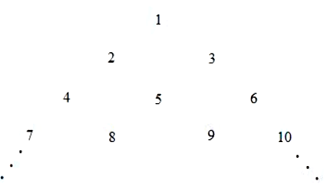
If the $$k^{th}$$ row contains exactly $$k$$ numbers for every natural number $$k$$, then the row in which the number 5310 will be, is ________
Login to view the detailed solution.
Let $$\alpha = \sum_{r=0}^{n}(4r^2 + 2r + 1)^nC_r$$ and $$\beta = \left(\sum_{r=0}^{n}\frac{^nC_r}{r+1}\right) + \frac{1}{n+1}$$. If $$140 < \frac{2\alpha}{\beta} < 281$$, then the value of $$n$$ is ________
Login to view the detailed solution.
If the orthocentre of the triangle formed by the lines $$2x + 3y - 1 = 0$$, $$x + 2y - 1 = 0$$ and $$ax + by - 1 = 0$$, is the centroid of another triangle, whose circumcentre and orthocentre respectively are $$(3, 4)$$ and $$(-6, -8)$$, then the value of $$|a - b|$$ is ________
Login to view the detailed solution.
The value of $$\lim_{x \to 0} 2\left(\frac{1 - \cos x\sqrt{\cos 2x}\sqrt[3]{\cos 3x} \cdots \sqrt[10]{\cos 10x}}{x^2}\right)$$ is
Login to view the detailed solution.
Let $$A = \begin{bmatrix} 2 & -1 \\ 1 & 1 \end{bmatrix}$$. If the sum of the diagonal elements of $$A^{13}$$ is $$3^n$$, then $$n$$ is equal to ________
Login to view the detailed solution.
If the range of $$f(\theta) = \frac{\sin^4\theta + 3\cos^2\theta}{\sin^4\theta + \cos^2\theta}, \theta \in \mathbb{R}$$ is $$[\alpha, \beta]$$, then the sum of the infinite G.P., whose first term is 64 and the common ratio is $$\frac{\alpha}{\beta}$$, is equal to ________
Login to view the detailed solution.
Let the area of the region enclosed by the curve $$y = \min\{\sin x, \cos x\}$$ and the $$x$$ axis between $$x = -\pi$$ to $$x = \pi$$ be $$A$$. Then $$A^2$$ is equal to ________
Login to view the detailed solution.
Let $$\vec{a} = 9\hat{i} - 13\hat{j} + 25\hat{k}$$, $$\vec{b} = 3\hat{i} + 7\hat{j} - 13\hat{k}$$ and $$\vec{c} = 17\hat{i} - 2\hat{j} + \hat{k}$$ be three given vectors. If $$\vec{r}$$ is a vector such that $$\vec{r} \times \vec{a} = (\vec{b} + \vec{c}) \times \vec{a}$$ and $$\vec{r} \cdot (\vec{b} - \vec{c}) = 0$$, then $$\frac{|593\vec{r} + 67\vec{a}|^2}{(593)^2}$$ is equal to ________
Login to view the detailed solution.
Three balls are drawn at random from a bag containing 5 blue and 4 yellow balls. Let the random variables $$X$$ and $$Y$$ respectively denote the number of blue and yellow balls. If $$\bar{X}$$ and $$\bar{Y}$$ are the means of $$X$$ and $$Y$$ respectively, then $$7\bar{X} + 4\bar{Y}$$ is equal to ________
Login to view the detailed solution.
Educational materials for JEE preparation
 Share
Share