NTA JEE Mains 06th April 2024 Shift 2
For the following questions answer them individually
NTA JEE Mains 06th April 2024 Shift 2 - Question 11
The number of electrons flowing per second in the filament of a $$110 \text{ W}$$ bulb operating at $$220 \text{ V}$$ is : (Given $$e = 1.6 \times 10^{-19} \text{ C}$$)
NTA JEE Mains 06th April 2024 Shift 2 - Question 12
Match List-I with List-II :
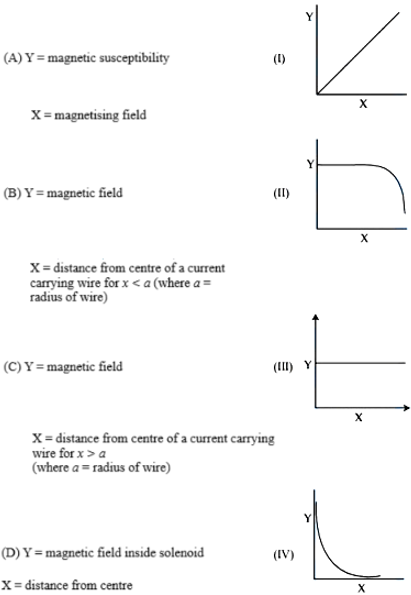
Choose the correct answer from the options given below :
NTA JEE Mains 06th April 2024 Shift 2 - Question 13
In a coil, the current changes from $$-2 \text{ A}$$ to $$+2 \text{ A}$$ in $$0.2 \text{ s}$$ and induces an emf of $$0.1 \text{ V}$$. The self inductance of the coil is :

NTA JEE Mains 06th April 2024 Shift 2 - Question 14
In the given electromagnetic wave $$E_y = 600 \sin(\omega t - kx) \text{ Vm}^{-1}$$, intensity of the associated light beam is (in $$\text{W/m}^2$$) : (Given $$\epsilon_0 = 9 \times 10^{-12} \text{ C}^2 \text{ N}^{-1} \text{ m}^{-2}$$)
NTA JEE Mains 06th April 2024 Shift 2 - Question 15
In finding out refractive index of glass slab the following observations were made through travelling microscope 50 vernier scale division $$= 49$$ MSD; 20 divisions on main scale in each cm. For mark on paper MSR $$= 8.45 \text{ cm}$$, VC $$= 26$$. For mark on paper seen through slab MSR $$= 7.12 \text{ cm}$$, VC $$= 41$$. For powder particle on the top surface of the glass slab MSR $$= 4.05 \text{ cm}$$, VC $$= 1$$. (MSR = Main Scale Reading, VC = Vernier Coincidence) Refractive index of the glass slab is :
NTA JEE Mains 06th April 2024 Shift 2 - Question 16
For the thin convex lens, the radii of curvature are at $$15 \text{ cm}$$ and $$30 \text{ cm}$$ respectively. The focal length the lens is $$20 \text{ cm}$$. The refractive index of the material is :
NTA JEE Mains 06th April 2024 Shift 2 - Question 17
When UV light of wavelength $$300 \text{ nm}$$ is incident on the metal surface having work function $$2.13 \text{ eV}$$, electron emission takes place. The stopping potential is: (Given $$hc = 1240 \text{ eVnm}$$)
NTA JEE Mains 06th April 2024 Shift 2 - Question 18
The longest wavelength associated with Paschen series is : (Given $$R_H = 1.097 \times 10^7 \text{ SI unit}$$)
NTA JEE Mains 06th April 2024 Shift 2 - Question 19
The acceptor level of a p-type semiconductor is $$6 \text{ eV}$$. The maximum wavelength of light which can create a hole would be : Given $$hc = 1242 \text{ eVnm}$$.
NTA JEE Mains 06th April 2024 Shift 2 - Question 20
In a vernier calliper, when both jaws touch each other, zero of the vernier scale shifts towards left and its $$4^{th}$$ division coincides exactly with a certain division on main scale. If 50 vernier scale divisions equal to 49 main scale divisions and zero error in the instrument is $$0.04 \text{ mm}$$ then how many main scale divisions are there in $$1 \text{ cm}$$?