NTA JEE Mains 22nd Jan 2025 Shift 2
For the following questions answer them individually
NTA JEE Mains 22nd Jan 2025 Shift 2 - Question 21
If $$\sum_{r=1}^{30}\f\frac{r^{2}({}^{30}C_{r})^{2}}{{}^{30}C_{r-1}}=\alpha \t\times 2^{29}$$, then $$\alpha$$ is equal to______.
789
456
123
0.-
Clear All
NTA JEE Mains 22nd Jan 2025 Shift 2 - Question 22
Let A = {1, 2, 3}. The number of relations on A, containing (1,2) and (2,3), which are reflexive and transitive but not symmetric, is ______ -
789
456
123
0.-
Clear All
NTA JEE Mains 22nd Jan 2025 Shift 2 - Question 23
Let A(6,8),$$B(10\cos \alpha, -10\sin \alpha)$$ and $$C(-10\sin \alpha, 10\cos \alpha)$$. be the vertices of a triangle. If L(a, 9) and G(h, k) be its orthocenter and centroid respectively, then $$(5a − 3h + 6k + 100 \sin 2\alpha)$$ is equals to_______.
789
456
123
0.-
Clear All

NTA JEE Mains 22nd Jan 2025 Shift 2 - Question 24
Let y = f(x) be the solution of the differential equation $$\frac{dy}{dx}+\frac{xy}{x^{2}-1}=\frac{x^{6}+4x}{\sqrt{1-x^{2}}},-1 < x < 1$$ such that f(0)=0.If $$6\int_{-\frac{1}{2}}^{\frac{1}{2}}f(x)dx=2\pi - \alpha$$ then $$\alpha^{2}$$ is equal to ______.
789
456
123
0.-
Clear All
NTA JEE Mains 22nd Jan 2025 Shift 2 - Question 25
Let the distance between two parallel lines be 5 units and a point P lie between the lines at a unit distance from one of them. An equilateral triangle PQR is formed such that Q lies on one of the parallel lines, while R lies on the other. Then $$(QR)^{2}$$ is equal to______.
789
456
123
0.-
Clear All
NTA JEE Mains 22nd Jan 2025 Shift 2 - Question 26
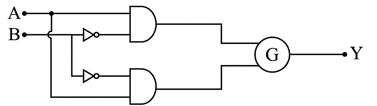
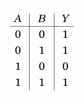
To obtain the given truth table, following logic gate should be placed at G:
NTA JEE Mains 22nd Jan 2025 Shift 2 - Question 27
A small rigid spherical ball of mass M is dropped in a long vertical tube containing glycerine. The velocity of the ball becomes constant after some time. If the density of glycerine is half of the density of the ball, then the viscous force acting on the ball will be (consider g as acceleration due to gravity)
NTA JEE Mains 22nd Jan 2025 Shift 2 - Question 28
The torque due to the force $$(2\widehat{i}+\widehat{j}+2\widehat{k})$$ about the origin, acting on a particle whose position vector is $$(\widehat{i}+\widehat{j}+\widehat{k})$$, would be
NTA JEE Mains 22nd Jan 2025 Shift 2 - Question 29
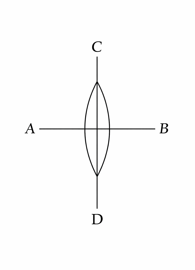
A symmetric thin biconvex lens is cut into four equal parts by two planes AB and CD as shown in figure. If the power of original lens is 4 D then the power of a part of the divided lens is
NTA JEE Mains 22nd Jan 2025 Shift 2 - Question 30
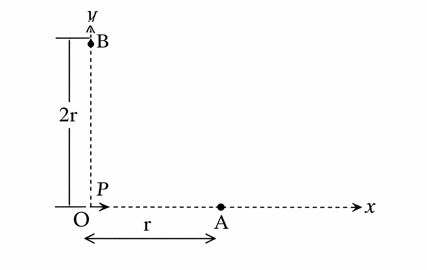
For a short dipole placed at origin O, the dipole moment is along x-axis, as shown in the figure. If the electric potential and electric field at A are $$V_{\circ}$$ and $$E_{\circ}$$, respectively, then the correct combination of the electric potential and electric field, respectively, at point B on the -axis is given by