NTA JEE Mains 22nd Jan 2025 Shift 1
For the following questions answer them individually
NTA JEE Mains 22nd Jan 2025 Shift 1 - Question 41
Two spherical bodies of same materials having radii 0.2 m and 0.8 m are placed in same atmosphere. The temperature of the smaller body is 800 K and temperature of the bigger body is 400 K . If the energy radiated from the smaller body is E, the energy radiated from the bigger body is (assume, effect of the surrounding temperature to be negligible),
NTA JEE Mains 22nd Jan 2025 Shift 1 - Question 42
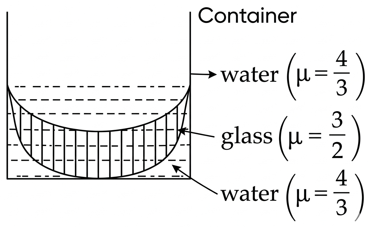
In the diagram given below, there are three lenses formed. Considering negligible thickness of each of them as compared to $$\mid R_1 \mid \text{ and } \mid R_2 \mid$$, i.e., the radii of curvature for upper and lower surfaces of the glass lens, the power of the combination is
NTA JEE Mains 22nd Jan 2025 Shift 1 - Question 43
Given below are two statements : one is labelled as Assertion (A) and the other is labelled as Reason (R).
Assertion-(A) : If Young's double slit experiment is performed in an optically denser medium than air, then the consecutive fringes come closer. Reason-(R) : The speed of light reduces in an optically denser medium than air while its frequency does not change. In the light of the above statements, choose the most appropriate answer from the options given below :

NTA JEE Mains 22nd Jan 2025 Shift 1 - Question 44
A parallel-plate capacitor of capacitance $$40\mu$$ F is connected to a 100 V power supply. Now the intermediate space between the plates is filled with a dielectric material of dielectric constant K=2. Due to the introduction of dielectric material, the extra charge and the change in the electrostatic energy in the capacitor, respectively, are
NTA JEE Mains 22nd Jan 2025 Shift 1 - Question 45
Which of the following resistivity $$(\rho) v/s$$ temperature (T) curves is most suitable to be used in wire bound standard resistors?
NTA JEE Mains 22nd Jan 2025 Shift 1 - Question 46
The driver sitting inside a parked car is watching vehicles approaching from behind with the help of his side view mirror, which is a convex mirror with radius of curvature R=2 m. Another car approaches him from behind with a uniform speed of 90 km/hr. When the car is at a distance of 24 m from him, the magnitude of the acceleration of the image of the car in the side view mirror is ' a '. The value of 100 a is ________ $$m/s^{2}$$.
789
456
123
0.-
Clear All
NTA JEE Mains 22nd Jan 2025 Shift 1 - Question 47
Two soap bubbles of radius 2 cm and 4 cm , respectively, are in contact with each other. The radius of curvature of the common surface, in cm , is ________ .
789
456
123
0.-
Clear All
NTA JEE Mains 22nd Jan 2025 Shift 1 - Question 48
The position vectors of two 1 kg particles, (A) and (B), are given by $$ \overrightarrow{r_A}=\left( \alpha_1 t^{2}\widehat{i}+ \alpha_2 t\widehat{j}+\alpha_3 t\widehat{k} \right)m \text{ and } \overrightarrow{r_B}=\left( \beta_1 t\widehat{i} + \beta_2 t^{2}\widehat{j} + \beta_3 t \widehat{k} \right)m,$$ respectively; $$ \left( \alpha_1= 1 m/s^{2}, \alpha_2 = 3nm/s, \alpha_3= 2m/s, \beta_1 = 2m/s, \beta_2 = -1 m/s^{2}, \beta_3 = 4pm/s \right),$$ where t is time, n and p are constants. At $$t=1s, \mid \overrightarrow{V_A}\mid = \mid \overrightarrow{V_B} \mid$$ and velocities $$\overrightarrow{V_A}$$ and $$\overrightarrow{V_B}$$ of the particles are orthogonal to each other. At $$t=1 s,$$ the magnitude of angular momentum of particle (A) with respect to the position of particle (B) is $$ \sqrt{L} kgm^{2} s^{-1}.\text{ The value of L is }$$ _______ .
789
456
123
0.-
Clear All
NTA JEE Mains 22nd Jan 2025 Shift 1 - Question 49
Three conductors of same length having thermal conductivity $$k_1, k_2 \text{ and } K_3$$ are connected as shown in figure.
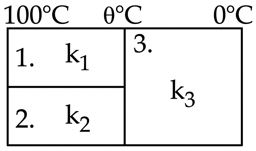
Area of cross sections of $$ 1^{st} \text{ and }2^{nd}$$ conductor are same and for $$3^{rd}$$ conductor it is double of the $$1^{st}$$ conductor. The temperatures are given in the figure. In steady state condition, the value of 0 is _______ $$^oC$$.
$$(\text{Given }:k_1=60Js^{-1}m^{-1}K^{-1},k_2= 120Js^{-1}m^{-1}K^{-1}, k_3= 135Js^{-1}m^{-1}K^{-1})$$
789
456
123
0.-
Clear All
NTA JEE Mains 22nd Jan 2025 Shift 1 - Question 50
A particle is projected at an angle of $$30^{o}$$ from horizontal at a speed of $$ 60 m/s.$$ The height traversed by the particle in the first second is $$ h_0 $$ and height traversed in the last second, before it reaches the maximum height, is $$ h_1.$$ The ratio $$h_0:h_1 $$ is _______[Take, $$g=10m/s^{2}]$$
789
456
123
0.-
Clear All