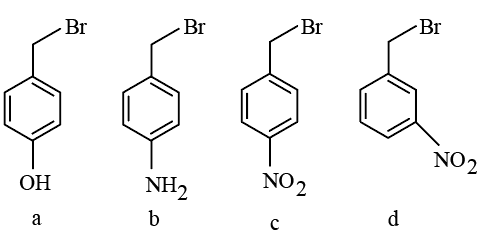
The correct order of reactivity of the following benzyl halides towards reaction with KCN is:
Sign in
Please select an account to continue using cracku.in
↓ →

Join Our JEE Preparation Group
Prep with like-minded aspirants; Get access to free daily tests and study material.
The correct order of reactivity of the following benzyl halides towards reaction with KCN is:
Login to view the detailed solution.
Given below are four compounds :
(a) n-propyl choride
(b) iso-propyl chloride
(c) sec-butyl chloride
(d) neo-pentyl chloride
Percentage of carbon in the one which exhibits optical isomerism is:
Login to view the detailed solution.
By usual analysis, 1.00 g of compound (X) gave 1.79 g of magnesium pyrophosphate. The percentage of phosphorus in compound (X) is: (nearest integer)
(Given, molar mass in $$gmol^{-1}$$ : 0 = 16, Mg = 24, P = 31 )
Login to view the detailed solution.
.webp)
Given below are two statements:
Statement I : Crystal Field Stabilization Energy (CFSE) of $$\left[Cr\left( H_{2}O \right)_{6} \right]^{2+}$$ is greater than that of $$\left[Mn\left( H_{2}O \right)_{6} \right]^{2+}$$.
Statement II: Potassium ferricyanide has a greater spin-only magnetic moment than sodium ferrocyanide.
In the light of the above statements, choose the correct answer from the options given below :
Login to view the detailed solution.
Aqueous HCI reacts with $$MnO_{2} \left(s\right)$$ to form $$MnCl_{2}\left(aq\right)$$, $$Cl_{2}\left(g\right)$$ and $$H_{2}O\left(l\right)$$. What is the weight (in g) of $$Cl_{2}$$ liberated when 8.7 g of $$MnO_{2} \left(s\right)$$ is reacted with excess aqueous HCI solution ?
(Given Molar mass in g $$mol^{-1}$$ Mn = 55, Cl = 35.5, 0 = 16, H = l )
Login to view the detailed solution.
For a closed circuit Daniell cell, which of the following plots is the accurate one at a given temperature?
Login to view the detailed solution.
.webp)
Match List - I with List - II.
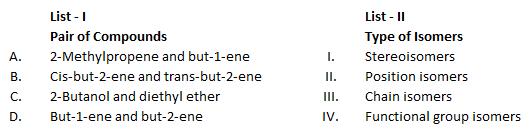
Choose the correct answer from the options given below :
Login to view the detailed solution.
Consider the following data :
$$\Delta_f H^\ominus$$ (methane, g) = - X kJ $$mol^{-1}$$
Enthalpy of sublimation of graphite = Y kJ $$mol^{-1}$$
Dissociation enthalpy of $$H_{2}$$ = Zkj $$mol^{-1}$$
The bond enthalpy of C - H bond is given by :
Login to view the detailed solution.
The correct order of the rate of the reaction for the following reaction with respect to nucleophiles is:
$$CH_{3}Br + Nu^{\ominus} \rightarrow CH_{3}Nu+Br^{\ominus}$$
Login to view the detailed solution.
.webp)
Given below are two statements:
Statement I: Compound (X), shown below, dissolves in $$NaHCO_{3}$$ solution and has two chiral carbon atoms
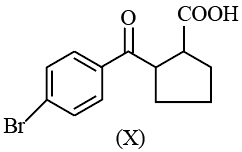
Statement II: Compound (Y), shown below, has two carbons with $$sp^{3}$$ hybridization, one carbon with $$sp^{2}$$ and one carbon with sp hybridization
%20slot%202.png)
In the light of the above statements, choose the correct answer from the options given below:
Login to view the detailed solution.
Given below are two statements:
Statement I: The correct order in terms of bond dissociation enthalpy is $$Cl_{2} > Br_{2} > F_{2} > I_{2}$$.
Statement II : The correct trend in the covalent character of the metal halides is $$[SnCl_{4} > SnCl_{2}]$$, $$[PbCl_{4}> PbCl_{2}]$$, and $$[UF_{4} > UF_{6}]$$.
In The light oh the above statements, choose the correct answer from the options given below:
Login to view the detailed solution.
Consider the following spectral lines for atomic hydrogen :
A. First line of Paschen series
B. Second line of Balmer series
C. Third line of Paschen series
D. Fourth line of Bracket series
The correct arrangement of the above lines in ascending order of energy is :
Login to view the detailed solution.
.webp)
Match List - I with List - II.
%20slot%202.png)
Choose the correct answer from the options given below:
Login to view the detailed solution.
Given below are some of the statements about Mn and $$Mn_{2}O_{7}$$. Identify the correct statements.
A. Mn forms the oxide $$Mn_{2}O_{7}$$, in which Mn is in its highest oxidation state.
B. Oxygen stabilizes the Mn in higher oxidation states by forming multiple bonds with Mn.
C. $$Mn_{2}O_{7}$$ is an ionic oxide.
D. The structure of $$Mn_{2}O_{7}$$ consists of one bridged oxygen.
Choose the correct answer from the options given below :
Login to view the detailed solution.
Decompasition of A is a first order reaction at T(K) and is given by $$A(g) \rightarrow B(g)+C(g)$$.
In a closed 1 L vessel, 1 bar A(g) is allowed to decompose at T(K). After 100 minutes, the total pressure was 1.5bar. What is the rate constant (in $$min^{-1})$$ of the reaction ? (log 2 = 0.3)
Login to view the detailed solution.

The correct increasing order of C - H(A), C - 0 (B), C = O(C) and C ≡ N (D) bonds in terms of covalent bond length is :
Login to view the detailed solution.
On heating a mixture of common salt and $$K_{2}Cr_{2}O_{7}$$ in equal amount along with concentrated $$H_{2}SO_{4}$$ in a test tube, a gas is evolved. Formula of the gas evolved and oxidation State of the central metal atom in the gas respectively are:
Login to view the detailed solution.
Given below are two statements:
Statement I: The correct order in terms of atomic/ionic radii is $$Al >Mg > Mg^{2+} >Al^{3+}$$
Statement II: The correct order in terms of the magnitude of electron gain enthalpy is Cl > Br >S >O.
In the light of the above statements, choose the correct answer from the options given below:
Login to view the detailed solution.
_1.webp)
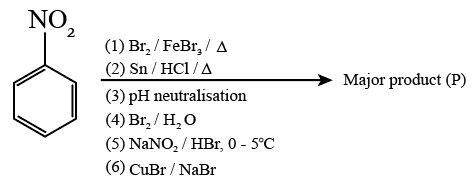
Consider the above sequence of reactions. The number of bromine atom(s) in the final product (P) will be:
Login to view the detailed solution.
The correct statements are :
A. Activation energy for enzyme catalysed hydrolysis of sucrose is lower than that of acid catalysed hydrolysis.
B. During denaturation, secondary and tertiary structures of a protein are destroyed but primary structure remains intact.
C. Nucleotides are joined together by glycosidic linkage between $$C_{1}$$ and $$C_{4}$$ carbons of the pentose sugar.
D. Quaternary structure of proteins represents overall folding of the polypeptide chain.
Choose the correct answer from the options given below :
Login to view the detailed solution.
The first and second ionization constants of $$H_{2}X$$ are $$2.5 \times 10^{-8}$$ and $$1.0 \times 10^{-13}$$ respectively. The concentration of $$X^{2-}$$ in $$0.1 MH_{2} X$$ solution is _________ $$\times 10^{-15}M$$. (Nearest Integer)
Login to view the detailed solution.
A substance 'X' (1.5 g) dissolved in 150 g of a solvent 'Y'(molar mass=300 g $$mol^{-1}$$ ) led to an elevation of the boiling point by 0.5 K. The relative lowering in the vapour pressure of the solvent 'Y' is __________ $$\times 10^{-2}$$. (nearest integer)
[Given : $$K_{b}$$ of the solvent =5.0 K kg $$mol^{-1}$$]
Assume the solution to be dilute and no association or dissociation of X takes place in solution.
Login to view the detailed solution.
The osmotic pressure of a living cell is 12 atm at 300 K. The strength of sodium chloride solution that is isotonic with the living cell at tltis temperature is __________ $$g L^{-1}$$.
(Nearest integer)
Given: R = 0.08 L atm $$K^{-1} mol^{-1}$$
Assume complete dissociation of NaCl
(Given : Molar mass of Na and Cl are 23 and 35.5 g $$mol^{-1}$$ respectively.)
Login to view the detailed solution.
MX is a sparingly soluble salt that follows the given solubility equilibrium at 298 K.
$$MX(s) \rightleftharpoons M^{+} (aq)+X^{-}(aq); K_{sp}=10^{-10}$$
If the standard reduction potential for $$M^{+}(aq)\xrightarrow {+e^{-}}M(s)$$ and $$\left(E_{M^{+}/M}^\ominus\right)=0.79V$$, then the value of the standard reduction potential for the metal/metal insoluble salt electrode $$E^{\ominus}_{X^{-}/MX (s)/M }$$ is __________mV.(nearest integer)
[Given : $$\frac{2.303RT}{F} = 0.059V$$]
Login to view the detailed solution.
Identify the metal ions among $$Co^{2+}, Ni^{2+}, Fe^{2+}, V^{3+} \text{ and } Ti^{2+}$$ having a spin-only magnetic moment value more than 3.0 BM. The sum of unpaired electrons present in the high spin octahedral complexes formed by those metal ions is __________.
Login to view the detailed solution.
Educational materials for JEE preparation
 Share
Share