For the following questions answer them individually
The radius $$r$$, length $$l$$ and resistance $$R$$ of a metal wire was measured in the laboratory as $$r = 0.35 \pm 0.05$$ cm, $$R = 100 \pm 10$$ ohm, $$l = 15 \pm 0.2$$ cm. The percentage error in resistivity of the material of the wire is :
The dimensional formula of angular impulse is :
A particle moving in a circle of radius $$R$$ with uniform speed takes time $$T$$ to complete one revolution. If this particle is projected with the same speed at an angle $$\theta$$ to the horizontal, the maximum height attained by it is equal to $$4R$$. The angle of projection $$\theta$$ is then given by :
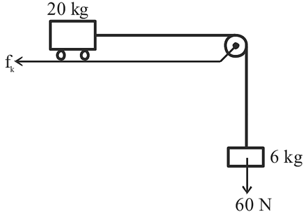
Consider a block and trolley system as shown in figure. If the coefficient of kinetic friction between the trolley and the surface is $$0.04$$, the acceleration of the system in m s$$^{-2}$$ is: (Consider that the string is massless and unstretchable and the pulley is also massless and frictionless):
A simple pendulum of length $$1$$ m has a wooden bob of mass $$1$$ kg. It is struck by a bullet of mass $$10^{-2}$$ kg moving with a speed of $$2 \times 10^{2}$$ m s$$^{-1}$$. The bullet gets embedded into the bob. The height to which the bob rises before swinging back is. (use $$g = 10$$ m s$$^{-2}$$)
A ball of mass $$0.5$$ kg is attached to a string of length $$50$$ cm. The ball is rotated on a horizontal circular path about its vertical axis. The maximum tension that the string can bear is $$400$$ N. The maximum possible value of angular velocity of the ball in rad s$$^{-1}$$ is :
If $$R$$ is the radius of the earth and the acceleration due to gravity on the surface of earth is $$g = \pi^2$$ m s$$^{-2}$$, then the length of the second's pendulum at a height $$h = 2R$$ from the surface of earth will be:
With rise in temperature, the Young's modulus of elasticity
The pressure and volume of an ideal gas are related as $$PV^{3/2} = K$$ (Constant). The work done when the gas is taken from state $$A(P_1, V_1, T_1)$$ to state $$B(P_2, V_2, T_2)$$ is :
Two moles of a monoatomic gas is mixed with six moles of a diatomic gas. The molar specific heat of the mixture at constant volume is :
Two identical capacitors have same capacitance $$C$$. One of them is charged to the potential $$V$$ and other to the potential $$2V$$. The negative ends of both are connected together. When the positive ends are also joined together, the decrease in energy of the combined system is :
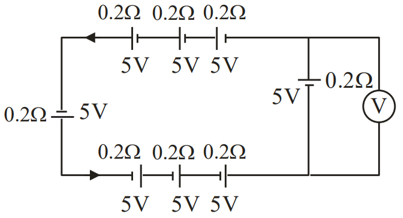
The reading in the ideal voltmeter $$V$$ shown in the given circuit diagram is:Â
A galvanometer has a resistance of $$50\ \Omega$$ and it allows maximum current of $$5$$ mA. It can be converted into voltmeter to measure upto $$100$$ V by connecting in series a resistor of resistance.
A parallel plate capacitor has a capacitance $$C = 200$$ pF. It is connected to $$230$$ V ac supply with an angular frequency $$300$$ rad s$$^{-1}$$. The rms value of conduction current in the circuit and displacement current in the capacitor respectively are :
In series LCR circuit, the capacitance is changed from $$C$$ to $$4C$$. To keep the resonance frequency unchanged, the new inductance should be :
A monochromatic light of wavelength $$6000\ \mathring{A}$$ is incident on the single slit of width $$0.01$$ mm. If the diffraction pattern is formed at the focus of the convex lens of focal length $$20$$ cm, the linear width of the central maximum is :
The de Broglie wavelengths of a proton and an $$\alpha$$ particle are $$\lambda$$ and $$2\lambda$$ respectively. The ratio of the velocities of proton and $$\alpha$$ particle will be :
The minimum energy required by a hydrogen atom in ground state to emit radiation in Balmer series is nearly :
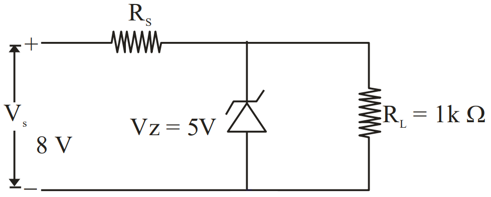
In the given circuit if the power rating of Zener diode is $$10$$ mW, the value of series resistance $$R_s$$ to regulate the input unregulated supply is:Â
$$10$$ divisions on the main scale of a Vernier calliper coincide with $$11$$ divisions on the Vernier scale. If each division on the main scale is of $$5$$ units, the least count of the instrument is :
A particle is moving in one dimension (along $$x$$ axis) under the action of a variable force. Its initial position was $$16$$ m right of origin. The variation of its position $$x$$ with time $$t$$ is given as $$x = -3t^3 + 18t^2 + 16t$$, where $$x$$ is in m and $$t$$ is in s. The velocity of the particle when its acceleration becomes zero is _________ m s$$^{-1}$$.
The identical spheres each of mass $$2M$$ are placed at the corners of a right angled triangle with mutually perpendicular sides equal to $$4$$ m each. Taking point of intersection of these two sides as origin, the magnitude of position vector of the centre of mass of the system is $$\frac{4\sqrt{2}}{x}$$, where the value of $$x$$ is ________.
A plane is in level flight at constant speed and each of its two wings has an area of $$40$$ m$$^2$$. If the speed of the air is $$180$$ km h$$^{-1}$$ over the lower wing surface and $$252$$ km h$$^{-1}$$ over the upper wing surface, the mass of the plane is ________kg. (Take air density to be $$1$$ kg m$$^{-3}$$ and $$g = 10$$ m s$$^{-2}$$)
A tuning fork resonates with a sonometer wire of length $$1$$ m stretched with a tension of $$6$$ N. When the tension in the wire is changed to $$54$$ N, the same tuning fork produces $$12$$ beats per second with it. The frequency of the tuning fork is _______ Hz.
Two identical charged spheres are suspended by strings of equal lengths. The strings make an angle $$\theta$$ with each other. When suspended in water the angle remains the same. If density of the material of the sphere is $$1.5$$ g/cc, the dielectric constant of water will be ______. (Take density of water $$= 1$$ g/cc)
The current in a conductor is expressed as $$I = 3t^2 + 4t^3$$, where $$I$$ is in Ampere and $$t$$ is in second. The amount of electric charge that flows through a section of the conductor during $$t = 1$$ s to $$t = 2$$ s is ____________ C.
A regular polygon of $$6$$ sides is formed by bending a wire of length $$4\pi$$ meter. If an electric current of $$4\pi\sqrt{3}$$ A is flowing through the sides of the polygon, the magnetic field at the centre of the polygon would be $$x \times 10^{-7}$$ T. The value of $$x$$ is ______.
A rectangular loop of sides $$12$$ cm and $$5$$ cm, with its sides parallel to the $$x$$-axis and $$y$$-axis respectively moves with a velocity of $$5$$ cm s$$^{-1}$$ in the positive $$x$$ axis direction, in a space containing a variable magnetic field in the positive $$z$$ direction. The field has a gradient of $$10^{-3}$$ T cm$$^{-1}$$ along the negative $$x$$ direction and it is decreasing with time at the rate of $$10^{-3}$$ T s$$^{-1}$$. If the resistance of the loop is $$6$$ m$$\Omega$$, the power dissipated by the loop as heat is ______ $$\times 10^{-9}$$ W.
The distance between object and its $$3$$ times magnified virtual image as produced by a convex lens is $$20$$ cm. The focal length of the lens used is ________ cm.
The radius of a nucleus of mass number $$64$$ is $$4.8$$ fermi. Then the mass number of another nucleus having radius of $$4$$ fermi is $$\frac{1000}{x}$$, where $$x$$ is _________.