NTA JEE Main 9th January 2020 Shift 1
For the following questions answer them individually
NTA JEE Main 9th January 2020 Shift 1 - Question 11
An electric dipole of moment $$\vec{p} = (-\hat{i} - 3\hat{j} + 2\hat{k}) \times 10^{-29}$$ C m at the origin $$(0,0,0)$$. The electric field due to this dipole at $$\vec{r} = +\hat{i} + 3\hat{j} + 5\hat{k}$$ (note that $$\vec{r} \cdot \vec{p} = 0$$) is parallel to:
NTA JEE Main 9th January 2020 Shift 1 - Question 12
In the given circuit diagram, a wire is joining points B and D. The current in this wire is: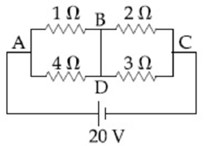
NTA JEE Main 9th January 2020 Shift 1 - Question 13
Radiation, with wavelength $$6561$$ Å falls on a metal surface to produce photoelectrons. The electrons are made to enter a uniform magnetic field of $$3 \times 10^{-4}$$ T. If the radius of the largest circular path followed by the electrons is $$10$$ mm, the work function of the metal is close to:

NTA JEE Main 9th January 2020 Shift 1 - Question 14
A long, straight wire of radius $$a$$ carries a current distributed uniformly over its cross-section. The ratio of the magnetic fields due to the wire at distance $$\frac{a}{3}$$ and $$2a$$, respectively from the axis of the wire is:
NTA JEE Main 9th January 2020 Shift 1 - Question 15
A charged particle of mass 'm' and charge 'q' moving under the influence of uniform electric field $$E\hat{i}$$ and a uniform magnetic field $$B\hat{k}$$ follows a trajectory from point P to Q as shown in figure. The velocities at P and Q are respectively, $$v\hat{i}$$ and $$-2v\hat{j}$$. Then which of the following statements (A, B, C, D) are the correct? (Trajectory shown is schematic and not to scale)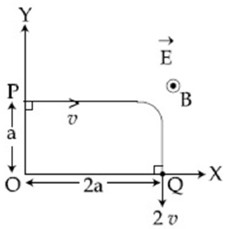
(A) $$E = \frac{3}{2}\left(\frac{mv^2}{qa}\right)$$
(B) Rate of work done by the electric field at P is $$\frac{3}{2}\left(\frac{mv^3}{a}\right)$$
(C) Rate of work done by both the fields at Q is zero
(D) The difference between the magnitude of angular momentum of the particle at P and Q is $$2mav$$.
NTA JEE Main 9th January 2020 Shift 1 - Question 16
The electric fields of two plane electromagnetic waves in vacuum are given by $$\vec{E_1} = E_0\hat{j}\cos(\omega t - kx)$$ and $$\vec{E_2} = E_0\hat{k}\cos(\omega t - ky)$$. At $$t = 0$$, a particle of charge $$q$$ is at origin with a velocity $$\vec{v} = 0.8c\hat{j}$$ ($$c$$ is the speed of light in vacuum). The instantaneous force experienced by the particle is:
NTA JEE Main 9th January 2020 Shift 1 - Question 17
A vessel of depth $$2h$$ is half filled with a liquid of refractive index $$2\sqrt{2}$$ and the upper half with another liquid of refractive index $$\sqrt{2}$$. The liquids are immiscible. The apparent depth of the inner surface of the bottom of the vessel will be:
NTA JEE Main 9th January 2020 Shift 1 - Question 18
The aperture diameter of a telescope is $$5$$ m. The separation between the moon and the earth is $$4 \times 10^5$$ km. With light of wavelength $$5500$$ Å, the minimum separation between objects on the surface of moon, so that they are just resolved, is close to:
NTA JEE Main 9th January 2020 Shift 1 - Question 19
A particle moving with kinetic energy $$E$$ has de Broglie wavelength $$\lambda$$. If energy $$\Delta E$$ is added to its energy, the wavelength become $$\frac{\lambda}{2}$$. Value of $$\Delta E$$, is:
NTA JEE Main 9th January 2020 Shift 1 - Question 20
If the screw on a screw-gauge is given six rotations, it moves by $$3 \; mm$$ on the main scale. If there are 50 divisions on the circular scale the least count of the screw gauge is: