NTA JEE Main 9th January 2020 Shift 1
For the following questions answer them individually
NTA JEE Main 9th January 2020 Shift 1 - Question 1
A quantity $$f$$ is given by $$f = \sqrt{\frac{hc^5}{G}}$$ where $$c$$ is speed of light, $$G$$ is universal gravitational constant and $$h$$ is the Planck's constant. Dimension of $$f$$ is that of:
NTA JEE Main 9th January 2020 Shift 1 - Question 2
Consider a force $$\vec{F} = -x\hat{i} + y\hat{j}$$. The work done by this force in moving a particle from point $$A(1,0)$$ to $$B(0,1)$$ along the line segment is: (all quantities are in SI units)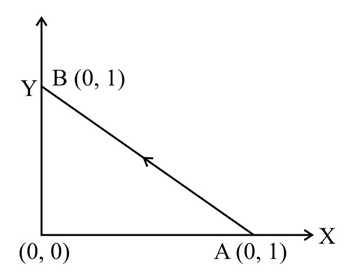
NTA JEE Main 9th January 2020 Shift 1 - Question 3
Two particles of equal mass $$m$$ have respective initial velocities $$u\hat{i}$$ and $$u\left(\frac{\hat{i}+\hat{j}}{2}\right)$$. They collide completely inelastically. The energy lost in the process is:

NTA JEE Main 9th January 2020 Shift 1 - Question 4
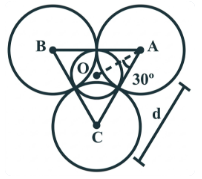
Three solid spheres each of mass $$m$$ and diameter $$d$$ are stuck together such that the lines connecting the centres form an equilateral triangle of side of length $$d$$. The ratio $$\frac{I_0}{I_A}$$ of moment of inertia $$I_0$$ of the system about an axis passing the centroid and about center of any of the spheres $$I_A$$ and perpendicular to the plane of the triangle is:
NTA JEE Main 9th January 2020 Shift 1 - Question 5
A body A of mass $$m$$ is moving in a circular orbit of radius $$R$$ about a planet. Another body B of mass $$\frac{m}{2}$$ collides with A with a velocity which is half $$\left(\frac{v}{2}\right)$$ the instantaneous velocity $$\vec{v}$$ of A. The collision is completely inelastic. Then, the combined body:
NTA JEE Main 9th January 2020 Shift 1 - Question 6
Water flows in a horizontal tube (see figure). The pressure of water changes by $$700 \; Nm^{-2}$$ between $$A$$ and $$B$$ where the area of cross section are $$40 \; cm^2$$ and $$20 \; cm^2$$, respectively. Find the rate of flow of water through the tube. (density of water $$= 1000 \; kgm^{-3}$$)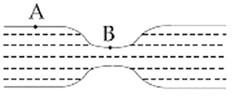
NTA JEE Main 9th January 2020 Shift 1 - Question 7
Which of the following is an equivalent cyclic process corresponding to the thermodynamic cyclic given in the figure? Where, $$1 \to 2$$ is adiabatic. (Graphs are schematic and are not to scale)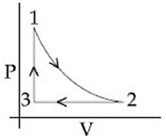
NTA JEE Main 9th January 2020 Shift 1 - Question 8
Consider two ideal diatomic gases $$A$$ and $$B$$ at some temperature $$T$$. Molecules of the gas $$A$$ are rigid, and have a mass $$m$$. Molecules of the gas $$B$$ have an additional vibrational mode and have a mass $$\frac{m}{4}$$. The ratio of the specific heats $$(C_V)_A$$ and $$(C_V)_B$$ of gas $$A$$ and $$B$$, respectively is:
NTA JEE Main 9th January 2020 Shift 1 - Question 9
Three harmonic waves having equal frequency $$\nu$$ and same intensity $$I_0$$, have phase angles $$0$$, $$\frac{\pi}{4}$$ and $$-\frac{\pi}{4}$$ respectively. When they are superimposed the intensity of the resultant wave is close to:
NTA JEE Main 9th January 2020 Shift 1 - Question 10
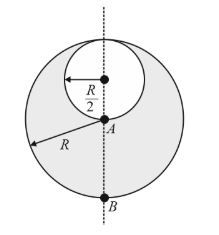
Consider a sphere of radius $$R$$ which carries a uniform charge density $$\rho$$. If a sphere of radius $$\frac{R}{2}$$ is carved out of it, as shown, the ratio $$\frac{|\vec{E_A}|}{|\vec{E_B}|}$$ of magnitude of electric field $$\vec{E_A}$$ and $$\vec{E_B}$$, respectively, at points $$A$$ and $$B$$ due to the remaining portion is: