NTA JEE Main 7th January 2020 Shift 1
For the following questions answer them individually
NTA JEE Main 7th January 2020 Shift 1 - Question 21
A particle (m = 1 kg) slides down a frictionless track (AOC) starting from rest at a point A (height 2m). After reaching C, the particle continues to move freely in air as a projectile. When it reaches its highest point P (height 1m), the kinetic energy of the particle (in J) is: (Figure drawn is schematic and not to scale; take $$g = 10$$ ms$$^{-2}$$)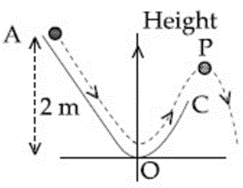
789
456
123
0.-
Clear All
NTA JEE Main 7th January 2020 Shift 1 - Question 22
A non-isotropic solid metal cube has coefficients of linear expansion as: $$5 \times 10^{-5}$$/$$^\circ$$C along the x-axis and $$5 \times 10^{-6}$$/$$^\circ$$C along the y and the z-axis. If the coefficient of volume expansion of the solid is $$C \times 10^{-6}$$/$$^\circ$$C then the value of C is
789
456
123
0.-
Clear All
NTA JEE Main 7th January 2020 Shift 1 - Question 23
A Carnot engine operates between two reservoirs of temperatures 900K and 300K. The engine performs 1200J of work per cycle. The heat energy (in J) delivered by the engine to the low temperature reservoir, in a cycle, is
789
456
123
0.-
Clear All

NTA JEE Main 7th January 2020 Shift 1 - Question 24
A loop ABCDEFA of straight edges has six corner points A(0, 0, 0), B(5, 0, 0), C(5, 5, 0), D(0, 5, 0), E(0, 5, 5) and F(0, 0, 5). The magnetic field in this region is $$\vec{B} = (3\hat{i} + 4\hat{k})$$ T. The quantity of flux through the loop ABCDEFA (in Wb) is
789
456
123
0.-
Clear All
NTA JEE Main 7th January 2020 Shift 1 - Question 25
A beam of electromagnetic radiation of intensity $$6.4 \times 10^{-5}$$ W/cm$$^2$$ is comprised of wavelength, $$\lambda = 310$$ nm. It falls normally on a metal (work function $$\varphi = 2$$ eV) of surface area of 1 cm$$^2$$. If one in $$10^3$$ photons ejects an electron, total number of electrons ejected in 1s is $$10^x$$. ($$hc = 1240$$ eVnm, $$1$$ eV $$= 1.6 \times 10^{-19}$$ J), then $$x$$ is
789
456
123
0.-
Clear All
NTA JEE Main 7th January 2020 Shift 1 - Question 26
Amongst the following statements, that which was not proposed by Dalton was:
NTA JEE Main 7th January 2020 Shift 1 - Question 27
The number of orbitals associated with quantum numbers $$n = 5$$, $$m_s = +\frac{1}{2}$$ is:
NTA JEE Main 7th January 2020 Shift 1 - Question 28
The electron gain enthalpy (in kJ/mol) of fluorine, chlorine, bromine and iodine, respectively, are
NTA JEE Main 7th January 2020 Shift 1 - Question 29
The dipole moments of CCl$$_4$$, CHCl$$_3$$ and CH$$_4$$ are in the order
NTA JEE Main 7th January 2020 Shift 1 - Question 30
The relative strength of the interionic/ intermolecular forces in a decreasing order is: