NTA JEE Main 7th January 2020 Shift 1
For the following questions answer them individually
NTA JEE Main 7th January 2020 Shift 1 - Question 1
A 60HP electric motor lifts an elevator having a maximum total load capacity of 2000 kg. If the frictional force on the elevator is 4000 N, the speed of the elevator at full load is close to: (1 HP = 746 W, $$g = 10$$ m s$$^{-2}$$)
NTA JEE Main 7th January 2020 Shift 1 - Question 2
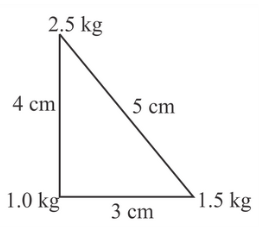
Three point particles of masses 1.0 kg, 1.5 kg and 2.5 kg are placed at three corners of a right angle triangle of sides 4.0 cm, 3.0 cm and 5.0 cm as shown in the figure. The centre of mass of the system is at a point:
NTA JEE Main 7th January 2020 Shift 1 - Question 3
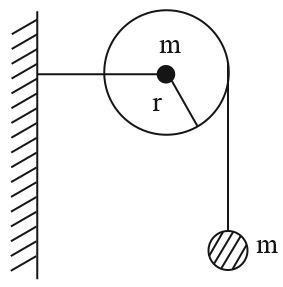
As shown in the figure, a bob of mass m is tied to a massless string whose other end portion is wound on a fly wheel (disc) of radius r and mass m. When released from rest the bob starts falling vertically. When it has covered a distance of h, the angular speed of the wheel will be:

NTA JEE Main 7th January 2020 Shift 1 - Question 4
The radius of gyration of a uniform rod of length $$l$$, about an axis passing through a point $$\frac{l}{4}$$ away from the centre of the rod, and perpendicular to it, is:
NTA JEE Main 7th January 2020 Shift 1 - Question 5
A satellite of mass $$M$$ is launched vertically upwards with an initial speed $$u$$ from the surface of the earth. After it reaches height $$R$$ ($$R$$ = radius of the earth), it ejects a rocket of mass $$\frac{M}{10}$$ so that subsequently the satellite moves in a circular orbit. The kinetic energy of the rocket is ($$G$$ is the gravitational constant; $$M_e$$ is the mass of the earth):
NTA JEE Main 7th January 2020 Shift 1 - Question 6
Speed of a transverse wave on a straight wire (mass 6.0 g, length 60 cm and area of cross-section 1.0 mm$$^2$$) is 90 m s$$^{-1}$$. If the Young's modulus of wire is $$16 \times 10^{11}$$ N m$$^{-2}$$, the extension of wire over its natural length is:
NTA JEE Main 7th January 2020 Shift 1 - Question 7
A litre of dry air at STP expands adiabatically to a volume of 3 litres. If $$\gamma = 1.40$$, the work done by air is: ($$3^{1.4} = 4.6555$$) [Take air to be an ideal gas]
NTA JEE Main 7th January 2020 Shift 1 - Question 8
Two moles of an ideal gas, with $$\frac{C_p}{C_v} = \frac{5}{3}$$, are mixed with three moles of another ideal gas $$\frac{C_p}{C_v} = \frac{4}{3}$$. The value of $$\frac{C_p}{C_v}$$ for the mixture is
NTA JEE Main 7th January 2020 Shift 1 - Question 9
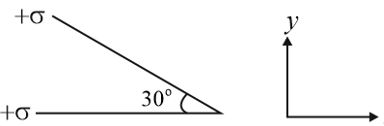
Two infinite planes each with uniform surface charge density $$+\sigma$$ are kept in such a way that the angle between them is 30$$^\circ$$. The electric field in the region shown between them is given by:
NTA JEE Main 7th January 2020 Shift 1 - Question 10
A parallel plate capacitor has plates of area A separated by distance d between them. It is filled with a dielectric which has a dielectric constant that varies as $$K(x) = K_0(1 + \alpha x)$$ where $$x$$ is the distance measured from one of the plates. If $$(\alpha d) \ll 1$$, the total capacitance of the system is best given by the expression: