JEE Main 11th January 2019 Shift 2
For the following questions answer them individually
JEE Main 11th January 2019 Shift 2 - Question 21
A particle of mass m and charge q is in an electric and magnetic field given by $$\vec{E} = 2\hat{i} + 3\hat{j}$$; $$\vec{B} = 4\hat{j} + 6\hat{k}$$. The charged particle is shifted from the origin to the point P$$(x = 1; y = 1)$$ along a straight path. The magnitude of the total work done is:
JEE Main 11th January 2019 Shift 2 - Question 22
A copper wire is wound on a wooden frame, whose shape is that of an equilateral triangle. If the linear dimension of each side of the frame is increased by a factor of 3, keeping the number of turns of the coil per unit length of the frame the same, then the self inductance of the coil:
JEE Main 11th January 2019 Shift 2 - Question 23
A 27 mW laser beam has a cross-sectional area of 10 mm$$^2$$. The magnitude of the maximum electric field in this electromagnetic wave is given by: [Given permittivity of space $$\epsilon_0 = 9 \times 10^{-12}$$ SI units, Speed of light $$c = 3 \times 10^8$$ m/s]

JEE Main 11th January 2019 Shift 2 - Question 24
A monochromatic light is incident at a certain angle on an equilateral triangular prism and suffers minimum deviation. If the refractive index of the material of the prism is $$\sqrt{3}$$, then the angle of incidence is:
JEE Main 11th January 2019 Shift 2 - Question 25
In a double-slit experiment, green light (5303 Å) falls on a double slit having a separation of $$19.44 \mu m$$ and a width of $$4.05 \mu m$$. The number of bright fringes between the first and the second diffraction minima is
JEE Main 11th January 2019 Shift 2 - Question 26
In a photoelectric experiment, the wavelength of the light incident on a metal is changed from 300 nm to 400 nm. The decrease in the stopping potential is close to: $$\left(\frac{hc}{e} = 1240 \text{ nm} \cdot V\right)$$
JEE Main 11th January 2019 Shift 2 - Question 27
In a hydrogen like atom, when an electron jumps from the M-shell to the L-shell, the wavelength of emitted radiation is $$L$$. If an electron jumps from N-shell to the L-shell, the wavelength of emitted radiation will be:
JEE Main 11th January 2019 Shift 2 - Question 28
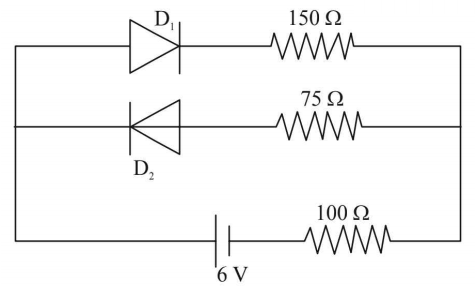
The circuit shown below contains two ideal diodes, each with a forward resistance of $$50\Omega$$. If the battery voltage is 6 V, the current through the $$100\Omega$$ resistance (in Amperes) is:
JEE Main 11th January 2019 Shift 2 - Question 29
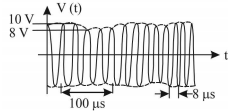
An amplitude modulated signal is plotted below. Which one of the following best describes the above signal?
JEE Main 11th January 2019 Shift 2 - Question 30
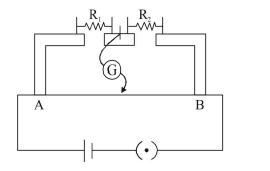
In the experimental set up of metre bridge shown in the figure, the null point is obtained at a distance of 40 cm from A. If a $$10\Omega$$ resistor is connected in series with $$R_1$$, the null point shifts by 10 cm. The resistance that should be connected in parallel with $$(R_1 + 10)\Omega$$ such that the null point shifts back to its initial position is