JEE Main 11th January 2019 Shift 2
For the following questions answer them individually
JEE Main 11th January 2019 Shift 2 - Question 31
25 mL of the given HCl solution requires 30 mL of 0.1M sodium carbonate solution. What is the volume of this HCl solution required to titrate 30 mL of 0.2M aqueous NaOH solution?
JEE Main 11th January 2019 Shift 2 - Question 32
The de Broglie wavelength $$(\lambda)$$ associated with a photoelectron varies with the frequency $$(\nu)$$ of the incident radiation as, [$$\nu_0$$ is threshold frequency]:
JEE Main 11th January 2019 Shift 2 - Question 33
The correct option with respect to the Pauling electronegativity values of the elements is:

JEE Main 11th January 2019 Shift 2 - Question 34
The reaction $$MgO(s) + C(s) \to Mg(s) + CO(g)$$, for which $$\Delta H° = +491.1$$ kJ mol$$^{-1}$$ and $$\Delta S° = 198.0$$ JK$$^{-1}$$ mol$$^{-1}$$ is not feasible at 298 K. Temperature above which reaction will be feasible is
JEE Main 11th January 2019 Shift 2 - Question 35
The standard reaction Gibbs energy for a chemical reaction at an absolute temperature T is given by $$\Delta G° = A - BT$$ where A and B are non-zero constants. Which of the following is true about this reaction?
JEE Main 11th January 2019 Shift 2 - Question 36
For the equilibrium $$2H_2O \rightleftharpoons H_3O^+ + OH^-$$; the value of $$\Delta G°$$ at 298 K is approximately:
JEE Main 11th January 2019 Shift 2 - Question 37
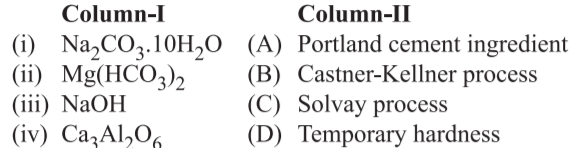
Match the following items in column I with the corresponding items in column II.
JEE Main 11th January 2019 Shift 2 - Question 38
The hydride that is NOT electron deficient is:
JEE Main 11th January 2019 Shift 2 - Question 39
The relative stability of +1 oxidation state of group 13 elements follows the order
JEE Main 11th January 2019 Shift 2 - Question 40
Which of the following compounds reacts with ethylmagnesium bromide and also decolourizes bromine water solution?