JEE Main 11th January 2019 Shift 2
For the following questions answer them individually
JEE Main 11th January 2019 Shift 2 - Question 11
When 100 g of a liquid A at $$100°C$$ is added to 50 g of a liquid B at temperature $$75°C$$, the temperature of the mixture becomes $$90°C$$. The temperature of the mixture, if 100 g of liquid A at $$100°C$$ is added to 50 g of liquid B at $$50°C$$, will be:
JEE Main 11th January 2019 Shift 2 - Question 12
A metal ball of mass 0.1 kg is heated upto $$500°C$$ and dropped into a vessel of heat capacity $$800 \text{ JK}^{-1}$$ and containing 0.5 kg water. The initial temperature of water and vessel is $$30°C$$. What is the approximate percentage increment in the temperature of the water? [Specific Heat Capacities of water and metal are, respectively, $$4200 \text{ Jkg}^{-1} \text{K}^{-1}$$ and $$400 \text{ Jkg}^{-1} \text{K}^{-1}$$]
JEE Main 11th January 2019 Shift 2 - Question 13
A pendulum is executing simple harmonic motion and its maximum kinetic energy is $$K_1$$. If the length of the pendulum is doubled and it performs simple harmonic motion with the same amplitude as in the first case, its maximum kinetic energy is $$K_2$$

JEE Main 11th January 2019 Shift 2 - Question 14
A simple pendulum of length 1 m is oscillating with an angular frequency 10 rad/s. The support of the pendulum starts oscillating up and down with a small angular frequency of 1 rad/s and an amplitude of $$10^{-2}$$ m. The relative change in the angular frequency of the pendulum is best given by:
JEE Main 11th January 2019 Shift 2 - Question 15
An electric field of 1000 V/m is applied to an electric dipole at angle of $$45°$$. The value of electric dipole moment is $$10^{-29}$$ C.m. What is the potential energy of the electric dipole?
JEE Main 11th January 2019 Shift 2 - Question 16
Seven capacitors, each of capacitance $$2\mu F$$, are to be connected in a configuration to obtain an effective capacitance of $$\left(\frac{6}{13}\right)\mu F$$. Which of the combinations, shown in figures below, will achieve the desired value?
JEE Main 11th January 2019 Shift 2 - Question 17
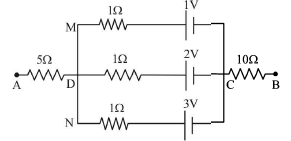
In the circuit shown, the potential difference between A and B is
JEE Main 11th January 2019 Shift 2 - Question 18
A galvanometer having a resistance of $$20\Omega$$ and 30 division on both sides has figure of merit 0.005 ampere/division. The resistance that should be connected in series such that it can be used as a voltmeter upto 15 volt, is:
JEE Main 11th January 2019 Shift 2 - Question 19
A paramagnetic substance in the form of a cube with sides 1 cm has a magnetic dipole moment of $$20 \times 10^{-6}$$ J/T when a magnetic intensity of $$60 \times 10^3$$ A/m is applied. Its magnetic susceptibility is:
JEE Main 11th January 2019 Shift 2 - Question 20
The region between $$y = 0$$ and $$y = d$$ contains a magnetic field $$\vec{B} = B\hat{z}$$. A particle of mass m and charge q enters the region with a velocity $$\vec{v} = v\hat{i}$$. If $$d = \frac{mv}{2qB}$$, the acceleration of the charged particle at the point of its emergence at the other side is: