For the following questions answer them individually
In the formula X = 5YZ$$^2$$, X and Z have dimensions of capacitance and magnetic field, respectively. What are the dimensions of Y in SI units?
A bullet of mass 20 g has an initial speed of 1 m s$$^{-1}$$, just before it starts penetrating a mud wall of thickness 20 cm. If the wall offers a mean resistance of $$2.5 \times 10^{-2}$$ N, the speed of the bullet after emerging from the other side of the wall is close to:
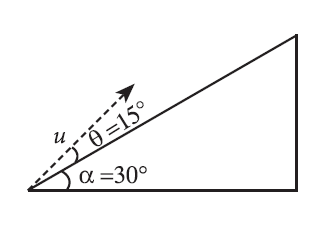
A plane is inclined at an angle $$\alpha = 30$$° with respect to the horizontal. A particle is projected with a speed u = 2 m s$$^{-1}$$, from the base of the plane, making an angle $$\theta = 15$$° with respect to the plane as shown in the figure. The distance from the base, at which the particle hits the plane is close to: (Take g = $$10\ m \ s^{-2}$$)
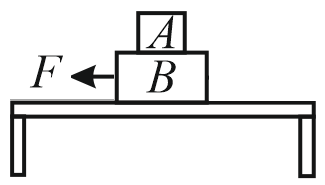
Two blocks A and B of masses m$$_A$$ = 1 kg and m$$_B$$ = 3 kg are kept on the table as shown in figure. The coefficients of friction between A and B is 0.2 and between B and the surface of the table is also 0.2. The maximum force F that can be applied on B horizontally, so that the block A does not slide over the block B is:
[Take g = 10 m/s$$^2$$]
A solid sphere of mass M and radius R is divided into two unequal parts. The first part has a mass of $$\frac{7M}{8}$$ and is converted into uniform disc of radius 2R. The second part is converted into a uniform solid sphere. Let I$$_1$$ be the moment of inertia of the disc about its axis and I$$_2$$ be the moment of inertia of the new sphere about its axis. The ratio I$$_1$$/I$$_2$$ is given by:
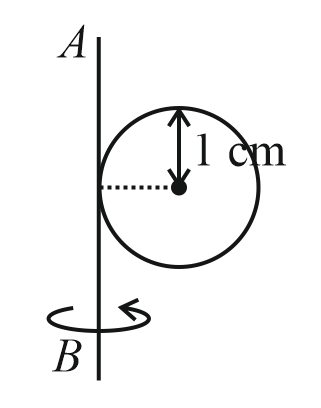
A metal coin of mass 5 g and radius 1 cm is fixed to a thin stick AB of negligible mass as shown in the figure. The system is initially at rest. The constant torque, that will make the system rotate about AB at 25 rotations per second in 5 s, is close to:
The time dependence of the position of a particle of mass m = 2 is given by $$\vec{r}(t) = 2t\hat{i} - 3t^2\hat{j}$$. Its angular momentum, with respect to the origin, at time t = 2 is:
A spaceship orbits around a planet at a height of 20 km from its surface. Assuming that only gravitational field of the planet acts on the spaceship, what will be the number of complete revolutions made by the spaceship in 24 hours around the planet?
[Given: Mass of planet = $$8 \times 10^{22}$$ kg, Radius of planet = $$2 \times 10^6$$ m, Gravitational constant G = $$6.67 \times 10^{-11}$$ Nm$$^2$$/kg$$^2$$]
The elastic limit of brass is 379 MPa. The minimum diameter of a brass rod if it is to support a 400 N load without exceeding its elastic limit will be
In an experiment, brass and steel wires of length 1 m each with areas of cross section 1 mm$$^2$$ are used. The wires are connected in series and one end of the combined wire is connected to a rigid support and other end is subjected to elongation. The stress required to produce a net elongation of 0.2 mm is,
[Given, the Young's Modulus for steel and brass are, respectively, $$120 \times 10^9$$ N/m$$^2$$ and $$60 \times 10^9$$ N/m$$^2$$]
A cubical block of side 0.5 m floats on water with 30% of its volume under water. What is the maximum weight that can be put on the block without fully submerging it under water?
[Take, density of water = 10$$^3$$ kg/m$$^3$$]
Water from a tap emerges vertically downwards with an initial speed of 1.0 ms$$^{-1}$$. The cross-sectional area of the tap is $$10^{-4}$$ m$$^2$$. Assume that the pressure is constant throughout the stream of water and that the flow is streamlined. The cross-sectional area of the stream, 0.15 m below the tap would be:
(Take g = 10 ms$$^{-2}$$)
A submarine experiences a pressure of $$5.05 \times 10^6$$ Pa at a depth of d$$_1$$ in a sea. When it goes further to a depth of d$$_2$$, it experiences a pressure of $$8.08 \times 10^6$$ Pa. Then d$$_2$$ - d$$_1$$ is approximately (density of water = 10$$^3$$ kg/m$$^3$$ and acceleration due to gravity = 10 ms$$^{-2}$$):
One mole of an ideal gas passes through a process where pressure and volume obey the relation P = P$$_0$$[1 - $$\frac{1}{2}\left(\frac{V_0}{V}\right)^2$$]. Here P$$_0$$ and V$$_0$$ are constants. Calculate the change in the temperature of the gas if its volume changes from V$$_0$$ to 2V$$_0$$.
When heat Q is supplied to a diatomic gas of rigid molecules, at constant volume its temperature increases by $$\Delta T$$. The heat required to produce the same change in temperature, at a constant pressure is:
A source of sound S is moving with a velocity of 50 m s$$^{-1}$$ towards a stationary observer. The observer measures the frequency of the source as 1000 Hz. What will be the apparent frequency of the source when it is moving away from the observer after crossing him? (Take velocity of sound in air is 350 m s$$^{-1}$$)
The correct figure that shows, schematically, the wave pattern produced by the superposition of two waves of frequencies 9 Hz and 11 Hz, is
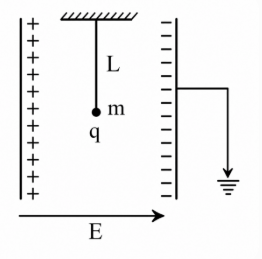
A simple pendulum of length L is placed between the plates of a parallel plate capacitor having electric field E, as shown in figure. Its bob has mass m and charge q. The time period of the pendulum is given by:
In free space, a particle A of charge 1 μC is held fixed at point P. Another particle B of the same charge and mass 4 μg is kept at a distance of 1 mm from P. If B is released, then its velocity at a distance of 9 mm from P is:
[Take $$\frac{1}{4\pi\varepsilon_0} = 9 \times 10^9$$ N m$$^2$$ C$$^{-2}$$]
Space between two concentric conducting spheres of radii a and b (b > a) is filled with a medium of resistivity $$\rho$$. The resistance between the two spheres will be:
A square loop is carrying a steady current I and the magnitude of its magnetic dipole moment is m. If this square loop is changed to a circular loop and it carries the same current, the magnitude of the magnetic dipole moment of circular loop will be:
The magnitude of the magnetic field at the centre of an equilateral triangular loop of side 1 m which is carrying a current of 10 A is:
[Take $$\mu_0 = 4\pi \times 10^{-7}$$ N A$$^{-2}$$]
A coil of self inductance 10 mH and resistance of 0.1 Ω is connected through a switch to a battery of internal resistance 0.9 Ω. After the switch is closed, the time taken for the current to attain 80% of the saturation value is: [ln5 = 1.6]
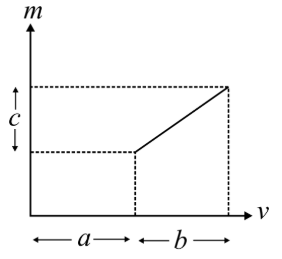
The graph shows how the magnification m produced by a thin lens varies with image distance v. The focal length of the lens used is
In a Young's double-slit experiment, the ratio of the slit's width is 4:1. The ratio of the intensity of maxima to minima, close to the central fringe on the screen, will be
Light is incident normally on a completely absorbing surface with an energy flux of 25 W cm$$^{-2}$$. If the surface has an area of 25 cm$$^2$$, the momentum transferred to the surface in 40 min time duration will be:
A 2 mW laser operates at a wavelength of 500 nm. The number of photons that will be emitted per second is:
[Given Planck's constant h = $$6.6 \times 10^{-34}$$ J s, speed of light c = $$3.0 \times 10^8$$ m/s]
In Li$$^{++}$$, electron in first Bohr orbit is excited to a level by a radiation of wavelength $$\lambda$$. When the ion gets de-excited to the ground state in all possible ways (including intermediate emissions), a total of six spectral lines are observed. What is the value of $$\lambda$$?
(Given: h = $$6.63 \times 10^{-34}$$ J s; c = $$3 \times 10^8$$ m s$$^{-1}$$)
Two radioactive substances A and B have decay constants $$5\lambda$$ and $$\lambda$$ respectively. At t = 0, a sample has the same number of the two nuclei. The time taken for the ratio of the number of nuclei to become $$\frac{1}{e^2}$$ will be
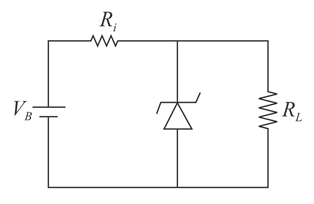
The figure represents a voltage regulator circuit using a Zener diode. The breakdown voltage of the Zener diode is 6 V and the load resistance is, R$$_L$$ = 4 kΩ. The series resistance of the circuit is R$$_i$$ = 1 kΩ. If the battery voltage V$$_B$$ varies from 8 V to 16 V, what are the minimum and maximum values of the current through Zener diode?