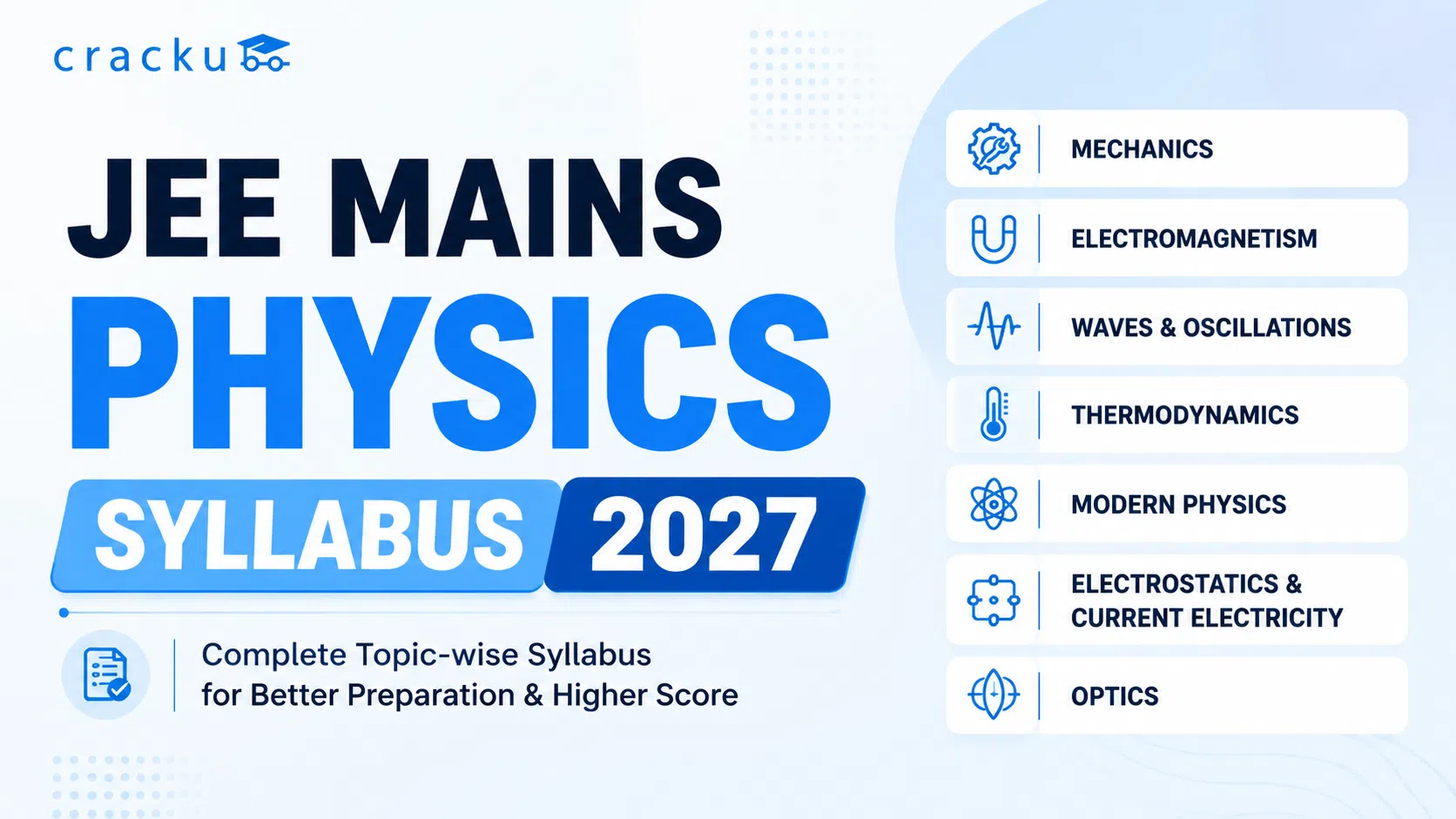
JEE Mains Physics Syllabus 2026, Important Topics, Weightage

Nehal Sharma

20

Mar 20, 2026

Latest Updates:

    • March 20, 2026: A complete JEE Mains formulas PDF for Physics, Chemistry, and Maths to support quick revision, enhance accuracy, and build confidence before exams.Read More
    • March 20, 2026: Explore the JEE Mains Physics syllabus 2026 with detailed topics, important formulas, and weightage to help you plan and improve your preparation strategy.Read More
    JEE Mains Physics Syllabus 2026, Important Topics, Weightage

    JEE Mains Physics Syllabus 2026

    Physics section is an important part of the JEE Mains examination, which involves a good conceptual knowledge as well as the ability to solve numerical problems. The JEE Mains Physics syllabus 2026 is based on topics from the Class 11 and Class 12 NCERT curriculum. It contains a combination of theoretical and numerical applications in fields of mechanics, electromagnetism, optics and modern physics. Knowledge of the syllabus would enable candidates to organize their preparations well and focus on high weightage areas.

    JEE Mains Physics Syllabus PDF

    Many aspirants prefer using the JEE Mains Physics Syllabus PDF in a downloadable format, as it makes revision and tracking much more convenient. The PDF includes a complete list of topics, subtopics, and key areas that are important for the exam, helping students stay organized during their preparation. It also allows students to monitor their progress, keep track of completed portions, and ensure that no important concept is missed. For a complete overview of all subjects, you can also check the JEE Mains Syllabus 2026, which helps in planning your preparation in a more structured and effective way.

    JEE Mains Physics Chapter-Wise Syllabus

    Refer to the table below to know about the important chapter-wise Physics syllabus of JEE Mains exam and the topics covered under them.

    Chapter Complete Topics
    Units and Measurements Units of measurements, System of units, SI units, Fundamental and derived units, Least count, Significant figures, Errors in measurements, Dimensions of physical quantities, Dimensional analysis and its applications
    Kinematics Frame of reference, Motion in a straight line, Speed and Velocity, Uniform and Non-Uniform motion, Average speed, Instantaneous velocity, Uniformly Accelerated motion, Velocity-time and Position-time graph, Relations for uniformly accelerated motion, Relative velocity, Motion in a plane, Projectile motion, Uniform circular motion
    Laws of Motion Force and Inertia, Newton’s first law, Momentum, Newton’s second law, impulse, Newton’s third law, Conservation of linear momentum and applications, Equilibrium of concurrent forces, Static and Kinetic friction, Laws of friction, Rolling friction, Dynamics of uniform circular motion, Centripetal force, Vehicle on level road, Vehicle on banked road
    Work, Energy and Power Work done by constant and variable force, Kinetic energy, Potential energy, Work-Energy theorem, Power, Potential energy of spring, Conservation of Mechanical energy, Conservative and Non-Conservative forces, Motion in vertical circle, Elastic and Inelastic collisions in One and Two dimensions
    Rotational Motion Centre of mass of two-particle system, Centre of mass of rigid body, Torque, Angular momentum, Conservation of angular momentum, Moment of Inertia, Radius of gyration, Values of moment of inertia, Parallel and Perpendicular axis theorem, Equilibrium of rigid body, Rotational motion equations, Comparison of Linear and Rotational motion
    Gravitation Universal law of gravitation, Acceleration due to gravity and Variation with altitude and depth, Kepler’s laws of planetary motion, Gravitational potential energy, Gravitational potential, Escape velocity, Motion of satellite, Orbital velocity, Time period and Energy of satellite
    Properties of Solids and Liquids Elastic behaviour, Stress-strain, Hooke’s law, Young modulus, Bulk modulus, Modulus of rigidity, Pressure due to fluid column, Pascal law, Effect of gravity on fluid pressure, Viscosity, Stokes law, Terminal velocity, Streamline and Turbulent flow, Critical velocity, Bernoulli theorem, Surface tension, Angle of contact, Excess pressure, Capillary rise, Heat, Temperature, Thermal expansion, Calorimetry, Latent heat, Conduction, Convection, Radiation
    Thermodynamics Thermal equilibrium, Temperature, Zeroth law, Heat, Work, Internal energy, First law of thermodynamics, Isothermal and Adiabatic process, Second law of thermodynamics, Reversible and Irreversible process
    Kinetic Theory of Gases Equation of state, Work done on gas, Kinetic theory, Pressure of gas, Kinetic interpretation of temperature, RMS speed, Degrees of freedom, Law of equipartition of energy, Specific heat, Mean free path, Avogadro number
    Oscillations and Waves Periodic motion, Time period, Frequency, SHM, Equation of SHM, Spring oscillation, Energy in SHM, Simple pendulum, Wave motion, Transverse and Longitudinal waves, Wave speed, Progressive wave, Superposition, Reflection, Standing waves, Organ pipe, Harmonics, Beats.
    Electrostatics Charge, Conservation of charge, Coulomb law, Superposition, Electric field, Field lines, Dipole, Torque on dipole, Electric flux, Gauss law, Field due to wire, Plane sheet, Spherical shell, Electric potential, Potential difference, Equipotential surface, Potential energy, Conductors, Insulators, Dielectrics, Polarization, Capacitor, Series and parallel capacitor, Energy stored in capacitor
    Current Electricity Electric current, Drift velocity, Mobility, Ohm law, Resistance, I-V characteristics, Electrical power, Resistivity, Conductivity, Series and parallel resistors, Temperature dependence, Internal resistance, Emf, Cells in series and parallel, Kirchhoff law, Wheatstone bridge, Metre bridge
    Magnetic Effects of Current and Magnetism Biot–Savart law, Ampere law, Magnetic field, Force on charge, Force on current conductor, Force between parallel currents, Definition of ampere, Torque on loop, Galvanometer, Ammeter, Voltmeter, Magnetic Dipole, Bar magnet, Magnetic field lines, Para, Dia, Ferromagnetic substances
    Electromagnetic Induction and Alternating Current Faraday law, Induced emf, Lenz law, Eddy current, Self inductance, Mutual inductance, Alternating current, RMS value, Reactance, Impedance, LCR circuit, Resonance, AC power, Transformer, Generator
    Electromagnetic Waves Displacement current, Electromagnetic waves, Properties, Transverse nature, Electromagnetic spectrum.
    Optics Reflection, Spherical mirror, Mirror formula, Refraction, Lens formula, Lens maker formula, Total internal reflection, Magnification, Power of lens, Combination of lenses, Prism, Microscope, Telescope, Wave optics, Huygens principle, Interference, Young experiment, Diffraction, Polarization, Brewster law
    Dual Nature of Matter and Radiation Photoelectric effect, Hertz and Lenard experiment, Einstein equation, Particle nature of light, Matter waves, de-Broglie relation
    Atoms and Nuclei Rutherford model, Bohr model, Hydrogen spectrum, Nucleus size, Mass defect, Binding energy, Nuclear fission, Nuclear fusion
    Electronic Devices Semiconductor, Diode, LED, Photodiode, Solar cell, Zener diode, Rectifier, Logic gates - OR, AND, NOT, NAND, NOR
    Experimental Skills Vernier calipers, Screw gauge, Simple pendulum, Metre scale, Young modulus, Surface tension, Viscosity, Speed of sound, Calorimetry, Metre bridge, Ohm law, Galvanometer, Focal length, Prism, Refractive index, Diode characteristics, Zener diode, Identification of components

    JEE Mains Physics Topic-Wise Weightage

    It is important for candidates to know the weightage of the various important chapters and topics as it enables the candidates to focus on crucial chapters. While the distribution may vary every year, there are some important topics and chapters that always have more weightage.

    Following are the topics with the number of questions that a candidate can expect in the exam.

    S. No. Topic (Combined) Chapters Included Weightage (%)
    1 Modern Physics Dual Nature, Atoms, Nuclei, Semiconductor 14.42%
    2 Magnetism + EMI + AC Moving Charges, Magnetism, EMI, AC 11.77%
    3 Mechanics Part 2 COM, Rotation, Gravitation 11.36%
    4 Waves + Oscillation + Solids + Fluids SHM, Waves, Solids, Fluids 10.27%
    5 Mechanics Part 1 Kinematics, Laws of Motion, Work Energy Power 9.97%
    6 Heat & Thermodynamics Thermal Physics, KTG, Thermodynamics 8.02%
    7 Electrostatics Charges, Potential, Capacitance 7.67%
    8 Optics Ray Optics, Wave Optics 7.34%
    9 Current Electricity Current Electricity 6.57%
    10 Units & Measurements Units, Dimensions, Math Tools 4.24%

    Important JEE Mains Physics Formulas

    Physics is largely dependent on numerical solutions that are in the form of equations and candidates will have to solve those questions by using a formula. The following are some of the important formulas that candidates can make a note of while preparing for their JEE Mains Physics section:

    Important Topics

    Formulae

    Kinematics

    Velocity: v = u + at

    Displacement: s = ut + ½at²

    Velocity–Displacement relation: v² = u² + 2as

    Projectile Motion

    Time of Flight: T = (2u sinθ) / g

    Maximum Height: H = (u² sin²θ) / (2g)

    Range: R = (u² sin2θ) / g

    Newton’s Laws of Motion

    Force: F = ma

    Frictional Force: F = μN

    Work, Energy, and Power

    Work Done: W = Fd cosθ

    Kinetic Energy: KE = ½mv²

    Gravitational Potential Energy: PE = mgh

    Rotational Dynamics

    Torque: τ = Iα

    Angular Momentum: L = Iω

    Gravitation

    Escape Velocity: ve = √(2GM / R)

    Orbital Velocity: vo = √(GM / r)

    Gravitational Potential: V = −GM / r

    Electrostatics & Capacitance

    Coulomb’s Law: F = k(q₁q₂ / r²)

    Electric Field: E = F / Q

    Electric Potential: V = kq / r

    Capacitance (Parallel Plate): C = ε₀A / d

    Energy Stored in Capacitor: U = ½CV²

    Current Electricity

    Ohm’s Law: V = IR

    Current: I = Q / t

    Kirchhoff’s Voltage Law: ΣΔV = 0

    Magnetic Effects of Current

    Biot–Savart Law: dB = (μ₀ / 4π) × (I dl sinθ / r²)

    Magnetic Force on Charge: F = q (v × B)

    Thermodynamics

    First Law: ΔU = Q − W

    Work Done (Isothermal Process): W = nRT ln(V₂ / V₁)

    Carnot Engine Efficiency: η = 1 − (T₂ / T₁)

    Kinetic Theory of Gases

    Ideal Gas Equation: PV = nRT

    RMS Speed: vrms = √(3RT / M)

    Ray & Wave Optics

    Lens Maker’s Formula: 1/f = (μ − 1)(1/R₁ − 1/R₂)

    Mirror Formula: 1/f = 1/v + 1/u

    Young’s Double Slit Fringe Width: β = λD / d

    Oscillations and Waves

    SHM Displacement: x = A sin(ωt + φ)

    Time Period of Simple Pendulum: T = 2π√(L / g)

    Doppler Effect: f′ = f[(v ± vo)/(v ∓ vs)]

    Atoms, Nuclei & Dual Nature

    Photovoltaic Equation: Kmax = hf − φ

    De Broglie Wavelength: λ = h / p

    Radioactive Decay Law: N = N₀e⁻ˡᵗ

    Semiconductors

    Mass Action Law: ni² = ne nh

    Transistor Current Gain: β = IC / IB

    Best Books for JEE Mains Physics Preparation

    Following are the best books that candidates can refer for JEE Mains Physics section preparation along with the past year papers.

    Best Books and Resources
    NCERT Physics (Class 11 & 12) for fundamental concepts and theory base
    Concepts of Physics (Vol I & II) by H.C. Verma for Concept clarity and good quality numerical
    Understanding Physics Series by D.C. Pandey (Arihant) for Topic-wise preparation and exam focused questions
    Problems in General Physics by I.E. Irodov – For advanced level problem-solving (useful mainly for JEE Advanced)
    Past Year Papers

    Preparation Tips for JEE Mains Physics

    The key to effective preparation for JEE Mains Physics section consist of a conceptual knowledge, problem solving and a lot of practice. Some useful tips include:

    • Learn subject concepts and not rote for sustainable learning.
    • Physics involves a good quality of numerical problems that candidates should solve everyday to keep in practice.
    • Have a formula sheet to check formulas on.
    • Solve past year papers to know the pattern and vital points for exams.
    • Complete mock tests to enhances speed, accuracy, and time management.

    Also Read: JEE Mains Physics Formulas 2026, Download Topic-wise PDF

    JEE Mains Physics Syllabus 2026: Conclusion

    The JEE Mains Physics syllabus 2026 is designed to test both conceptual understanding and problem-solving ability across a wide range of topics. From mechanics and thermodynamics to electromagnetism and modern physics, each section plays an important role in the overall exam. Having a clear understanding of the syllabus helps students plan their preparation effectively and focus on high-weightage areas.

    To perform well, students should combine strong conceptual clarity with consistent practice of numerical problems. Regular revision of formulas, solving previous year questions, and taking mock tests can significantly improve accuracy and confidence. With a structured study plan and the right resources, mastering the Physics syllabus becomes much easier and more manageable.

    How helpful did you find this article?

    Our Success Stories
    CAT 2025
    99.97%ile
    Manhar Joshi
    Manhar Joshi scored 99.97 percentile in CAT 2025 with a perfect 100 in VARC. His journey shows how strong basics, regular mocks, and structured preparation with Cracku lead to success. show more
    CAT 2025
    99.60%ile
    Ritwik
    Ritwik scored 99.6 percentile in CAT 2025 with the help of Cracku. His journey shows how daily targets, realistic mocks, and detailed analysis can boost confidence and performance. show more
    CAT 2025
    99.09%ile
    Tejas Sharma
    Tejas Sharma jumped from 44 percentile in DILR to 99.09 percentile in CAT 2025. His journey shows how focused practice, realistic mocks, and structured prep with Cracku can transform results. show more
    CAT 2025
    99.91%ile
    Vidit Nayal
    Vidit Nayal scored 99.91 percentile in CAT 2025 with the help of Cracku mocks. His journey shows how regular mocks, smart analysis, and video solutions improve timing and confidence. show more
    CAT 2025
    99.03%ile
    Srija
    Srija From fearing CAT to scoring 99.03 percentile in her first attempt, Srija’s journey shows how clear guidance, daily consistency, and structured preparation with Cracku can change everything. show more
    CAT 2025
    99.99%ile
    Vihaan Verma
    Vihaan Verma scored an exceptional 99.99 percentile in CAT 2025. His success shows how focused sectional practice, smart strategy, and Cracku’s guidance can make a big impact even in the final month. show more
    CAT 2025
    99.97%ile
    Ojas Jain
    Ojas Jain scored 99.97 percentile in CAT 2025 with the help of Cracku’s test series. His journey highlights the value of realistic mocks, clear analysis, and expert guidance. show more
    CAT 2025
    99.71%ile
    Dr. Jayesh Bansal
    Dr. Jayesh Bansal scored 99.71 percentile in CAT 2025 by refining his strategy in the final phase. His journey shows how Cracku’s mocks, analysis, and expert insights boost confidence. show more
    CAT 2025
    100%ile
    Bhaskar
    Bhaskar moved from a 97.3 percentile in his first attempt to 100 percentile in CAT 2025 by refining his strategy, focusing on section-wise preparation, and deeply analysing mock test performance. show more
    CAT 2025
    99.99%ile
    Adhiraj
    Adhiraj achieved an incredible 99.99 percentile in CAT 2025 with focused preparation, strategic planning, and smart practice. His journey shows how consistency, discipline, and the right study approa… show more

    Related Blogs

    Frequently Asked Questions

    620+ students in Cracku's
    paid courses scored 99+%ile in CAT 2025

    Crack CAT 2026 & Other Exams with Cracku!