JEE Advanced 2026 Paper-2
For the following questions answer them individually
JEE Advanced 2026 Paper-2 - Question 1
A metal wire of cross-sectional area $$0.5\,\mathrm{mm^2}$$ and length $$100\,\mathrm{m}$$ is connected across a battery of e.m.f. $$2\,\mathrm{V}$$ and internal resistance $$1\,\Omega$$. The density, atomic mass and electrical conductivity of the metal are $$6.35\times 10^{3}\,\mathrm{kg\,m^{-3}}$$, $$63.5\,\mathrm{gm/mole}$$ and $$2\times 10^{8}\,\mathrm{mho\,m^{-1}}$$, respectively. Assuming one conduction electron per atom of the metal, the drift velocity (in $$\mathrm{mm\,s^{-1}}$$) of the electrons in the wire is:
[Take Avogadro's number as $$6\times 10^{23}$$ and charge of the electron as $$1.6\times 10^{-19}\,\mathrm{C}$$.]
JEE Advanced 2026 Paper-2 - Question 2
A nuclear reactor starts producing a radioactive nuclide $$X$$ from $$t=0$$, at a constant rate of $$\alpha$$ per second. Each decay of $$X$$ produces energy $$E_0$$, which is utilized to heat a liquid of mass $$m$$ and specific heat $$s$$. Assuming no heat loss from the liquid and taking $$\lambda$$ as the decay constant of $$X$$, the rate of increase in the temperature of the liquid is:
JEE Advanced 2026 Paper-2 - Question 3
A beam of polychromatic light passes through a thin prism of prism angle $$6^\circ$$. The refractive index of the material of the prism varies with wavelength $$(\lambda)$$ as $$n(\lambda)=\alpha\lambda+\dfrac{\beta}{\lambda^2}$$, where $$\alpha=3\,\mu\mathrm{m^{-1}}$$ and $$\beta=0.096\,\mu\mathrm{m^2}$$. If $$\lambda_{\min}$$ is the wavelength at which the angle of minimum deviation $$D_m$$ is smallest, then the correct value of $$D_m$$ at $$\lambda_{\min}$$ is

JEE Advanced 2026 Paper-2 - Question 4
A particle of mass $$m$$, and angular momentum $$\ell$$ is moving in a circular orbit of radius $$r_0$$ under the influence of an attractive force $$\vec{F}(r)=-\dfrac{k}{r^2}\hat{r}$$. Keeping its angular momentum unchanged, the particle is displaced radially by a small distance $$\delta r\ll r_0$$, due to which its radial distance varies periodically. The corresponding time period is:
JEE Advanced 2026 Paper-2 - Question 5
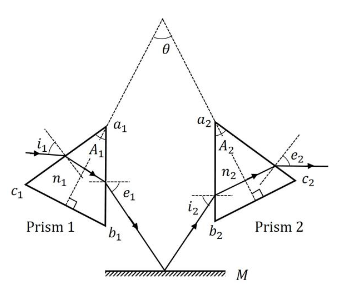
Consider two isosceles prisms 1 and 2 with prism angles $$A_1$$ and $$A_2$$ and refractive indices $$n_1$$ and $$n_2$$, respectively, as shown in the figure. The faces $$a_1b_1$$ and $$a_2b_2$$ are parallel to each other and perpendicular to the mirror $$M$$. If a ray of light is incident on the face $$a_1c_1$$ and emerges from the face $$a_2c_2$$, then the correct statement(s) is/are:
JEE Advanced 2026 Paper-2 - Question 6
In a vacuum chamber, a particle of charge $$1\,\mu\mathrm{C}$$ and mass $$1\,\mathrm{mg}$$ is projected with a velocity $$(\hat{i}+2\hat{j})\,\mathrm{ms^{-1}}$$ from the $$XZ$$ plane at time $$t=0$$ in an electric field of $$1\hat{i}\,\mathrm{Vm^{-1}}$$. At $$t=0.2\,\mathrm{s}$$, the electric field is switched off and a magnetic field of $$6\hat{j}\,\mathrm{T}$$ is switched on. The acceleration due to gravity is $$-10\hat{j}\,\mathrm{ms^{-2}}$$. Correct option(s) is/are:
JEE Advanced 2026 Paper-2 - Question 7
Two charges $$Q_1=q$$ and $$Q_2=mq$$ are placed at the points $$P_1(a,b)$$ and $$P_2(ma,mb)$$, respectively, in the $$XY$$ plane, where $$a,b\neq 0$$ and $$m\neq 0,1$$. If $$V_1$$ is the potential at a point in the $$XY$$ plane due to charge $$Q_1$$ and $$V_2$$ is the potential at that point due to charge $$Q_2$$. Correct statement(s) for the points at which $$|V_1|=|V_2|$$ is/are:
JEE Advanced 2026 Paper-2 - Question 8
Consider an electric dipole comprising two charges $$+q$$ and $$-q$$ each with mass $$m$$, separated by a fixed distance $$d$$ and initially at rest with its dipole moment pointing along $$\hat{i}$$. A uniform electric field $$E\hat{j}$$ is turned on at time $$t=0$$ and it is turned off at $$t=t_f$$, when the dipole moment makes an angle $$\theta_f$$ with $$\hat{i}$$. Neglecting any sources of energy loss, correct option(s) is/are:
JEE Advanced 2026 Paper-2 - Question 9
Ten moles of an ideal monatomic gas, initially in state $$\boldsymbol{a}$$ at atmospheric pressure and temperature $$T_a=27^\circ\mathrm{C}$$, is enclosed in a metal cylinder of volume $$V_0$$ fitted with a frictionless piston. The gas is suddenly compressed to state $$\boldsymbol{b}$$ with volume $$V_0/3$$. Now, keeping the piston stationary, the cylinder is submerged in a water bath of temperature $$11^\circ\mathrm{C}$$ until the gas reaches the temperature of the water bath, which is denoted as state $$\boldsymbol{c}$$. Finally, while still in the water bath, the piston is brought slowly to its initial position, which is denoted as state $$\boldsymbol{f}$$. If $$R$$ is universal gas constant, then the correct option(s) is/are:
[Given: $$9^{1/3}=2.08$$]
JEE Advanced 2026 Paper-2 - Question 10
Two thin wires, Wire-1 of diameter $$0.650\,\mathrm{mm}$$ and Wire-2 of unknown diameter $$d$$ are given. To obtain the value of $$d$$, the diameters of the two wires are measured with a screw gauge. The screw gauge has a pitch of $$0.5\,\mathrm{mm}$$ and there are $$100$$ divisions on the circular scale (CS). The smallest division on the linear scale (LS) is $$0.5\,\mathrm{mm}$$. The table shows the readings of LS and CS for the measurements. The value of $$d$$ (in $$\mu\mathrm{m}$$) is:
| Readings | ||
| LS (mm) | CS | |
| Wire-1 | 0.5 | 42 |
| Wire-2 | 1.5 | 95 |
789
456
123
0.-
Clear All