For the following questions answer them individually
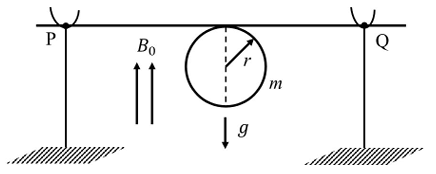
A thin stiff insulated metal wire is bent into a circular loop with its two ends extending tangentially from the same point of the loop. The wire loop has mass $$m$$ and radius $$r$$ and it is in a uniform vertical magnetic field $$B_0$$, as shown in the figure. Initially, it hangs vertically downwards, because of acceleration due to gravity $$g$$, on two conducting supports at $$P$$ and $$Q$$. When a current $$I$$ is passed through the loop, the loop turns about the line $$PQ$$ by an angle $$\theta$$ given by
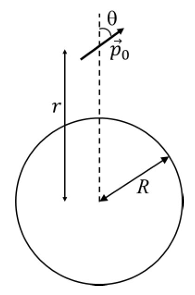
A small electric dipole $$\vec{p}_0$$, having a moment of inertia $$I$$ about its center, is kept at a distance $$r$$ from the center of a spherical shell of radius $$R$$. The surface charge density $$\sigma$$ is uniformly distributed on the spherical shell. The dipole is initially oriented at a small angle $$\theta$$ as shown in the figure. While staying at a distance $$r$$, the dipole is free to rotate about its center.
If released from rest, then which of the following statement(s) is (are) correct?
[$$\varepsilon_0$$ is the permittivity of free space.]
A table tennis ball has radius $$(3/2) \times 10^{-2}$$ m and mass $$(22/7) \times 10^{-3}$$ kg. It is slowly pushed down into a swimming pool to a depth of $$d = 0.7$$ m below the water surface and then released from rest. It emerges from the water surface at speed $$v$$, without getting wet, and rises up to a height $$H$$. Which of the following option(s) is (are) correct?
[Given: $$\pi = 22/7$$, $$g = 10$$ ms$$^{-2}$$, density of water $$= 1 \times 10^3$$ kg m$$^{-3}$$, viscosity of water $$= 1 \times 10^{-3}$$ Pa·s.]
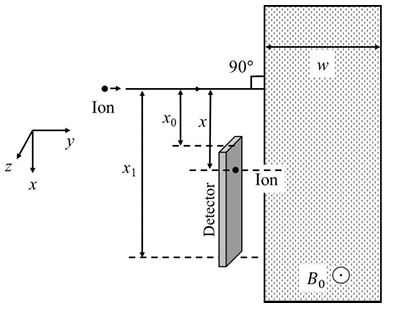
A positive, singly ionized atom of mass number $$A_M$$ is accelerated from rest by the voltage 192 V. Thereafter, it enters a rectangular region of width $$w$$ with magnetic field $$\vec{B}_0 = 0.1\hat{k}$$ Tesla, as shown in the figure. The ion finally hits a detector at the distance $$x$$ below its starting trajectory.
[Given: Mass of neutron/proton $$= (5/3) \times 10^{-27}$$ kg, charge of the electron $$= 1.6 \times 10^{-19}$$ C.]
Which of the following option(s) is(are) correct?
The dimensions of a cone are measured using a scale with a least count of 2 mm. The diameter of the base and the height are both measured to be 20.0 cm. The maximum percentage error in the determination of the volume is ______.
A ball is thrown from the location $$(x_0, y_0) = (0,0)$$ of a horizontal playground with an initial speed $$v_0$$ at an angle $$\theta_0$$ from the $$+x$$-direction. The ball is to be hit by a stone, which is thrown at the same time from the location $$(x_1, y_1) = (L, 0)$$. The stone is thrown at an angle $$(180^\circ - \theta_1)$$ from the $$+x$$-direction with a suitable initial speed. For a fixed $$v_0$$, when $$(\theta_0, \theta_1) = (45^\circ, 45^\circ)$$, the stone hits the ball after time $$T_1$$, and when $$(\theta_0, \theta_1) = (60^\circ, 30^\circ)$$, it hits the ball after time $$T_2$$. In such a case, $$(T_1/T_2)^2$$ is ________.
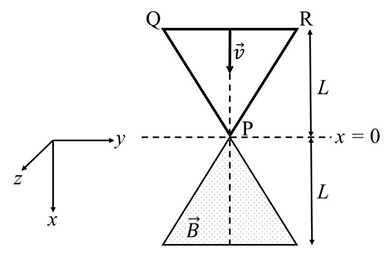
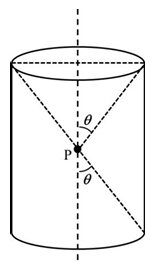
A charge is kept at the central point $$P$$ of a cylindrical region. The two edges subtend a half-angle $$\theta$$ at $$P$$, as shown in the figure. When $$\theta = 30^\circ$$, then the electric flux through the curved surface of the cylinder is $$\Phi$$. If $$\theta = 60^\circ$$, then the electric flux through the curved surface becomes $$\Phi / \sqrt{n}$$, where the value of $$n$$ is ________.
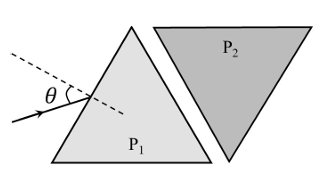
Two equilateral-triangular prisms $$P_1$$ and $$P_2$$ are kept with their sides parallel to each other, in vacuum, as shown in the figure. A light ray enters prism $$P_1$$ at an angle of incidence $$\theta$$ such that the outgoing ray undergoes minimum deviation in prism $$P_2$$. If the respective refractive indices of $$P_1$$ and $$P_2$$ are $$\sqrt{\dfrac{3}{2}}$$ and $$\sqrt{3}$$, $$\theta = \sin^{-1}\left[\sqrt{\dfrac{3}{2}} \sin\left(\dfrac{\pi}{\beta}\right)\right]$$, where the value of $$\beta$$ is ________.
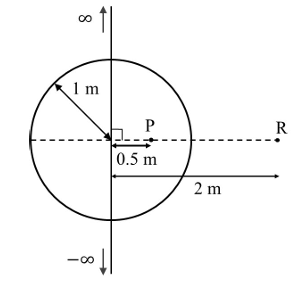
An infinitely long thin wire, having a uniform charge density per unit length of 5 nC/m, is passing through a spherical shell of radius 1 m, as shown in the figure. A 10 nC charge is distributed uniformly over the spherical shell. If the configuration of the charges remains static, the magnitude of the potential difference between points $$P$$ and $$R$$, in Volt, is ________.
[Given: In SI units $$\dfrac{1}{4\pi \varepsilon_0} = 9 \times 10^9$$, ln 2 = 0.7. Ignore the area pierced by the wire.]
A spherical soap bubble inside an air chamber at pressure $$P_0 = 10^5$$ Pa has a certain radius so that the excess pressure inside the bubble is $$\Delta P = 144$$ Pa. Now, the chamber pressure is reduced to $$8P_0/27$$ so that the bubble radius and its excess pressure change. In this process, all the temperatures remain unchanged. Assume air to be an ideal gas and the excess pressure $$\Delta P$$ in both the cases to be much smaller than the chamber pressure. The new excess pressure $$\Delta P$$ in Pa is ________.