For the following questions answer them individually
Let $$\vec{p} = 2\hat{i} + \hat{j} + 3\hat{k}$$ and $$\vec{q} = \hat{i} - \hat{j} + \hat{k}$$. If for some real numbers $$\alpha$$, $$\beta$$ and $$\gamma$$, we have $$15\hat{i} + 10\hat{j} + 6\hat{k} = \alpha(2\vec{p} + \vec{q}) + \beta(\vec{p} - 2\vec{q}) + \gamma(\vec{p} \times \vec{q})$$, then the value of $$\gamma$$ is ______.
A normal with slope $$\frac{1}{\sqrt{6}}$$ is drawn from the point $$(0, -\alpha)$$ to the parabola $$x^2 = -4ay$$, where $$a > 0$$. Let $$L$$ be the line passing through $$(0, -\alpha)$$ and parallel to the directrix of the parabola. Suppose that $$L$$ intersects the parabola at two points $$A$$ and $$B$$. Let $$r$$ denote the length of the latus rectum and $$s$$ denote the square of the length of the line segment $$AB$$. If $$r : s = 1 : 16$$, then the value of $$24a$$ is ______.
Let the function $$f : [1, \infty) \to \mathbb{R}$$ be defined by
$$f(t) = \begin{cases} (-1)^{n+1} \cdot 2, & \text{if } t = 2n-1, \, n \in \mathbb{N}, \\ \frac{(2n+1-t)}{2} f(2n-1) + \frac{(t-(2n-1))}{2} f(2n+1), & \text{if } 2n-1 < t < 2n+1, \, n \in \mathbb{N}. \end{cases}$$
Define $$g(x) = \int_1^x f(t) \, dt$$, $$x \in (1, \infty)$$. Let $$\alpha$$ denote the number of solutions of the equation $$g(x) = 0$$ in the interval $$(1, 8]$$ and $$\beta = \lim_{x \to 1^+} \frac{g(x)}{x-1}$$. Then the value of $$\alpha + \beta$$ is equal to ______.
Let $$S = \{1, 2, 3, 4, 5, 6\}$$ and $$X$$ be the set of all relations $$R$$ from $$S$$ to $$S$$ that satisfy both the following properties:
i. $$R$$ has exactly 6 elements.
ii. For each $$(a, b) \in R$$, we have $$|a - b| \geq 2$$.
Let $$Y = \{R \in X : \text{The range of } R \text{ has exactly one element}\}$$ and
$$Z = \{R \in X : R \text{ is a function from } S \text{ to } S\}$$.
Let $$n(A)$$ denote the number of elements in a set $$A$$.
If $$n(X) = {}^{m}C_6$$, then the value of $$m$$ is ______.
If the value of $$n(Y) + n(Z)$$ is $$k^2$$, then $$|k|$$ is ______.
Let $$f : \left[0, \frac{\pi}{2}\right] \to [0, 1]$$ be the function defined by $$f(x) = \sin^2 x$$ and let $$g : \left[0, \frac{\pi}{2}\right] \to [0, \infty)$$ be the function defined by $$g(x) = \sqrt{\frac{\pi x}{2} - x^2}$$.
The value of $$2\int_0^{\frac{\pi}{2}} f(x)g(x) \, dx - \int_0^{\frac{\pi}{2}} g(x) \, dx$$ is ______.
The value of $$\frac{16}{\pi^3} \int_0^{\frac{\pi}{2}} f(x)g(x) \, dx$$ is ______.
For the following questions answer them individually
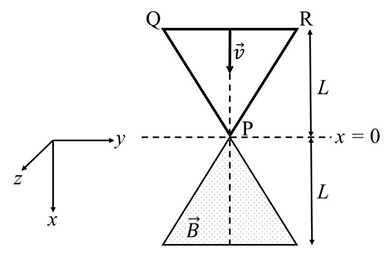
A region in the form of an equilateral triangle (in $$x - y$$ plane) of height $$L$$ has a uniform magnetic field $$\vec{B}$$ pointing in the $$+z$$-direction. A conducting loop $$PQR$$, in the form of an equilateral triangle of the same height $$L$$, is placed in the $$x - y$$ plane with its vertex $$P$$ at $$x = 0$$ in the orientation shown in the figure. At $$t = 0$$, the loop starts entering the region of the magnetic field with a uniform velocity $$\vec{v}$$ along the $$+x$$-direction. The plane of the loop and its orientation remain unchanged throughout its motion.
Which of the following graph best depicts the variation of the induced emf ($$E$$) in the loop as a function of the distance ($$x$$) starting from $$x = 0$$?
A particle of mass $$m$$ is under the influence of the gravitational field of a body of mass $$M$$ ($$\gg m$$). The particle is moving in a circular orbit of radius $$r_0$$ with time period $$T_0$$ around the mass $$M$$. Then, the particle is subjected to an additional central force, corresponding to the potential energy $$V_c(r) = m\alpha / r^3$$, where $$\alpha$$ is a positive constant of suitable dimensions and $$r$$ is the distance from the center of the orbit. If the particle moves in the same circular orbit of radius $$r_0$$ in the combined gravitational potential due to $$M$$ and $$V_c(r)$$, but with a new time period $$T_1$$, then $$(T_1^2 - T_0^2)/T_1^2$$ is given by
[$$G$$ is the gravitational constant.]
A metal target with atomic number $$Z = 46$$ is bombarded with a high energy electron beam. The emission of X-rays from the target is analyzed. The ratio $$r$$ of the wavelengths of the $$K_\alpha$$-line and the cut-off is found to be $$r = 2$$. If the same electron beam bombards another metal target with $$Z = 41$$, the value of $$r$$ will be