For the following questions answer them individually
Let $$A = \left\{\frac{1967 + 1686i\sin\theta}{7 - 3i\cos\theta} : \theta \in \mathbb{R}\right\}$$. If A contains exactly one positive integer n, then the value of n is
Let P be the plane $$\sqrt{3}x + 2y + 3z = 16$$ and let $$S = \left\{\alpha\hat{i} + \beta\hat{j} + \gamma\hat{k} : \alpha^2 + \beta^2 + \gamma^2 = 1 \text{ and the distance of } (\alpha, \beta, \gamma) \text{ from the plane P is } \frac{7}{2}\right\}$$. Let $$\vec{u}$$, $$\vec{v}$$ and $$\vec{w}$$ be three distinct vectors in S such that $$|\vec{u} - \vec{v}| = |\vec{v} - \vec{w}| = |\vec{w} - \vec{u}|$$. Let V be the volume of the parallelepiped determined by vectors $$\vec{u}$$, $$\vec{v}$$ and $$\vec{w}$$. Then the value of $$\frac{80}{\sqrt{3}}V$$ is
Let a and b be two nonzero real numbers. If the coefficient of $$x^5$$ in the expansion of $$\left(ax^2 + \frac{70}{27bx}\right)^4$$ is equal to the coefficient of $$x^{-5}$$ in the expansion of $$\left(ax - \frac{1}{bx^2}\right)^7$$, then the value of $$2b$$ is
Let $$\alpha$$, $$\beta$$ and $$\gamma$$ be real numbers. Consider the following system of linear equations
$$x + 2y + z = 7$$
$$x + \alpha z = 11$$
$$2x - 3y + \beta z = \gamma$$
Match each entry in List-I to the correct entries in List-II.
| List-I | List-II | ||
|---|---|---|---|
| (P) | If $$\beta = \frac{1}{2}(7\alpha - 3)$$ and $$\gamma = 28$$, then the system has | (1) | a unique solution |
| (Q) | If $$\beta = \frac{1}{2}(7\alpha - 3)$$ and $$\gamma \neq 28$$, then the system has | (2) | no solution |
| (R) | If $$\beta \neq \frac{1}{2}(7\alpha - 3)$$ where $$\alpha = 1$$ and $$\gamma \neq 28$$, then the system has | (3) | infinitely many solutions |
| (S) | If $$\beta \neq \frac{1}{2}(7\alpha - 3)$$ where $$\alpha = 1$$ and $$\gamma = 28$$, then the system has | (4) | $$x = 11, y = -2$$ and $$z = 0$$ as a solution |
| (5) | $$x = -15, y = 4$$ and $$z = 0$$ as a solution | ||
Consider the given data with frequency distribution
| $$x_i$$ | 3 | 8 | 11 | 10 | 5 | 4 |
| $$f_i$$ | 5 | 2 | 3 | 2 | 4 | 4 |
Match each entry in List-I to the correct entries in List-II.
| List-I | List-II | ||
|---|---|---|---|
| (P) | The mean of the above data is | (1) | 2.5 |
| (Q) | The median of the above data is | (2) | 5 |
| (R) | The mean deviation about the mean of the above data is | (3) | 6 |
| (S) | The mean deviation about the median of the above data is | (4) | 2.7 |
| (5) | 2.4 | ||
The correct option is:
Let $$\ell_1$$ and $$\ell_2$$ be the lines $$\vec{r}_1 = \lambda(\hat{i} + \hat{j} + \hat{k})$$ and $$\vec{r}_2 = (\hat{j} - \hat{k}) + \mu(\hat{i} + \hat{k})$$, respectively. Let X be the set of all the planes H that contain the line $$\ell_1$$. For a plane H, let d(H) denote the smallest possible distance between the points of $$\ell_2$$ and H. Let $$H_0$$ be the plane in X for which d($$H_0$$) is the maximum value of d(H) as H varies over all planes in X.
Match each entry in List-I to the correct entries in List-II.
| List-I | List-II | ||
|---|---|---|---|
| (P) | The value of d($$H_0$$) is | (1) | $$\sqrt{3}$$ |
| (Q) | The distance of the point (0, 1, 2) from $$H_0$$ is | (2) | $$\frac{1}{\sqrt{3}}$$ |
| (R) | The distance of origin from $$H_0$$ is | (3) | 0 |
| (S) | The distance of origin from the point of intersection of planes $$y = z$$, $$x = 1$$ and $$H_0$$ is | (4) | $$\sqrt{2}$$ |
| (5) | $$\frac{1}{\sqrt{2}}$$ | ||
The correct option is:
Let z be complex number satisfying $$|z|^3 + 2z^2 + 4\bar{z} - 8 = 0$$, where $$\bar{z}$$ denotes the complex conjugate of z. Let the imaginary part of z be nonzero.
Match each entry in List-I to the correct entries in List-II.
| List-I | List-II | ||
|---|---|---|---|
| (P) | $$|z|^2$$ is equal to | (1) | 12 |
| (Q) | $$|z - \bar{z}|^2$$ is equal to | (2) | 4 |
| (R) | $$|z|^2 + |z + \bar{z}|^2$$ is equal to | (3) | 8 |
| (S) | $$|z + 1|^2$$ is equal to | (4) | 10 |
| (5) | 7 | ||
The correct option is:
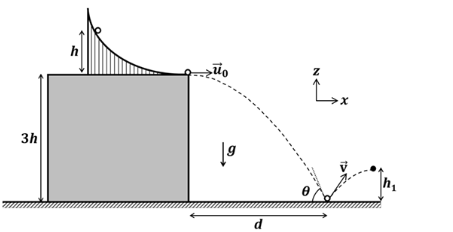
A slide with a frictionless curved surface, which becomes horizontal at its lower end, is fixed on the terrace of a building of height $$3h$$ from the ground, as shown in the figure. A spherical ball of mass m is released on the slide from rest at a height $$h$$ from the top of the terrace. The ball leaves the slide with a velocity $$\vec{u}_0 = u_0 \hat{x}$$ and falls on the ground at a distance $$d$$ from the building making an angle $$\theta$$ with the horizontal. It bounces off with a velocity $$\vec{v}$$ and reaches a maximum height $$h_1$$. The acceleration due to gravity is $$g$$ and the coefficient of restitution of the ground is $$1/\sqrt{3}$$. Which of the following statement(s) is(are) correct?
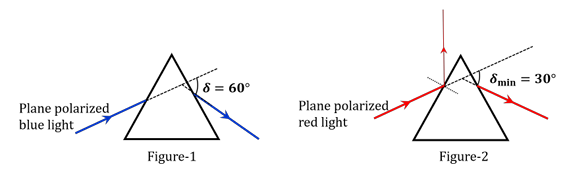
A plane polarized blue light ray is incident on a prism such that there is no reflection from the surface of the prism. The angle of deviation of the emergent ray is $$\delta = 60^\circ$$ (see Figure-1). The angle of minimum deviation for red light from the same prism is $$\delta_{min} = 30^\circ$$ (see Figure-2). The refractive index of the prism material for blue light is $$\sqrt{3}$$. Which of the following statement(s) is(are) correct?
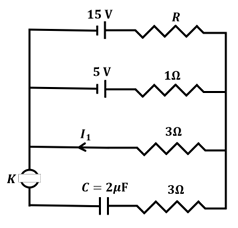
In a circuit shown in the figure, the capacitor $$C$$ is initially uncharged and the key $$K$$ is open. In this condition, a current of 1 A flows through the 1 $$\Omega$$ resistor. The key is closed at time $$t = t_0$$. Which of the following statement(s) is(are) correct?
[Given: $$e^{-1} = 0.36$$]