91- 6303239042
 IPMAT WhatsApp Group


 Preferred Source

 Google Discover
IPMAT Verbal Syllabus 2027
The Verbal Ability section in IPMAT 2027 is a part of the examination to check your ease and ability to read, understand and use the English language and not just the ability to recall many words. Though the IPMAT official notification of the actual exam pattern for the upcoming admission cycle 2027 is yet to be out from IIM Indore and IIM Rohtak but the syllabus remains more or less the same from many previous admission cycles so one can plan on starting preparation from the existing pattern.
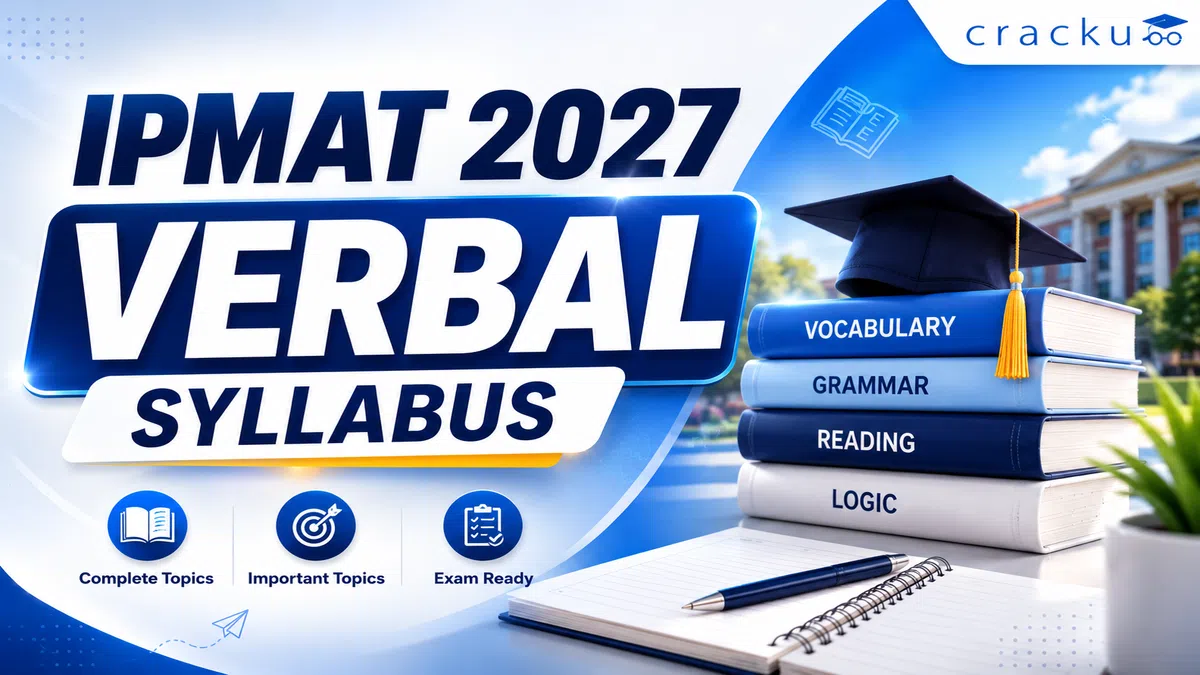
In general, the IPMAT Verbal Ability Syllabus 2027 consists of the following four broad topics:
- Reading Comprehension (RC) : It contains passages on varied topics such as philosophy, business, science & technology, society, literature and opinions followed by questions that test the candidate on the main idea, inference, tone and details.
- Vocabulary : This includes words on synonyms, antonyms, usage in context, phrases and idioms, word roots.
- Grammar : The topics covered here are sentence correction, error spotting, parts of speech, subject-verb agreement and modifiers.
- Verbal Reasoning / Logical Ability in Language : This section will comprise questions on para jumbles, paragraph completion, sentence reordering and logical consistency.
IPMAT Verbal Syllabus for Indore
The Verbal Ability section for IPMAT Indore tests your ability to comprehend English based on class 10-12 level rather than strictly memorising grammar rules. The questions will be based on context and inference, unlike typical grammar-based entrance tests.
The Verbal Ability section generally has 45 MCQs, which have to be attempted within 40 minutes of sectional time. It is one of the two main sections in the exam, the other being Quantitative Ability. The following types of questions can be expected to be a part of this section:
Reading Comprehension: The section will likely contain 2-3 moderate to difficult passages. They are likely to be from opinion, literature or business journals. These questions assess your ability to interpret meaning in context and make inferences.
Vocabulary: These questions will focus on synonyms, antonyms, word meanings and fill-in-the-blanks Idioms and phrases, one-word substitutions, phrasal verbs, spelling errors
Word roots based on understanding vocabulary in context.
Grammar and sentence correction: This will involve identifying errors in sentences and corrections, subject-verb agreement, active & passive voices, direct & indirect speeches.
Para Jumbles: Likely a non-MCQ type question appearing towards the end of the section.
IPMAT Verbal Syllabus for Rohtak
Similar to the IPMAT Indore exam, the verbal ability section of the IPMAT Rohtak exam includes Reading Comprehension passages, Vocabulary and Grammar usage but with emphasis on grammar rules and logical verbal ability.
The Verbal Ability section of the IPMAT Rohtak paper is one of the three sections which contains 40 MCQs with a sectional time limit of 40 minutes.
Reading Comprehension: These passages will check reading ability, comprehension skills (meaning, inferences, tone, title), contextual vocabulary recall and factual retrieval. They may be in the form of poems, literary texts, opinion pieces, business articles.
Vocabulary: It consists of topics like Synonyms, antonyms, commonly confused words, idiomatic expressions and sentence completion, including usage in a sentence context.
Grammar: This includes parts of speech, connectors, direct and indirect speech, active and passive voice, subject-verb agreement, sentence structure, parallelism, and modifiers will be tested. The questions will primarily be error-spotting and error-correction based.
Verbal Reasoning: Analogy, paragraph completion, para jumbles, and logically consistent passages are also expected in this section.
Read More: How to Prepare for IPMAT 2027, Section-Wise Strategy, Tips
IPMAT Indore Verbal topics with weightage
You need to know about question distribution to plan the study schedule effectively. For Verbal Ability of IPMAT Indore, there are 45 questions which you must solve within a rigid time limit of 40 mins per section. Each correct answer will be awarded +4 marks while a wrong answer for MCQ will result in a penalty of -1.
Based on the previous exam analysis and recurrent patterns the topic-wise distribution and weightage blueprint for IIM Indore is given as below:
Core Topic Area | Specific Sub-Topics Focus | Expected Number of Questions | Approximate Sectional Weightage |
Reading Comprehension | Inference, Central Idea, Tone, Fact vs. Opinion | 12 -18 Questions (3-4 Passages) | 30% - 40% |
Verbal Reasoning | Para Jumbles, Para Completion, Odd One Out | 10 -12 Questions | 22% - 26% |
Grammar Mechanics | Error Spotting, Sentence Correction, Parallelism/Modifiers | 5 -8 Questions | 12% - 18% |
Contextual Vocabulary | Phrasal Verbs, Double Fillers, Confusing Words, Idioms | 10 -12 Questions | 22% - 26% |
Total Section | Comprehensive VARC Core | 45 Questions | 100% |
IPMAT Rohtak Verbal topics with weightage
In IPMAT Rohtak, quantitative ability, logical reasoning, and verbal ability are the three major sections, all of which hold an equal weightage. The verbal section requires you to answer exactly 40 questions in 40 minutes. The marking scheme will be +4 marks for correct answer and -1 mark for a wrong answer. There is no sectional time constraint, but it's advisable to pace yourself through the test.
The topic weightage distribution for IIM Rohtak shows the importance of traditional usage of the English language:
Core Topic Area | Key Elements Evaluated | Expected Number of Questions | Approximate Sectional Weightage |
Vocabulary & Analogies | Synonyms, Antonyms, Spellings, Direct Idioms, Analogies | 12 -14 Questions | 30% - 35% |
Grammar Usage | Voice, Narration, Articles, Prepositions, Spotting Errors | 10 -12 Questions | 25% - 30% |
Reading Comprehension | Direct Facts, Contextual Meanings, Title Selection | 8 -10 Questions (2-3 Passages) | 20% - 25% |
Sentence Rearrangement | Short Para Jumbles (with MCQ options) | 6 -8 Questions | 15% - 20% |
Total Section | Comprehensive Grammar & Vocabulary | 40 Questions | 100% |
How to Prepare for IPMAT Verbal 2027?
Consistent effort over time is required for preparing for the IPMAT 2027 Verbal Ability section, as opposed to merely cramming word lists right before the test. The following tiered preparation plan will aid your systematic preparation:
1. Build a high-level reading endurance:
The candidate should spend 45 minutes each morning in perusing high-quality texts because RC topics contain the highest weightage in both the IPMAT exams. While reading, the candidates should prioritize opinion and editorial sections from the most reputed Indian national dailies such as The Hindu and Indian Express, as well as online essays from sites like Aeon. During your reading sessions, focus on identifying the core argument & idea in each paragraph, tone of the author and work on summarizing longer passages in your own words.
2. Understand structural grammar and etymology:
It’s time to get acquainted with basic structural mechanics. Use reliable etymology resources to break down and grasp complex words based on their roots, prefixes, and suffixes. Simultaneously, learn fundamental grammar principles systematically by emphasizing subject-verb agreement, pronoun case and structural parallelism.
3. Master Verbal Logic and apply it in practice:
The candidates should begin solving topic-wise practice sets. With para-jumbles, concentrate on pattern recognition and discerning logical connections by looking for mandatory pairs within the jumbled sentences. For more challenging inference questions, sharpen yourself to represent lengthy textual arguments in simple logical chains.
4. Take sectional mock tests:
The candidates after finishing the basics and fundamentals can switch from practice sheets without time limits to 40-minute timed sectional mocks since timing was the most concerning factor in the exam. During this stage, prioritize developing efficient time-management techniques by knowing when to skip difficult vocabulary questions so as to reserve ample time for valuable Reading Comprehension passages with reducing the negative marks.
Preparation Tips for IPMAT Verbal
Here are some high-impact additional strategies you may adopt for improving Verbal Ability score in IPMAT:
Purposeful reading: When reading any text, actively search for the central argument, the writer’s intention and their attitude. This can greatly aid performance in RC questions.
Don't miss common words: Looking for very obscure or very difficult words and idioms may detract your attention from generally tested and commonly used vocabulary and idioms which are often found in the exam.
Set time for mocks: Use a stopwatch invariably in each of your IPMAT mock tests. This is the right time to know how to leave an awkward question and not lose precious time in it, and devote your attention to the well-rewarding Reading Comprehension section.
Use elimination in MCQs: When you are in doubt, make a point to remove all the possible incorrect options. This will enhance your possibility to choose the correct option.
Log your errors: Make a note of the vocabulary words and grammatical rules that you find challenging in practice sessions and mocks and revise it at least once a week. This is a superb strategy for targeted progress.
Consistent strategy for RCs: It's highly recommended to choose one consistent method for answering RC questions before your exam, like reading questions first before trying to get the gist of the passage.
Prioritize revision in the last few weeks: During the last 4-6 weeks before the exam, move away from new learning and spend most of your time re-revising already studied concepts. Invest nearly 70% of your time for revision of what you've learnt and the analysis of mock tests.
Consistency is the key: Spending 30 minutes each day learning new concepts for about six months will benefit you much more than spending hours to cram at the weekend.
Read More: IPMAT Preparation Strategy, Section-Wise Tips for Exam
IPMAT Verbal Syllabus 2027: Conclusion
The IPMAT Verbal Syllabus 2027 helps candidates understand the key areas tested in the Verbal Ability section, including Reading Comprehension, Vocabulary, Grammar and Verbal Reasoning. Since both IIM Indore and IIM Rohtak test English usage differently, candidates should prepare with a balanced approach that covers reading skills, grammar accuracy and logical language-based questions.
To score well in IPMAT Verbal Ability 2027, regular practice is very important. Aspirants should read quality articles daily, solve RC passages, revise common grammar rules, practise para jumbles and take timed mock tests. A consistent preparation plan can improve speed, accuracy and confidence for the final exam.