IPMAT WhatsApp Group


IIM Kozhikode BMS 2026 Expected Questions
The IIM Kozhikode BMS Expected Questions PDF can be very helpful for students who want to prepare in a smart and planned way. It helps you understand what kind of questions may appear in the IIM Kozhikode BMS entrance exam. The BMS exam has two main sections: Quantitative Ability and Verbal Ability. Students should prepare both sections equally because each section carries marks and affects their final score.
Expected questions do not mean the exact same questions will come in the exam. They are carefully selected practice questions based on important topics, previous year patterns, and common question types. If you practice them regularly, you can improve your speed, accuracy, and confidence before the actual exam.
IIM Kozhikode BMS 2026 Expected Questions PDF
A good IIM Kozhikode BMS Expected Questions PDF should include questions from both sections, Quantitative Ability and Verbal Ability. It should have topic-wise questions with clear and simple solutions, important formulas, grammar rules, vocabulary exercises, and full-length practice sets. Having everything in one place saves time and makes your revision easier and more effective.
IIM Kozhikode BMS 2026 Exam Pattern Overview
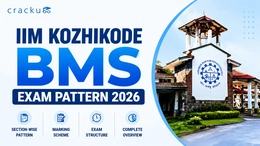
Before you start practicing expected questions, it is important to understand the exam pattern. The IIM Kozhikode BMS entrance exam is conducted in online mode with multiple choice questions. The exam covers two sections — Quantitative Ability and Verbal Ability. There is negative marking in the exam, so you should attempt only those questions where you are confident about the answer. Do not guess randomly because wrong answers will reduce your score.
IIM Kozhikode BMS 2026 Section-wise Preparation Strategy
Start your preparation with a clear section-wise plan. Do not try to cover everything at once. Divide your time wisely between both sections and give extra attention to your weak areas. Practicing regularly with a proper plan is the best way to score well.
Quantitative Ability
Start with basic concepts and formulas before moving to difficult questions. Do not skip any topic thinking it is too easy or too hard. Practice arithmetic topics like percentage, profit and loss, ratio and proportion, time and work, and time speed distance regularly. Then move to algebra, number system, geometry, and data interpretation.
Solve at least 15 to 20 questions every day from different topics. Try to solve questions without a calculator to improve your calculation speed. After solving, always check your mistakes and understand where you went wrong. Revise formulas every week so you do not forget them before the exam.
Verbal Ability
Read English articles, editorials, and short passages every day. This will improve both your reading speed and comprehension. Practice reading comprehension questions where you have to find the main idea, tone of the passage, and meaning of difficult words in context.
Also focus on grammar topics like sentence correction, fill in the blanks, para jumbles, and error spotting. Try to learn 5 to 10 new words every day and use them in sentences to remember their meaning better. Strong vocabulary will help you in both reading comprehension and other verbal questions.
IIM Kozhikode BMS 2026 Expected Questions PDF: Conclusion
Preparing for the IIM Kozhikode BMS 2026 exam becomes easier if you follow a clear plan. Using an expected questions PDF helps you practice both Quantitative and Verbal sections. Regular practice improves your speed, accuracy, and confidence, and also helps you know your weak areas. By following a section-wise plan and revising formulas, grammar, and vocabulary regularly, you can do your best on exam day.
A good preparation plan also means understanding the exam pattern and checking previous year trends. Divide your practice time between Quants and Verbal sections, solve full-length question sets, and review your mistakes. With consistent effort and the right resources, you can face the IIMK BMS exam confidently and increase your chances of getting a high score and admission.