
Join Our JEE Preparation Group
Prep with like-minded aspirants; Get access to free daily tests and study material.
Sign in
Please select an account to continue using cracku.in
↓ →
Join Our JEE Preparation Group
Prep with like-minded aspirants; Get access to free daily tests and study material.
Let the curve $$y = y(x)$$ be the solution of the differential equation, $$\frac{dy}{dx} = 2(x+1)$$. If the numerical value of area bounded by the curve $$y = y(x)$$ and $$x$$-axis is $$\frac{4\sqrt{8}}{3}$$, then the value of $$y(1)$$ is equal to ________.
Correct Answer: 2
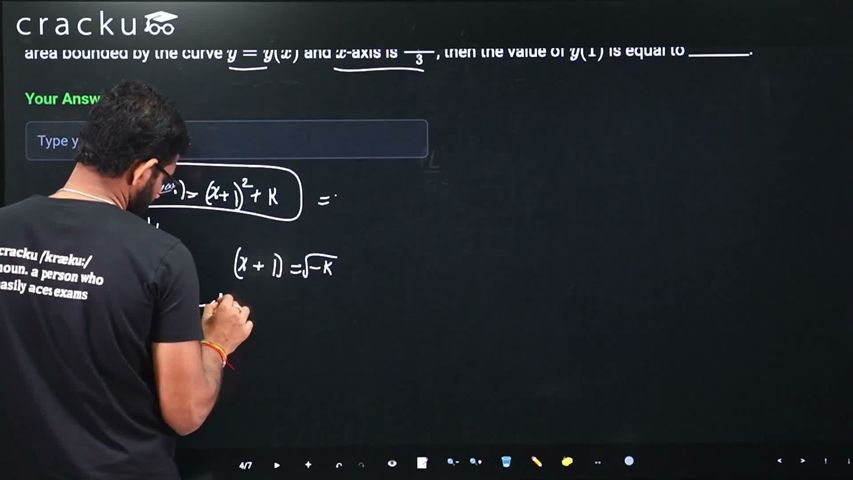
The differential equation is $$\frac{dy}{dx} = 2(x + 1)$$. Integrating: $$y = (x+1)^2 + C$$ for some constant $$C$$.
This is a parabola opening upward with vertex at $$(-1, C)$$. The curve intersects the $$x$$-axis when $$y = 0$$, i.e., $$(x+1)^2 = -C$$. For real intersections, we need $$C < 0$$. Let $$C = -c^2$$ where $$c > 0$$. Then $$x + 1 = \pm c$$, giving $$x = -1 + c$$ and $$x = -1 - c$$.
The area bounded by the curve and the $$x$$-axis is $$\int_{-1-c}^{-1+c} |y|\,dx$$. Since the parabola dips below the $$x$$-axis between the roots:
$$\text{Area} = -\int_{-1-c}^{-1+c} [(x+1)^2 - c^2]\,dx$$.
Substituting $$u = x + 1$$: $$-\int_{-c}^{c} (u^2 - c^2)\,du = -\left[\frac{u^3}{3} - c^2 u\right]_{-c}^{c} = -\left[\left(\frac{c^3}{3} - c^3\right) - \left(\frac{-c^3}{3} + c^3\right)\right]$$.
$$= -\left[\frac{-2c^3}{3} - \frac{2c^3}{3}\right] = -\left[\frac{-4c^3}{3}\right] = \frac{4c^3}{3}$$.
Setting this equal to $$\frac{4\sqrt{8}}{3}$$: $$\frac{4c^3}{3} = \frac{4\sqrt{8}}{3}$$, so $$c^3 = \sqrt{8} = 2\sqrt{2}$$, giving $$c = (2\sqrt{2})^{1/3} = 2^{1/2} \cdot 2^{1/3} \cdot \frac{1}{1}$$... Let us compute more carefully: $$c^3 = 2\sqrt{2} = 2^{3/2}$$, so $$c = 2^{1/2} = \sqrt{2}$$.
Therefore $$C = -c^2 = -2$$, and $$y(x) = (x+1)^2 - 2$$.
At $$x = 1$$: $$y(1) = (1+1)^2 - 2 = 4 - 2 = 2$$.
Was this solution helpful?
Click on the Email ☝️ to Watch the Video Solution
Create a FREE account and get:
_1.webp)

Educational materials for JEE preparation

Ask our AI anything

AI can make mistakes. Please verify important information.
AI can make mistakes. Please verify important information.
