
Join Our JEE Preparation Group
Prep with like-minded aspirants; Get access to free daily tests and study material.
Sign in
Please select an account to continue using cracku.in
↓ →
Join Our JEE Preparation Group
Prep with like-minded aspirants; Get access to free daily tests and study material.
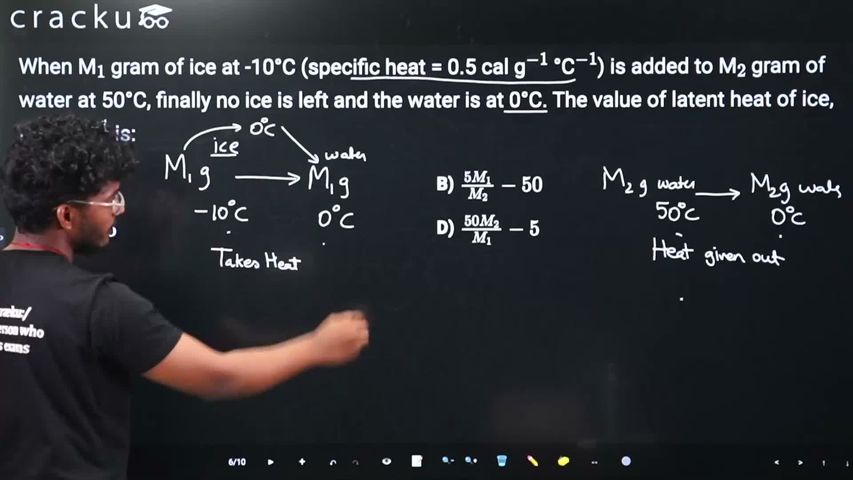
When M$$_1$$ gram of ice at -10°C (specific heat = 0.5 cal g$$^{-1}$$ °C$$^{-1}$$) is added to M$$_2$$ gram of water at 50°C, finally no ice is left and the water is at 0°C. The value of latent heat of ice, in cal g$$^{-1}$$ is:
The situation is a classic calorimetry problem, so we apply the principle that in an isolated system the total heat lost by the hotter part equals the total heat gained by the colder part.
Here the hotter part is the water that starts at 50 °C and cools to 0 °C. The colder part is the ice that starts at -10 °C, first warms up to 0 °C and then melts completely. At the end everything is liquid water at 0 °C, so energy balance gives
$$\text{Heat lost by water} \;=\; \text{Heat gained by ice}.$$
We evaluate each side one step at a time.
Heat lost by the water. The formula for sensible heat is $$Q = m c \Delta T.$$ Mass of water is $$M_2\ \text{g},$$ its specific heat is $$1\ \text{cal g}^{-1}\,^\circ\text{C}^{-1},$$ and the fall in temperature is $$\Delta T = 50^\circ\text{C} - 0^\circ\text{C} = 50^\circ\text{C}.$$ So
$$Q_{\text{water}} \;=\; M_2 \times 1 \times 50 \;=\; 50\,M_2\ \text{cal}.$$
Heat gained by the ice. The ice first has to warm from -10 °C to 0 °C and then undergo the phase change.
1. Warming the ice: again using $$Q = m c \Delta T,$$ with mass $$M_1,$$ specific heat of ice $$0.5\ \text{cal g}^{-1}\,^\circ\text{C}^{-1},$$ and temperature rise $$\Delta T = 0^\circ\text{C} - (-10^\circ\text{C}) = 10^\circ\text{C},$$ we get
$$Q_{\text{warming}} \;=\; M_1 \times 0.5 \times 10 \;=\; 5\,M_1\ \text{cal}.$$
2. Melting the ice: the heat needed is $$Q = mL,$$ where $$L$$ is the latent heat of fusion of ice. Thus
$$Q_{\text{melting}} \;=\; M_1 \, L.$$
The total heat absorbed by the ice is the sum of these two contributions:
$$Q_{\text{ice}} \;=\; 5\,M_1 \;+\; M_1\,L.$$
Setting heat lost equal to heat gained gives
$$50\,M_2 \;=\; 5\,M_1 \;+\; M_1\,L.$$
Now we solve for the latent heat $$L.$$ First subtract $$5\,M_1$$ from both sides:
$$50\,M_2 \;-\; 5\,M_1 \;=\; M_1\,L.$$
Finally divide both sides by $$M_1$$:
$$L \;=\; \frac{50\,M_2}{M_1} \;-\; 5.$$
This matches exactly the expression given in Option D.
Hence, the correct answer is Option D.
Click on the Email ☝️ to Watch the Video Solution
Create a FREE account and get:
_1.webp)

Educational materials for JEE preparation

Ask our AI anything

AI can make mistakes. Please verify important information.
AI can make mistakes. Please verify important information.


