
Join Our JEE Preparation Group
Prep with like-minded aspirants; Get access to free daily tests and study material.
Sign in
Please select an account to continue using cracku.in
↓ →
Join Our JEE Preparation Group
Prep with like-minded aspirants; Get access to free daily tests and study material.
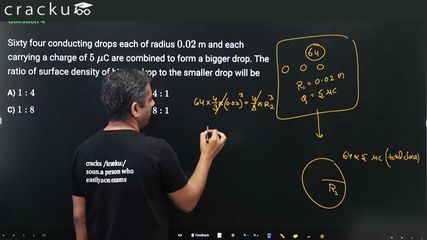
Sixty four conducting drops each of radius $$0.02$$ m and each carrying a charge of $$5$$ $$\mu$$C are combined to form a bigger drop. The ratio of surface density of bigger drop to the smaller drop will be
When 64 small conducting drops combine to form a bigger drop, the total charge and total volume are conserved.
Volume is conserved:
$$64 \times \frac{4}{3}\pi r^3 = \frac{4}{3}\pi R^3$$
$$R^3 = 64r^3$$
$$R = 4r$$
where $$r = 0.02$$ m is the radius of each small drop and $$R$$ is the radius of the bigger drop.
Total charge is conserved:
$$Q = 64 \times q = 64 \times 5 = 320 \text{ } \mu\text{C}$$
$$\sigma_s = \frac{q}{4\pi r^2}$$
$$\sigma_B = \frac{Q}{4\pi R^2} = \frac{64q}{4\pi (4r)^2} = \frac{64q}{4\pi \times 16r^2} = \frac{4q}{4\pi r^2}$$
$$\frac{\sigma_B}{\sigma_s} = \frac{\frac{4q}{4\pi r^2}}{\frac{q}{4\pi r^2}} = 4$$
Therefore, $$\sigma_B : \sigma_s = 4 : 1$$
Hence, the correct answer is Option B.
Was this solution helpful?
Click on the Email ☝️ to Watch the Video Solution
Create a FREE account and get:
_1.webp)

Educational materials for JEE preparation

Ask our AI anything

AI can make mistakes. Please verify important information.
AI can make mistakes. Please verify important information.
