
Join Our JEE Preparation Group
Prep with like-minded aspirants; Get access to free daily tests and study material.
Sign in
Please select an account to continue using cracku.in
↓ →
Join Our JEE Preparation Group
Prep with like-minded aspirants; Get access to free daily tests and study material.
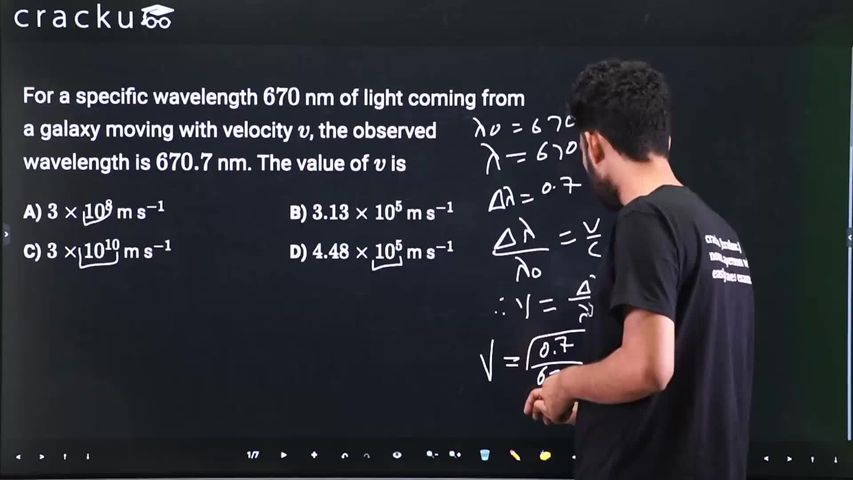
For a specific wavelength $$670$$ nm of light coming from a galaxy moving with velocity $$v$$, the observed wavelength is $$670.7$$ nm. The value of $$v$$ is
We use the Doppler effect for light to find the velocity of the galaxy.
Actual wavelength: $$\lambda_0 = 670$$ nm
Observed wavelength: $$\lambda = 670.7$$ nm
Since $$\lambda > \lambda_0$$, the galaxy is moving away (redshift).
For a source moving away at non-relativistic speed:
$$\frac{\Delta\lambda}{\lambda_0} = \frac{v}{c}$$
$$\Delta\lambda = 670.7 - 670 = 0.7 \text{ nm}$$
$$v = \frac{\Delta\lambda}{\lambda_0} \times c = \frac{0.7}{670} \times 3 \times 10^8$$
$$v = \frac{7}{6700} \times 3 \times 10^8 = \frac{21 \times 10^8}{6700}$$
$$v = 3.134 \times 10^5 \text{ m s}^{-1}$$
$$v \approx 3.13 \times 10^5 \text{ m s}^{-1}$$
Hence, the correct answer is Option B.
Was this solution helpful?
Click on the Email ☝️ to Watch the Video Solution
Create a FREE account and get:
_1.webp)

Educational materials for JEE preparation

Ask our AI anything

AI can make mistakes. Please verify important information.
AI can make mistakes. Please verify important information.
