
Join Our JEE Preparation Group
Prep with like-minded aspirants; Get access to free daily tests and study material.
Sign in
Please select an account to continue using cracku.in
↓ →
Join Our JEE Preparation Group
Prep with like-minded aspirants; Get access to free daily tests and study material.
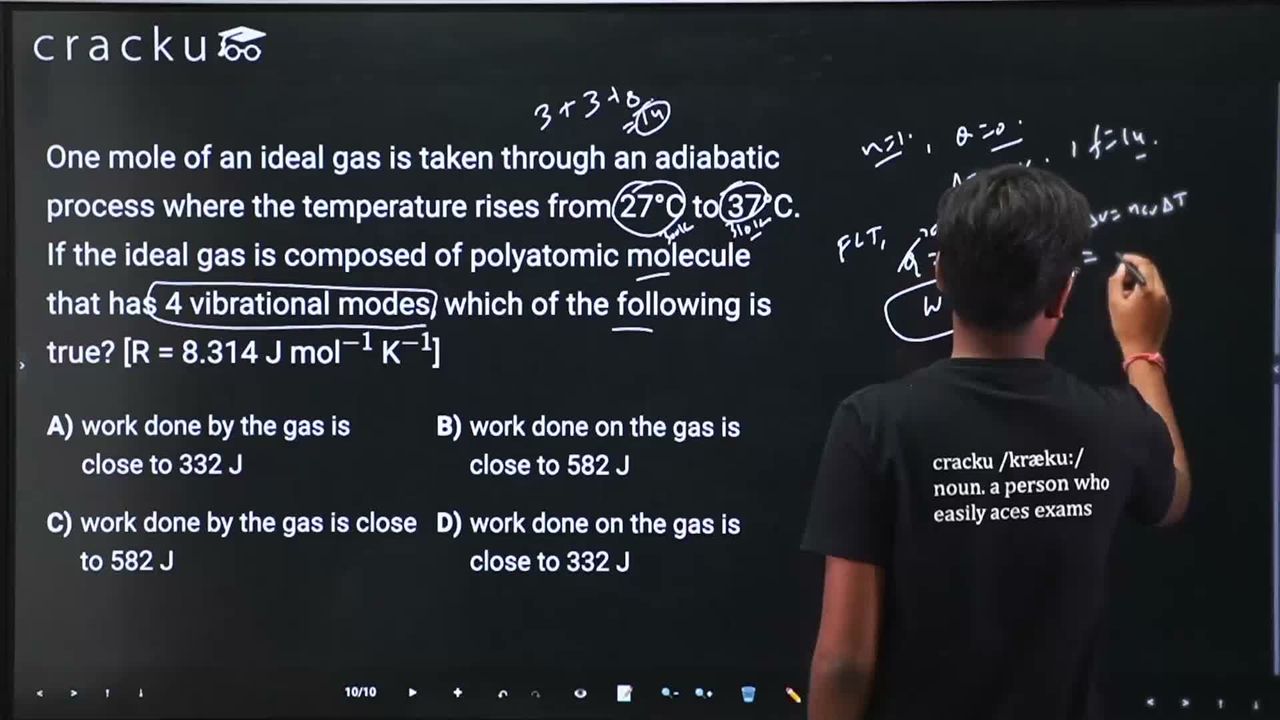
One mole of an ideal gas is taken through an adiabatic process where the temperature rises from 27°C to 37°C. If the ideal gas is composed of polyatomic molecule that has 4 vibrational modes, which of the following is true? [R = 8.314 J mol$$^{-1}$$ K$$^{-1}$$]
First, we change the given temperatures into the absolute (kelvin) scale because all thermodynamic formulas use kelvin.
We have $$T_{1}=27^{\circ}\text{C}=27+273=300\ \text{K}$$ and $$T_{2}=37^{\circ}\text{C}=37+273=310\ \text{K}.$$
Now we must find the molar heat capacity at constant volume, $$C_{V},$$ of the gas. According to the classical equipartition theorem every quadratic degree of freedom contributes $$\tfrac12kT$$ (per molecule) to the internal energy. For one mole the contribution becomes $$\tfrac12RT.$$ Hence we first count the quadratic degrees of freedom (d.o.f.).
For a non-linear polyatomic molecule we have
• 3 translational d.o.f.
• 3 rotational d.o.f.
• 4 vibrational modes, and each vibrational mode supplies two quadratic d.o.f. (one kinetic + one potential), so $$4\times2=8$$ vibrational d.o.f.
Therefore the total number of quadratic degrees of freedom is
$$f = 3 + 3 + 8 = 14.$$
Stating the equipartition formula for one mole, the internal energy is
$$U = \frac{f}{2}RT.$$
Consequently the molar heat capacity at constant volume is
$$C_{V} = \frac{\partial U}{\partial T} = \frac{f}{2}R = \frac{14}{2}R = 7R.$$
We now calculate the change in internal energy when the temperature changes by $$\Delta T = T_{2}-T_{1} = 310\ \text{K} - 300\ \text{K} = 10\ \text{K}.$$
Hence (for one mole)
$$\Delta U = C_{V}\,\Delta T = 7R\,(10\ \text{K}).$$
Substituting $$R = 8.314\ \text{J mol}^{-1}\text{K}^{-1},$$ we get
$$\Delta U = 7 \times 8.314 \times 10 = 581.98\ \text{J} \approx 582\ \text{J}.$$
The process is specified to be adiabatic, so we write the first law in the form
$$\Delta U = Q - W,$$
and because $$Q = 0$$ for an adiabatic change, this simplifies to
$$\Delta U = -W.$$
Rearranging, we have
$$W = -\Delta U.$$
Since $$\Delta U$$ is positive (the gas has gained internal energy), $$W$$ is negative, meaning that the work is done on the gas. Its magnitude equals $$|\Delta U| \approx 582\ \text{J}.$$
Therefore, the work done on the gas is close to 582 J.
Hence, the correct answer is Option 2.
Was this solution helpful?
Click on the Email ☝️ to Watch the Video Solution
Create a FREE account and get:
_1.webp)

Educational materials for JEE preparation

Ask our AI anything

AI can make mistakes. Please verify important information.
AI can make mistakes. Please verify important information.
