
Join Our JEE Preparation Group
Prep with like-minded aspirants; Get access to free daily tests and study material.
Sign in
Please select an account to continue using cracku.in
↓ →
Join Our JEE Preparation Group
Prep with like-minded aspirants; Get access to free daily tests and study material.
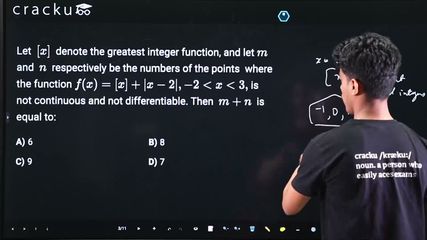
Let $$[x]$$ denote the greatest integer function, and let $$m$$ and $$n$$ respectively be the numbers of the points where the function $$f(x) = [x] + |x-2|, -2 < x < 3,$$ is not continuous and not differentiable. Then $$m+n$$ is equal to:
$$|x - 2|$$ is continuous everywhere and $$[x]$$ is discontinuous at all integers, within the interval $$(-2,3)$$ the integers are $$-1, 0, 1, 2$$.
Because $$f(x)$$ combines these two parts and only $$[x]$$ causes discontinuities, it follows that $$f(x)$$ is discontinuous exactly at $$x = -1, 0, 1, 2$$, giving $$m = 4$$.
$$x = -1, 0, 1, 2$$, $$f$$ is non-differentiable at those four points. Although $$|x - 2|$$ introduces a corner at $$x = 2$$, this point has already been counted among the discontinuities. No additional points of non-differentiability arise because between consecutive integers both $$[x]$$ (which is constant) and $$|x - 2|$$ (which is linear) are differentiable. Therefore, $$n = 4$$.
$$m + n = 4 + 4 = 8$$.
Was this solution helpful?
Click on the Email ☝️ to Watch the Video Solution
Create a FREE account and get:
_1.webp)

Educational materials for JEE preparation

Ask our AI anything

AI can make mistakes. Please verify important information.
AI can make mistakes. Please verify important information.
