
Join Our JEE Preparation Group
Prep with like-minded aspirants; Get access to free daily tests and study material.
Sign in
Please select an account to continue using cracku.in
↓ →
Join Our JEE Preparation Group
Prep with like-minded aspirants; Get access to free daily tests and study material.
Four identical long solenoids A, B, C and D are connected to each other as shown in the figure. If the magnetic field at the center of A is 3 T the field at the center of C would be: (Assume that the magnetic field is confined with in the volume of respective solenoid).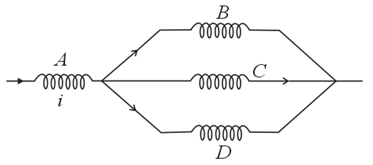
Each long solenoid behaves like a resistance when a steady d.c. current flows through it.
All four solenoids are identical, so let their resistances be $$R$$ each.
The external connections (see figure in the question) join the four solenoids to form a closed square-shaped loop A-B-C-D, and the d.c. source is connected across the solenoid A.
Label the junctions as follows: the ends of A are P and Q, the ends of B are Q and R, the ends of C are R and S, and the ends of D are S and P.
Thus the resistive network is a square P-Q-R-S with equal resistances $$R$$ on every side.
Take the potential of P (the positive terminal of the source) to be $$V$$ and the potential of Q (negative terminal) to be $$0$$.
Let the unknown potentials at R and S be $$V_R$$ and $$V_S$$ respectively.
Step 1 : Kirchhoff’s current law at R
Current enters R from Q through solenoid B and from S through solenoid C, and leaves R towards Q and S.
Using KCL (algebraic sum of currents leaving a junction is zero):
$$\frac{V_R-0}{R} + \frac{V_R-V_S}{R} = 0 \quad -(1)$$
Multiplying by $$R$$:
$$V_R + V_R - V_S = 0 \;\;\Longrightarrow\;\; 2V_R = V_S \quad -(2)$$
Step 2 : Kirchhoff’s current law at S
$$\frac{V_S-V}{R} + \frac{V_S-V_R}{R} = 0 \quad -(3)$$
Multiplying by $$R$$ and substituting $$V_S$$ from $$(2)$$:
$$V_S - V + V_S - V_R = 0$$
$$2V_S - V - V_R = 0$$
Replace $$V_S$$ with $$2V_R$$ (from $$(2)$$):
$$2(2V_R) - V - V_R = 0 \;\;\Longrightarrow\;\; 3V_R = V \quad -(4)$$
Using $$(4)$$ in $$(2)$$:
$$V_S = 2V_R = 2\left(\frac{V}{3}\right) = \frac{2V}{3}$$
Step 3 : Currents through the four solenoids
• Through A (P → Q): $$I_A = \dfrac{V-0}{R} = \dfrac{V}{R}$$
• Through B (Q → R): $$I_B = \dfrac{0-V_R}{R} = -\dfrac{V}{3R}$$ (magnitude $$\dfrac{V}{3R}$$)
• Through C (R → S): $$I_C = \dfrac{V_R-V_S}{R} = \dfrac{V/3 - 2V/3}{R} = -\dfrac{V}{3R}$$ (magnitude $$\dfrac{V}{3R}$$)
• Through D (S → P): $$I_D = \dfrac{V_S-V}{R} = \dfrac{2V/3 - V}{R} = -\dfrac{V}{3R}$$ (magnitude $$\dfrac{V}{3R}$$)
Thus the current in solenoid C is one-third of that in solenoid A:
$$\frac{I_C}{I_A} = \frac{V/3R}{V/R} = \frac13 \quad -(5)$$
Step 4 : Magnetic field comparison
For a long solenoid, $$B = \mu_0 n I$$, so the field is directly proportional to the current.
From $$(5)$$:
$$B_C = \frac{I_C}{I_A}\,B_A = \frac13 \times 3\;{\rm T} = 1\;{\rm T}$$
Answer: The magnetic field at the centre of solenoid C is $$1\;{\rm T}$$ ⇒ Option D.
Was this solution helpful?
_1.webp)

Educational materials for JEE preparation

Ask our AI anything

AI can make mistakes. Please verify important information.
AI can make mistakes. Please verify important information.