
Join Our JEE Preparation Group
Prep with like-minded aspirants; Get access to free daily tests and study material.
Sign in
Please select an account to continue using cracku.in
↓ →
Join Our JEE Preparation Group
Prep with like-minded aspirants; Get access to free daily tests and study material.
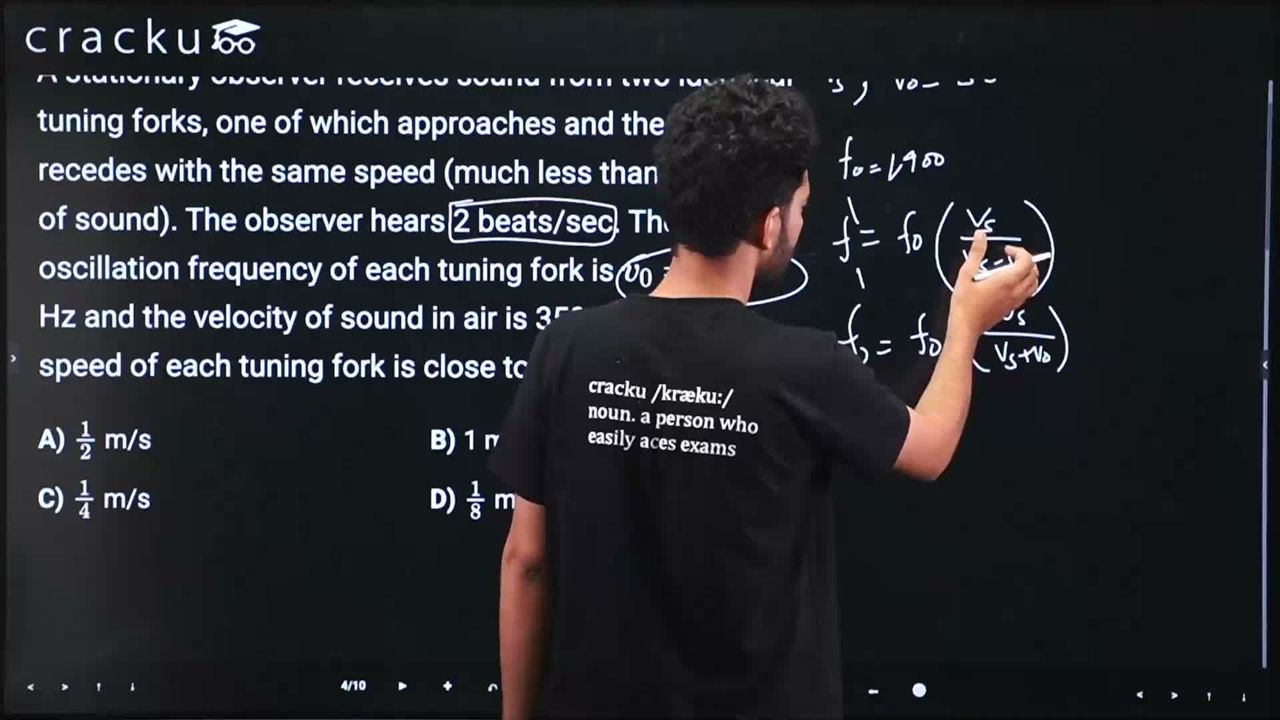
A stationary observer receives sound from two identical tuning forks, one of which approaches and the other one recedes with the same speed (much less than the speed of sound). The observer hears 2 beats/sec. The oscillation frequency of each tuning fork is $$v_0 = 1400$$ Hz and the velocity of sound in air is 350 m/s. The speed of each tuning fork is close to:
We start with the standard Doppler-effect formula for the apparent frequency heard by a stationary observer when the source itself is moving. If the source of true frequency $$v_0$$ moves with speed $$u$$ and the speed of sound in air is $$v$$, then
• when the source moves towards the observer, the apparent frequency is
$$v_{\text{towards}} = v_0 \,\frac{v}{\,v - u\,}$$
• when the source moves away from the observer, the apparent frequency is
$$v_{\text{away}} = v_0 \,\frac{v}{\,v + u\,}$$
In the present situation both forks are identical, each having natural frequency $$v_0 = 1400\ \text{Hz}$$. One fork approaches the observer with speed $$u$$ while the other recedes with the same speed $$u$$. Therefore, the observer hears two different apparent frequencies:
$$v_1 = v_0 \,\frac{v}{v - u} \qquad\text{and}\qquad v_2 = v_0 \,\frac{v}{v + u}.$$
The beat frequency is the absolute difference between these two apparent frequencies. By definition,
$$\text{Beat frequency } = |\,v_1 - v_2\,|.$$
According to the question, the observer hears 2 beats per second, so
$$|\,v_1 - v_2\,| = 2\ \text{Hz}.$$
Let us compute the difference algebraically. Substituting the expressions for $$v_1$$ and $$v_2$$, we have
$$|\,v_1 - v_2\,| = v_0\Bigl|\frac{v}{v - u} - \frac{v}{v + u}\Bigr|.$$
Combining the two fractions inside the absolute value gives
$$\frac{v}{v - u} - \frac{v}{v + u} = v\left[\frac{\,v + u - (v - u)\,}{(v - u)(v + u)}\right] = v\left[\frac{2u}{v^2 - u^2}\right].$$
Hence
$$|\,v_1 - v_2\,| = v_0 \cdot v \cdot \frac{2u}{v^2 - u^2}.$$
The speed of each fork is said to be “much less than the speed of sound,” i.e. $$u \ll v$$. Under this condition $$u^2$$ is negligibly small compared with $$v^2$$, so we may approximate
$$(v^2 - u^2) \approx v^2.$$
Substituting this approximation simplifies the expression for the beat frequency to
$$|\,v_1 - v_2\,| \approx v_0 \cdot v \cdot \frac{2u}{v^2} = \frac{2v_0u}{v}.$$
Setting this equal to the observed 2 beats per second gives a single linear equation for $$u$$:
$$\frac{2v_0u}{v} = 2.$$
Dividing both sides by 2 yields
$$\frac{v_0u}{v} = 1.$$
Now solving for $$u$$, we multiply both sides by $$v$$ and divide by $$v_0$$:
$$u = \frac{v}{v_0}.$$
We substitute the numerical values, $$v = 350\ \text{m/s}$$ and $$v_0 = 1400\ \text{Hz}$$:
$$u = \frac{350}{1400}\ \text{m/s} = 0.25\ \text{m/s}.$$
The fraction $$0.25$$ is exactly $$\tfrac14$$, so the speed of each tuning fork is $$\tfrac14\ \text{m/s}$$.
Hence, the correct answer is Option C.
Was this solution helpful?
Click on the Email ☝️ to Watch the Video Solution
Create a FREE account and get:
_1.webp)

Educational materials for JEE preparation

Ask our AI anything

AI can make mistakes. Please verify important information.
AI can make mistakes. Please verify important information.
