
Join Our JEE Preparation Group
Prep with like-minded aspirants; Get access to free daily tests and study material.
Sign in
Please select an account to continue using cracku.in
↓ →
Join Our JEE Preparation Group
Prep with like-minded aspirants; Get access to free daily tests and study material.
The equation of a plane containing the line of intersection of the planes $$2x - y - 4 = 0$$ and $$y + 2z - 4 = 0$$ and passing through the point (1, 1, 0) is:
We want a plane which simultaneously satisfies two conditions: it must contain every point lying on the common line of the two given planes $$2x - y - 4 = 0$$ and $$y + 2z - 4 = 0$$, and it must also pass through the specific point (1, 1, 0). Because all planes through the line of intersection of two planes can be written as a linear combination of their equations, we first write the general family of such planes.
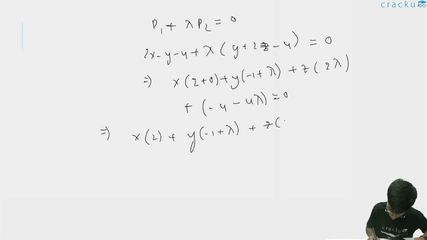
The standard result (or “formula”) is: if two planes are $$P_1 = 0$$ and $$P_2 = 0,$$ then every plane that contains their intersection line can be expressed as $$P_1 + \lambda P_2 = 0,$$ where $$\lambda$$ is a real parameter.
Here, $$P_1$$ and $$P_2$$ are
$$P_1:\;2x - y - 4 = 0,$$
$$P_2:\;y + 2z - 4 = 0.$$
So we write the required family:
$$\bigl(2x - y - 4\bigr) + \lambda\bigl(y + 2z - 4\bigr) = 0.$$
Now we expand and collect like terms:
$$2x - y - 4 + \lambda y + 2\lambda z - 4\lambda = 0.$$
Grouping the coefficients of $$x,\,y,\,z$$ and the constant term, we have
$$2x + (-1 + \lambda)\,y + 2\lambda\,z + (-4 - 4\lambda) = 0.$$
Next, this plane must pass through the point (1, 1, 0). We substitute $$x = 1,\;y = 1,\;z = 0$$:
$$2(1) + (-1 + \lambda)(1) + 2\lambda(0) + (-4 - 4\lambda) = 0.$$
Simplifying step by step:
$$2 + (-1 + \lambda) + 0 + (-4 - 4\lambda) = 0,$$
$$\bigl(2 - 1 - 4\bigr) + \bigl(\lambda - 4\lambda\bigr) = 0,$$
$$(-3) + (-3\lambda) = 0,$$
$$-3(1 + \lambda) = 0.$$
This gives $$1 + \lambda = 0,$$ so
$$\lambda = -1.$$
We substitute $$\lambda = -1$$ back into the general family equation:
$$2x - y - 4 + (-1)\bigl(y + 2z - 4\bigr) = 0.$$
Distributing the minus sign:
$$2x - y - 4 - y - 2z + 4 = 0.$$
Combining like terms:
$$2x - 2y - 2z + ( -4 + 4 ) = 0,$$
$$2x - 2y - 2z = 0.$$
All coefficients have a common factor 2, which we divide out to simplify:
$$x - y - z = 0.$$
This simplified equation exactly matches Option C.
Hence, the correct answer is Option C.
Was this solution helpful?
Click on the Email ☝️ to Watch the Video Solution
Create a FREE account and get:
_1.webp)

Educational materials for JEE preparation

Ask our AI anything

AI can make mistakes. Please verify important information.
AI can make mistakes. Please verify important information.
