
Join Our JEE Preparation Group
Prep with like-minded aspirants; Get access to free daily tests and study material.
Sign in
Please select an account to continue using cracku.in
↓ →
Join Our JEE Preparation Group
Prep with like-minded aspirants; Get access to free daily tests and study material.
The length of the perpendicular from the point (2, -1, 4) on the straight line $$\frac{x + 3}{10} = \frac{y - 2}{-7} = \frac{z}{1}$$ is:
We are given the point $$P(2,\,-1,\,4)$$ and the straight line
$$\frac{x + 3}{10} \;=\; \frac{y - 2}{-7} \;=\; \frac{z}{1}.$$
Writing the line in symmetric form tells us at once:
• a convenient point on the line is obtained by putting the common parameter $$\lambda = 0$$, giving the point $$A(-3,\,2,\,0).$$
• the direction ratios of the line are $$10,\,-7,\,1,$$ so the direction vector is
$$\vec d = 10\hat i - 7\hat j + 1\hat k.$$
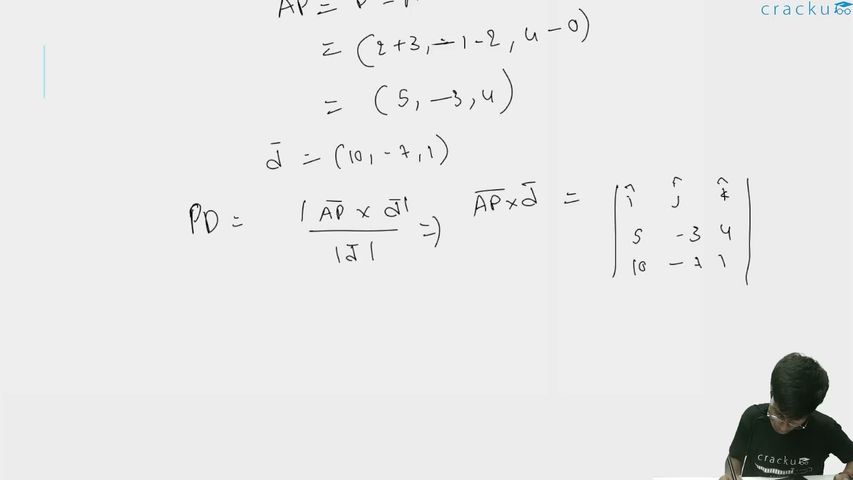
To find the perpendicular distance from $$P$$ to the line we employ the standard three-dimensional formula
$$\boxed{\,d \;=\; \dfrac{\lvert\vec{AP}\times\vec d\rvert}{\lvert\vec d\rvert}\,},$$
where $$\vec{AP} = \overrightarrow{A P}$$ is the vector from $$A$$ to $$P.$
We first obtain $$\vec{AP}:$$
$$\vec{AP} = (2 - (-3))\hat i + (-1 - 2)\hat j + (4 - 0)\hat k = 5\hat i - 3\hat j + 4\hat k.$$
Next we compute the cross product $$\vec{AP}\times\vec d:$$
$$ \vec{AP}\times\vec d \;=\; \begin{vmatrix} \hat i & \hat j & \hat k\\ 5 & -3 & 4\\ 10 & -7 & 1 \end{vmatrix}. $$
Expanding the determinant step by step, we have
$$ \vec{AP}\times\vec d = \hat i\!\Big[(-3)(1) - 4(-7)\Big] - \hat j\!\Big[5(1) - 4(10)\Big] + \hat k\!\Big[5(-7) - (-3)(10)\Big]. $$
Evaluating the brackets:
$$ \vec{AP}\times\vec d = \hat i(-3 + 28) - \hat j\big(5 - 40\big) + \hat k\big(-35 + 30\big) = 25\hat i + 35\hat j - 5\hat k. $$
Its magnitude is
$$ \lvert\vec{AP}\times\vec d\rvert = \sqrt{25^{2} + 35^{2} + (-5)^{2}} = \sqrt{625 + 1225 + 25} = \sqrt{1875} = 25\sqrt3. $$
We now find the magnitude of the direction vector $$\vec d$$:
$$ \lvert\vec d\rvert = \sqrt{10^{2} + (-7)^{2} + 1^{2}} = \sqrt{100 + 49 + 1} = \sqrt{150} = 5\sqrt6. $$
Substituting in the distance formula,
$$ d = \frac{25\sqrt3}{5\sqrt6} = 5 \,\frac{\sqrt3}{\sqrt6} = 5 \,\sqrt{\frac{3}{6}} = 5 \,\sqrt{\frac12} = \frac{5}{\sqrt2}. $$
Numerically,
$$ d \;\approx\; \frac{5}{1.414} \;\approx\; 3.535. $$
This value is greater than 3 but less than 4.
Hence, the correct answer is Option A.
Was this solution helpful?
Click on the Email ☝️ to Watch the Video Solution
Create a FREE account and get:
_1.webp)

Educational materials for JEE preparation

Ask our AI anything

AI can make mistakes. Please verify important information.
AI can make mistakes. Please verify important information.
