
Join Our JEE Preparation Group
Prep with like-minded aspirants; Get access to free daily tests and study material.
Sign in
Please select an account to continue using cracku.in
↓ →
Join Our JEE Preparation Group
Prep with like-minded aspirants; Get access to free daily tests and study material.
If the shortest distance between the lines $$\frac{x - \lambda}{3} = \frac{y - 2}{-1} = \frac{z - 1}{1}$$ and $$\frac{x + 2}{-3} = \frac{y + 5}{2} = \frac{z - 4}{4}$$ is $$\frac{44}{\sqrt{30}}$$, then the largest possible value of $$|\lambda|$$ is equal to ___________
Correct Answer: 43
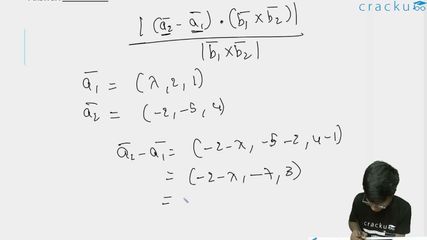
We need to find the largest $$|\lambda|$$ if the shortest distance between two lines equals $$\frac{44}{\sqrt{30}}$$. The first line passes through $$(\lambda, 2, 1)$$ with direction vector $$\vec{b_1} = (3, -1, 1)$$ and the second line passes through $$(-2, -5, 4)$$ with direction vector $$\vec{b_2} = (-3, 2, 4)$$.
The cross product of the direction vectors is $$\vec{b_1}\times\vec{b_2} = \begin{vmatrix} \hat{i} & \hat{j} & \hat{k} \\ 3 & -1 & 1 \\ -3 & 2 & 4 \end{vmatrix} = (-4 - 2)\hat{i} - (12 + 3)\hat{j} + (6 - 3)\hat{k} = (-6, -15, 3)$$ and its magnitude is $$|\vec{b_1}\times\vec{b_2}| = \sqrt{36 + 225 + 9} = \sqrt{270} = 3\sqrt{30}$$.
The vector from the point on the first line to the point on the second line is $$\vec{a_2}-\vec{a_1} = (-2-\lambda, -7, 3)$$, and its dot product with the cross product is $$(-2-\lambda)(-6) + (-7)(-15) + (3)(3) = 6(2+\lambda) + 105 + 9 = 6\lambda + 126\,. $$
Using the formula for the shortest distance between skew lines, we have $$d = \frac{|(\vec{a_2}-\vec{a_1})\cdot(\vec{b_1}\times\vec{b_2})|}{|\vec{b_1}\times\vec{b_2}|} = \frac{|6\lambda + 126|}{3\sqrt{30}} = \frac{44}{\sqrt{30}}\,, $$ which implies $$|6\lambda + 126| = 132\,. $$ Hence, $$6\lambda + 126 = 132 \implies \lambda = 1$$ or $$6\lambda + 126 = -132 \implies \lambda = -43\,. $$
The larger value of $$|\lambda|$$ is $$\max(|1|, |-43|) = 43$$, so the correct answer is 43.
Was this solution helpful?
Click on the Email ☝️ to Watch the Video Solution
Create a FREE account and get:
_1.webp)

Educational materials for JEE preparation

Ask our AI anything

AI can make mistakes. Please verify important information.
AI can make mistakes. Please verify important information.
