
Join Our JEE Preparation Group
Prep with like-minded aspirants; Get access to free daily tests and study material.
Sign in
Please select an account to continue using cracku.in
↓ →
Join Our JEE Preparation Group
Prep with like-minded aspirants; Get access to free daily tests and study material.
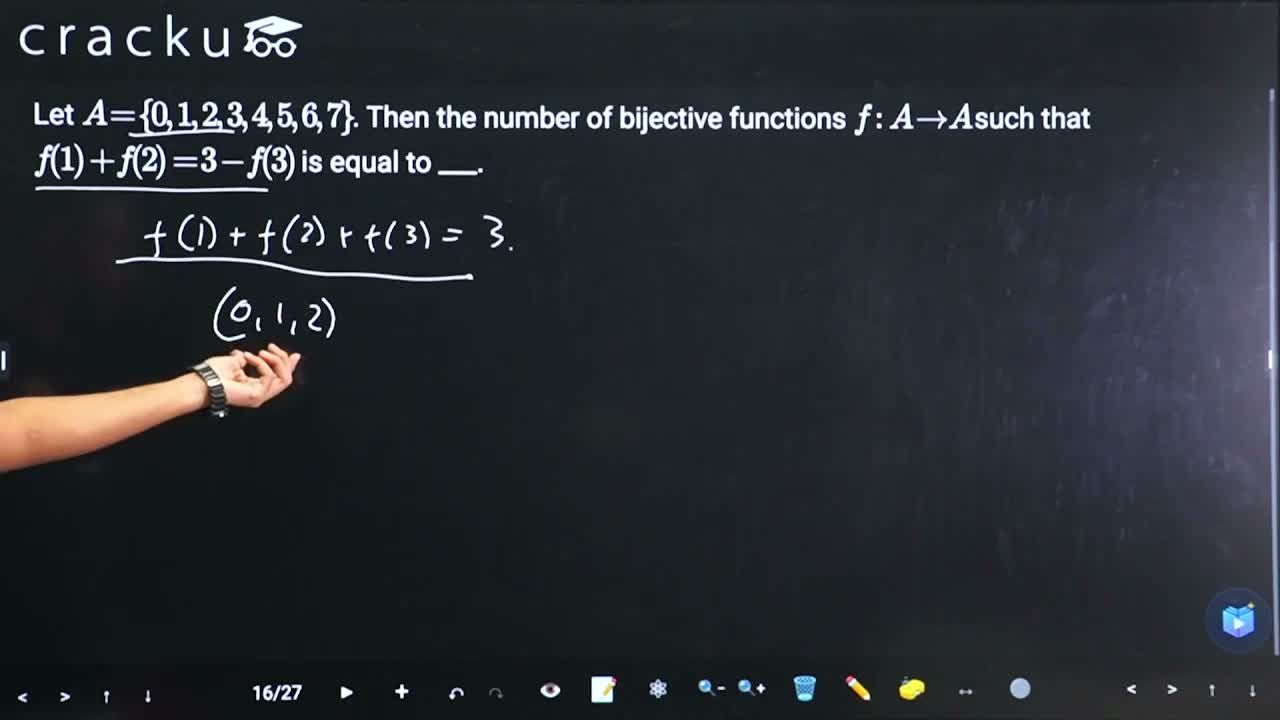
Let $$A = \{0, 1, 2, 3, 4, 5, 6, 7\}$$. Then the number of bijective functions $$f : A \to A$$ such that $$f(1) + f(2) = 3 - f(3)$$ is equal to ___.
Correct Answer: 720
We need bijective functions $$f : A \to A$$ where $$A = \{0, 1, 2, 3, 4, 5, 6, 7\}$$ satisfying $$f(1) + f(2) = 3 - f(3)$$, i.e., $$f(1) + f(2) + f(3) = 3$$.
Since $$f$$ is a bijection (permutation of $$A$$), the values $$f(1), f(2), f(3)$$ must be three distinct elements of $$A$$ that sum to 3.
We need to find all sets of three distinct non-negative integers from $$\{0, 1, 2, 3, 4, 5, 6, 7\}$$ that sum to 3. The possible unordered sets are:
$$\{0, 1, 2\}$$: sum $$= 0 + 1 + 2 = 3$$. This works.
No other triple of distinct non-negative integers from $$A$$ sums to 3, since the next smallest sum of three distinct elements would be $$0 + 1 + 3 = 4$$.
So $$\{f(1), f(2), f(3)\} = \{0, 1, 2\}$$. The three values can be assigned to $$f(1), f(2), f(3)$$ in $$3! = 6$$ ways.
The remaining 5 inputs $$\{0, 4, 5, 6, 7\}$$ must map to the remaining 5 outputs $$\{3, 4, 5, 6, 7\}$$, and these can be assigned in $$5! = 120$$ ways.
The total number of bijective functions is $$6 \times 120 = 720$$.
Click on the Email ☝️ to Watch the Video Solution
Create a FREE account and get:
_1.webp)

Educational materials for JEE preparation

Ask our AI anything

AI can make mistakes. Please verify important information.
AI can make mistakes. Please verify important information.


