
Join Our JEE Preparation Group
Prep with like-minded aspirants; Get access to free daily tests and study material.
Sign in
Please select an account to continue using cracku.in
↓ →
Join Our JEE Preparation Group
Prep with like-minded aspirants; Get access to free daily tests and study material.
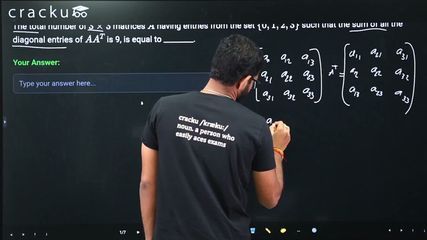
The total number of $$3 \times 3$$ matrices $$A$$ having entries from the set $$\{0, 1, 2, 3\}$$ such that the sum of all the diagonal entries of $$AA^T$$ is 9, is equal to ________.
Correct Answer: 766
For a $$3 \times 3$$ matrix $$A$$ with entries from $$\{0, 1, 2, 3\}$$, the $$(i,i)$$-th entry of $$AA^T$$ is the sum of squares of the entries in the $$i$$-th row. Specifically, if $$A = (a_{ij})$$, then $$(AA^T)_{ii} = \sum_{j=1}^{3} a_{ij}^2$$.
The sum of all diagonal entries of $$AA^T$$ is $$\sum_{i=1}^{3}\sum_{j=1}^{3} a_{ij}^2 = 9$$. We need the sum of squares of all 9 entries to equal 9.
Each entry $$a_{ij} \in \{0, 1, 2, 3\}$$ contributes $$a_{ij}^2 \in \{0, 1, 4, 9\}$$. We need the total sum of these 9 squared values to be 9.
Since each squared value is at least 0, and the maximum single contribution from entry value 3 is 9, the possible distributions of entry values across 9 positions (where the sum of squares = 9) are:
Case 1: Exactly 9 entries equal to 1 (and 0 entries of other values). Sum of squares = $$9 \times 1 = 9$$. Number of matrices = 1.
Case 2: Exactly one entry equals 2 (contributing 4), exactly 5 entries equal 1 (contributing 5), and 3 entries equal 0. Sum = $$4 + 5 = 9$$. Number of ways = $$\binom{9}{1} \times \binom{8}{5} = 9 \times 56 = 504$$.
Case 3: Exactly two entries equal 2 (contributing 8), exactly 1 entry equals 1 (contributing 1), and 6 entries equal 0. Sum = $$8 + 1 = 9$$. Number of ways = $$\binom{9}{2} \times \binom{7}{1} = 36 \times 7 = 252$$.
Case 4: Exactly one entry equals 3 (contributing 9), and 8 entries equal 0. Sum = 9. Number of ways = $$\binom{9}{1} = 9$$.
Total = $$1 + 504 + 252 + 9 = 766$$.
Click on the Email ☝️ to Watch the Video Solution
Create a FREE account and get:
_1.webp)

Educational materials for JEE preparation

Ask our AI anything

AI can make mistakes. Please verify important information.
AI can make mistakes. Please verify important information.


