
Join Our JEE Preparation Group
Prep with like-minded aspirants; Get access to free daily tests and study material.
Sign in
Please select an account to continue using cracku.in
↓ →
Join Our JEE Preparation Group
Prep with like-minded aspirants; Get access to free daily tests and study material.
Let $$S = [-\pi, \frac{\pi}{2}) - \{-\frac{\pi}{2}, -\frac{\pi}{4}, -\frac{3\pi}{4}, \frac{\pi}{4}\}$$. Then the number of elements in the set $$A = \{\theta \in S : \tan\theta(1 + \sqrt{5}\tan(2\theta)) = \sqrt{5} - \tan(2\theta)\}$$ is _____
Correct Answer: 5
We need the number of elements in $$A = \{\theta \in S : \tan\theta(1 + \sqrt{5}\tan 2\theta) = \sqrt{5} - \tan 2\theta\}$$ where $$S = \left[-\pi, \frac{\pi}{2}\right) \setminus \left\{-\frac{\pi}{2}, -\frac{\pi}{4}, -\frac{3\pi}{4}, \frac{\pi}{4}\right\}$$.
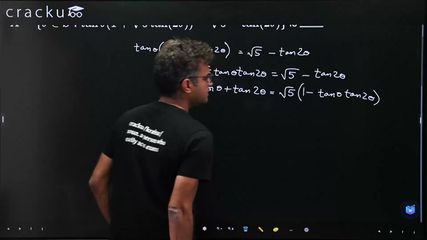
We rearrange the given equation. Starting from $$\tan\theta + \sqrt{5}\tan\theta\tan 2\theta = \sqrt{5} - \tan 2\theta$$, we move the $$\tan 2\theta$$ term to the left:
$$\tan\theta + \tan 2\theta = \sqrt{5} - \sqrt{5}\tan\theta\tan 2\theta = \sqrt{5}(1 - \tan\theta\tan 2\theta)$$
Dividing both sides by $$(1 - \tan\theta\tan 2\theta)$$ (which must be nonzero for the expression to be valid):
$$\frac{\tan\theta + \tan 2\theta}{1 - \tan\theta\tan 2\theta} = \sqrt{5}$$
The left side is exactly the tangent addition formula $$\tan(\theta + 2\theta) = \tan 3\theta$$. So we need $$\tan 3\theta = \sqrt{5}$$.
Let $$\alpha = \arctan(\sqrt{5})$$, where $$\alpha \in (0, \pi/2)$$ since $$\sqrt{5} > 0$$. The general solution of $$\tan 3\theta = \sqrt{5}$$ is $$3\theta = n\pi + \alpha$$ for integer $$n$$, giving:
$$\theta = \frac{n\pi + \alpha}{3}$$
We need $$\theta \in [-\pi, \pi/2)$$, so $$-\pi \leq \frac{n\pi + \alpha}{3} < \frac{\pi}{2}$$, which gives $$-3\pi \leq n\pi + \alpha < \frac{3\pi}{2}$$.
Since $$0 < \alpha < \pi/2$$: for the left inequality, $$n\pi \geq -3\pi - \alpha > -3\pi - \pi/2 = -7\pi/2$$, so $$n \geq -3$$ (since $$n = -3$$ gives $$-3\pi + \alpha > -3\pi$$, which satisfies $$\geq -3\pi$$). For the right inequality, $$n\pi < 3\pi/2 - \alpha < 3\pi/2$$, so $$n < 3/2$$, meaning $$n \leq 1$$.
This gives $$n \in \{-3, -2, -1, 0, 1\}$$, yielding 5 candidate solutions.
Now we verify none fall in the excluded set $$\{-\pi/2, -\pi/4, -3\pi/4, \pi/4\}$$. For each excluded value $$\theta_0$$, we check $$\tan 3\theta_0$$:
At $$\theta_0 = -\pi/2$$: $$3\theta_0 = -3\pi/2$$, where $$\tan$$ is undefined (not $$\sqrt{5}$$).
At $$\theta_0 = -\pi/4$$: $$\tan(-3\pi/4) = \tan(\pi/4) = 1 \neq \sqrt{5}$$.
At $$\theta_0 = -3\pi/4$$: $$\tan(-9\pi/4) = \tan(-\pi/4) = -1 \neq \sqrt{5}$$.
At $$\theta_0 = \pi/4$$: $$\tan(3\pi/4) = -1 \neq \sqrt{5}$$.
Since none of the excluded points satisfy our equation, no solutions are lost.
We also verify that $$\tan\theta$$ and $$\tan 2\theta$$ are defined at each solution. Since $$\tan 3\theta = \sqrt{5}$$ is finite, $$3\theta \neq \pi/2 + k\pi$$. For $$\tan\theta$$ to be undefined, we need $$\theta = \pi/2 + k\pi$$, which would make $$3\theta = 3\pi/2 + 3k\pi$$, but $$\tan(3\pi/2 + 3k\pi)$$ is undefined, not $$\sqrt{5}$$. Similarly for $$\tan 2\theta$$: if $$2\theta = \pi/2 + k\pi$$, then $$\theta = \pi/4 + k\pi/2$$, giving $$3\theta = 3\pi/4 + 3k\pi/2$$, and $$\tan(3\pi/4) = -1 \neq \sqrt{5}$$. So all 5 solutions have both $$\tan\theta$$ and $$\tan 2\theta$$ well-defined.
Hence, the correct answer is 5.
Was this solution helpful?
Click on the Email ☝️ to Watch the Video Solution
Create a FREE account and get:
_1.webp)

Educational materials for JEE preparation

Ask our AI anything

AI can make mistakes. Please verify important information.
AI can make mistakes. Please verify important information.
