
Join Our JEE Preparation Group
Prep with like-minded aspirants; Get access to free daily tests and study material.
Sign in
Please select an account to continue using cracku.in
↓ →
Join Our JEE Preparation Group
Prep with like-minded aspirants; Get access to free daily tests and study material.
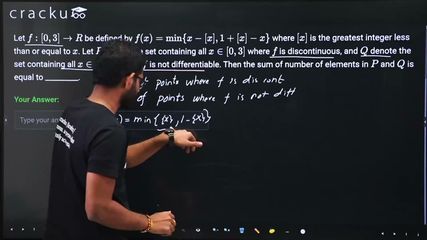
Let $$f : [0, 3] \rightarrow R$$ be defined by $$f(x) = \min\{x - [x], 1 + [x] - x\}$$ where $$[x]$$ is the greatest integer less than or equal to $$x$$. Let $$P$$ denote the set containing all $$x \in [0, 3]$$ where $$f$$ is discontinuous, and $$Q$$ denote the set containing all $$x \in (0, 3)$$ where $$f$$ is not differentiable. Then the sum of number of elements in $$P$$ and $$Q$$ is equal to _________.
Correct Answer: 5
We have the function $$f:[0,3]\to\mathbb R$$ given by
$$f(x)=\min\{x-[x],\;1+[x]-x\},$$
where $$[x]$$ denotes the greatest integer less than or equal to $$x$$. For each integer $$n$$ with $$0\le n\le2$$, every point $$x$$ in the sub-interval $$[n,n+1)$$ satisfies $$[x]=n$$, so we may write
$$x-[x]=x-n\quad\text{and}\quad 1+[x]-x = 1+n-x.$$
If we introduce the fractional part $$\{x\}=x-n\;(0\le\{x\}<1)$$, then inside the same sub-interval we obtain the much simpler expression
$$f(x)=\min\{\{x\},\;1-\{x\}\}.$$
Now $$\{x\}$$ increases linearly from $$0$$ to $$1$$ while $$1-\{x\}$$ decreases linearly from $$1$$ to $$0$$. The smaller of the two is therefore
$$\{x\}\quad\text{when}\quad\{x\}\le\frac12,\qquad\text{and}\qquad1-\{x\}\quad\text{when}\quad\{x\}\ge\frac12.$$
Hence on each open unit interval $$(n,n+1)$$ the function assumes the piece-wise linear form
$$ f(x)= \begin{cases} \{x\}, & 0\le\{x\}\le\dfrac12,\\\\ 1-\{x\}, & \dfrac12\le\{x\}<1. \end{cases} $$
Continuity is checked first. At a non-end-point $$x$$ lying strictly between two consecutive integers, $$f$$ is given by one of the linear formulas above, so it is continuous there. At an integer $$k\;(k=0,1,2,3)$$ we have
$$\lim_{x\to k^-}f(x)=0,\qquad\lim_{x\to k^+}f(x)=0,$$
while directly from the definition
$$f(k)=\min\{k-k,\;1+k-k\}=0.$$
Since the left limit, the right limit and the value of the function coincide, $$f$$ is continuous at every integer as well. Thus the set
$$P=\{x\in[0,3]\mid f\text{ is discontinuous at }x\}$$
is empty, so $$|P|=0.$$
We now investigate differentiability. Inside each open interval $$(n,n+1)$$ we already have linear pieces, so the derivative exists there and equals
$$f'(x)= \begin{cases} 1, & 0<\{x\}<\dfrac12,\\\\ -1, & \dfrac12<\{x\}<1. \end{cases} $$
Possible trouble points are where these two formulas meet, namely where $$\{x\}=\dfrac12$$, and also the integers where two adjacent unit intervals meet.
(i) Points with fractional part ½.
Solving $$\{x\}=\dfrac12$$ in each interval $$(n,n+1)$$ gives
$$x=n+\dfrac12.$$
Within the domain $$[0,3]$$ this yields the three points
$$x=0.5,\;1.5,\;2.5.$$
At each of them the left derivative equals $$1$$ while the right derivative equals $$-1$$, so $$f$$ is not differentiable there.
(ii) Integer points.
At an integer $$k$$ the left derivative (coming from the slope $$-1$$ of the segment that ends at $$x=k$$) equals $$-1$$, whereas the right derivative (coming from the slope $$1$$ of the segment that starts at $$x=k$$) equals $$1$$. Therefore $$f$$ fails to be differentiable at every integer.
All integers in our closed interval are $$0,1,2,3$$, but the set
$$Q=\{x\in(0,3)\mid f\text{ is not differentiable at }x\}$$
excludes the endpoints $$0$$ and $$3$$. Consequently only $$1$$ and $$2$$ from the list above belong to $$Q$$.
Collecting everything lying strictly between $$0$$ and $$3$$, the non-differentiable points are
$$1,\;2,\;0.5,\;1.5,\;2.5,$$
so $$|Q|=5.$$
Finally, the required sum is
$$|P|+|Q| = 0 + 5 = 5.$$
Hence, the correct answer is Option 5.
Was this solution helpful?
Click on the Email ☝️ to Watch the Video Solution
Create a FREE account and get:
_1.webp)

Educational materials for JEE preparation

Ask our AI anything

AI can make mistakes. Please verify important information.
AI can make mistakes. Please verify important information.
