
Join Our JEE Preparation Group
Prep with like-minded aspirants; Get access to free daily tests and study material.
Sign in
Please select an account to continue using cracku.in
↓ →
Join Our JEE Preparation Group
Prep with like-minded aspirants; Get access to free daily tests and study material.
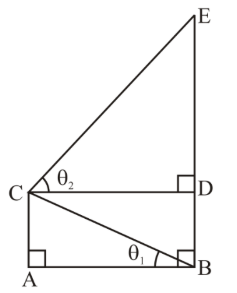
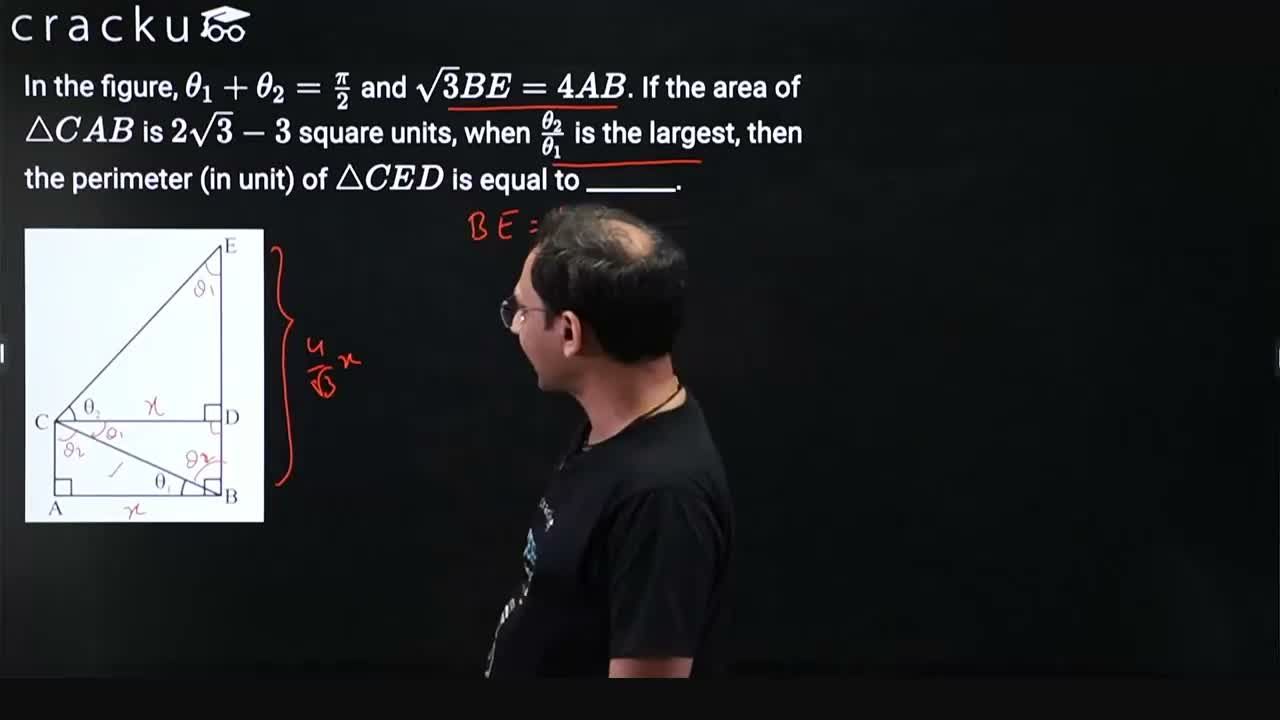
In the figure, $$\theta_1 + \theta_2 = \frac{\pi}{2}$$ and $$\sqrt{3}BE = 4AB$$. If the area of $$\triangle CAB$$ is $$2\sqrt{3} - 3$$ square units, when $$\frac{\theta_2}{\theta_1}$$ is the largest, then the perimeter (in unit) of $$\triangle CED$$ is equal to _______.
Correct Answer: 6
From the figure:
You are given that $$\sqrt{3}BE = 4AB$$, which means $$BE = \frac{4}{\sqrt{3}}AB$$.
From the geometry, $$BE = BD + DE$$.
Since $$BD = AC$$ (opposite sides of rectangle $$ACDB$$), we have:
$$BE = AB \tan \theta_1 + AB \cot \theta_1$$
$$\frac{4}{\sqrt{3}}AB = AB (\tan \theta_1 + \cot \theta_1)$$
$$\frac{4}{\sqrt{3}} = \frac{\sin \theta_1}{\cos \theta_1} + \frac{\cos \theta_1}{\sin \theta_1} = \frac{\sin^2 \theta_1 + \cos^2 \theta_1}{\sin \theta_1 \cos \theta_1} = \frac{1}{\sin \theta_1 \cos \theta_1}$$
$$\sin(2\theta_1) = 2 \sin \theta_1 \cos \theta_1 = 2 \left( \frac{\sqrt{3}}{4} \right) = \frac{\sqrt{3}}{2}$$
This gives two possible values for $$2\theta_1$$: $$60^\circ$$ or $$120^\circ$$.
The problem states $$\frac{\theta_2}{\theta_1}$$ is largest, so we choose $$\theta_1 = 30^\circ$$ and $$\theta_2 = 60^\circ$$.
Using the area of $$\triangle CAB$$:
$$\frac{1}{2} (AB)^2 \tan 30^\circ = 2\sqrt{3} - 3$$
$$\frac{1}{2} (AB)^2 \left( \frac{1}{\sqrt{3}} \right) = 2\sqrt{3} - 3$$
$$(AB)^2 = 2\sqrt{3}(2\sqrt{3} - 3) = 4(3) - 6\sqrt{3} = 12 - 6\sqrt{3}$$
Using the identity $$12 - 6\sqrt{3} = (3 - \sqrt{3})^2$$:
$$AB = 3 - \sqrt{3}$$
In $$\triangle CED$$ (a $$30^\circ-60^\circ-90^\circ$$ triangle with $$\theta_2 = 60^\circ$$):
Perimeter $$= CD + ED + CE$$:
$$(3 - \sqrt{3}) + (3\sqrt{3} - 3) + (6 - 2\sqrt{3})$$
$$3 - 3 + 6 - \sqrt{3} + 3\sqrt{3} - 2\sqrt{3}$$
$$6 + 0\sqrt{3} = 6$$
Final Answer: 6
Was this solution helpful?
Click on the Email ☝️ to Watch the Video Solution
Create a FREE account and get:
_1.webp)

Educational materials for JEE preparation

Ask our AI anything

AI can make mistakes. Please verify important information.
AI can make mistakes. Please verify important information.


