
Join Our JEE Preparation Group
Prep with like-minded aspirants; Get access to free daily tests and study material.
Sign in
Please select an account to continue using cracku.in
↓ →
Join Our JEE Preparation Group
Prep with like-minded aspirants; Get access to free daily tests and study material.
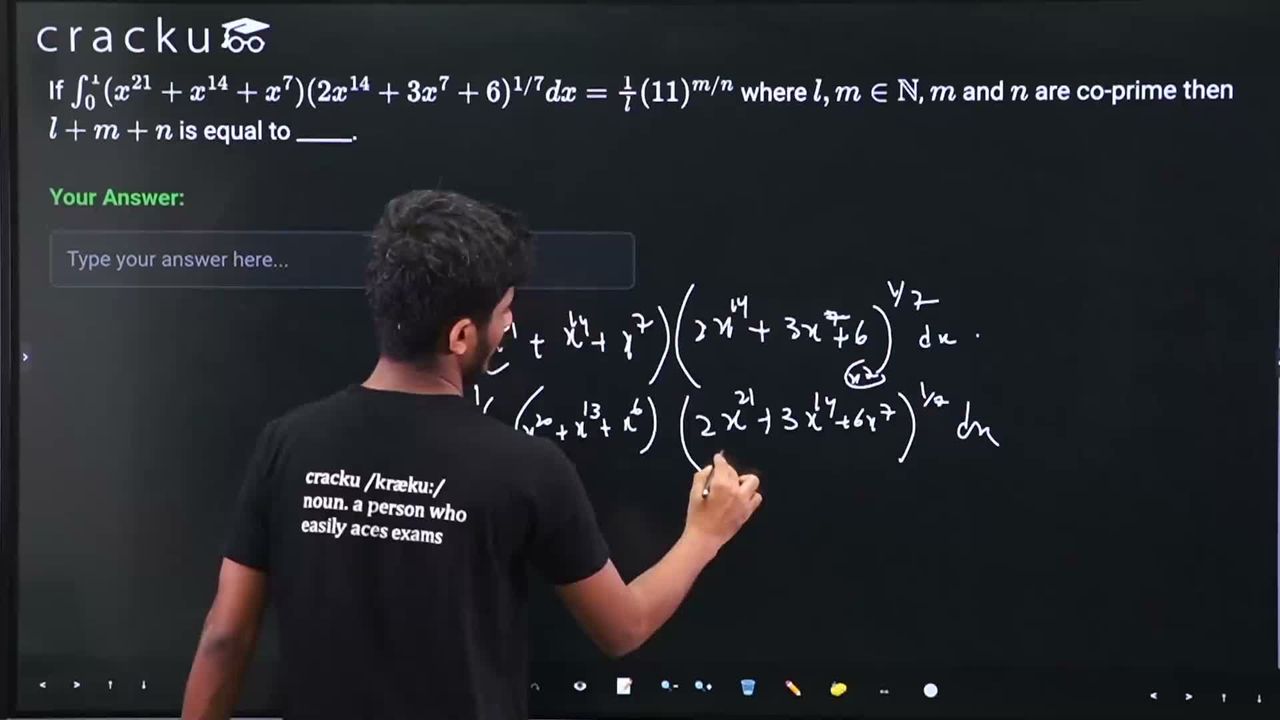
If $$\int_0^1 (x^{21} + x^{14} + x^7)(2x^{14} + 3x^7 + 6)^{1/7} dx = \frac{1}{l}(11)^{m/n}$$ where $$l, m \in \mathbb{N}$$, $$m$$ and $$n$$ are co-prime then $$l + m + n$$ is equal to _____.
Correct Answer: 63
We need to evaluate: $$\int_0^1 (x^{21} + x^{14} + x^7)(2x^{14} + 3x^7 + 6)^{1/7}\, dx$$
Let $$v = 2x^{21} + 3x^{14} + 6x^7$$. Then:
$$ \frac{dv}{dx} = 42x^{20} + 42x^{13} + 42x^6 = 42x^6(x^{14} + x^7 + 1) $$
Note that the integrand can be rewritten. Factor $$x^7$$ from the cubic bracket:
$$ 2x^{14} + 3x^7 + 6 = \frac{2x^{21} + 3x^{14} + 6x^7}{x^7} = \frac{v}{x^7} $$
Also, $$(x^{21} + x^{14} + x^7) = x^7(x^{14} + x^7 + 1)$$.
The integral becomes:
$$ \int_0^1 x^7(x^{14} + x^7 + 1) \cdot \left(\frac{v}{x^7}\right)^{1/7} dx = \int_0^1 x^7 \cdot \frac{x^{14} + x^7 + 1}{1} \cdot \frac{v^{1/7}}{x} \, dx $$
$$ = \int_0^1 x^6(x^{14} + x^7 + 1) \cdot v^{1/7}\, dx = \int_0^1 v^{1/7} \cdot \frac{dv}{42} $$
$$ = \frac{1}{42} \cdot \frac{v^{8/7}}{8/7}\Big|_0^1 = \frac{1}{48} v^{8/7}\Big|_0^1 $$
At $$x = 1$$: $$v = 2 + 3 + 6 = 11$$. At $$x = 0$$: $$v = 0$$.
$$ = \frac{1}{48} \cdot 11^{8/7} $$
So $$l = 48$$, $$m = 8$$, $$n = 7$$ (which are coprime).
$$ l + m + n = 48 + 8 + 7 = 63 $$
Therefore, the answer is 63.
Was this solution helpful?
Click on the Email ☝️ to Watch the Video Solution
Create a FREE account and get:
_1.webp)

Educational materials for JEE preparation

Ask our AI anything

AI can make mistakes. Please verify important information.
AI can make mistakes. Please verify important information.
