
Join Our JEE Preparation Group
Prep with like-minded aspirants; Get access to free daily tests and study material.
Sign in
Please select an account to continue using cracku.in
↓ →
Join Our JEE Preparation Group
Prep with like-minded aspirants; Get access to free daily tests and study material.
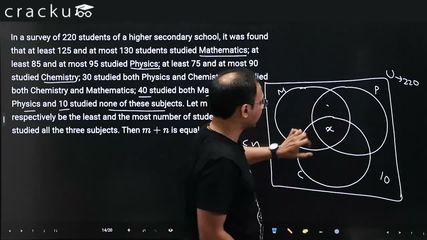
In a survey of 220 students of a higher secondary school, it was found that at least 125 and at most 130 students studied Mathematics; at least 85 and at most 95 studied Physics; at least 75 and at most 90 studied Chemistry; 30 studied both Physics and Chemistry; 50 studied both Chemistry and Mathematics; 40 studied both Mathematics and Physics and 10 studied none of these subjects. Let m and n respectively be the least and the most number of students who studied all the three subjects. Then $$m + n$$ is equal to ______.
Correct Answer: 45
Using inclusion-exclusion: |M∪P∪C| = |M|+|P|+|C|-|M∩P|-|P∩C|-|M∩C|+|M∩P∩C|
Students studying at least one = 220 - 10 = 210
210 = |M|+|P|+|C| - 40 - 30 - 50 + |M∩P∩C|
|M|+|P|+|C| + |M∩P∩C| = 330
Min sum: 125+85+75 = 285, max sum: 130+95+90 = 315
Min |M∩P∩C| = 330-315 = 15, Max |M∩P∩C| = 330-285 = 45
But we also need each pairwise intersection ≥ triple intersection.
Max triple ≤ min(40,30,50) = 30
So m = 15, n = 30, m+n = 45
The answer is 45.
Was this solution helpful?
Click on the Email ☝️ to Watch the Video Solution
Create a FREE account and get:
_1.webp)

Educational materials for JEE preparation

Ask our AI anything

AI can make mistakes. Please verify important information.
AI can make mistakes. Please verify important information.
