
Join Our JEE Preparation Group
Prep with like-minded aspirants; Get access to free daily tests and study material.
Sign in
Please select an account to continue using cracku.in
↓ →
Join Our JEE Preparation Group
Prep with like-minded aspirants; Get access to free daily tests and study material.
If $$\lim_{x\to 1}\frac{(5x+1)^{1/3}-(x+5)^{1/3}}{(2x+3)^{1/2}-(x+4)^{1/2}} = \frac{m\sqrt{5}}{n(2n)^{2/3}}$$, where gcd(m, n) = 1, then $$8m + 12n$$ is equal to ______.
Correct Answer: 100
Using L'Hôpital or Taylor series for the limit as x→1:
Let f(x) = $$(5x+1)^(1/3)-(x+5)^(1/3) $$ and $$g(x)=(2x+3)^(1/2)-(x+4)^(1/2)$$
f(1) = $$6^(1/3)-6^(1/3)=0,g(1)=5^(1/2)-5^(1/2)$$= 0
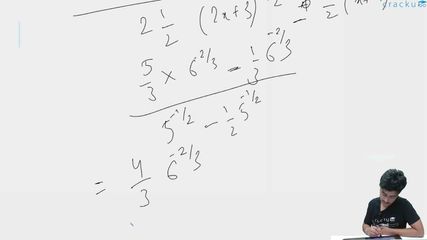
f'(x) =$$5/(3(5x+1)^(2/3))-1/(3(x+5)^(2/3))$$
f'(1) = $$5/(3·6^(2/3))-1/(3·6^(2/3))=4/(3·6^(2/3))$$
g'(x) =$$1/\sqrt{(}2x+3)-1/(2\sqrt{(}x+4))$$
g'(1) = $$1/\sqrt{5}-1/(2\sqrt{5})=1/(2\sqrt{5})$$
Limit = $$f'(1)/g'(1)=[4/(3·6^(2/3))]·[2\sqrt{5}/1]=8\sqrt{5}/(3·6^(2/3))$$
= $$8\sqrt{5}/(3·(2·3)^(2/3))=8\sqrt{5}/(3·2^(2/3)·3^(2/3))=8\sqrt{5}/(3^(5/3)·2^(2/3))$$
Comparing with$$m\sqrt{5}/(n·(2n)^(2/3)$$): we need n such that $$n·(2n)^(2/3)=3^(5/3)·2^(2/3)$$
Try n=3: 3·6^(2/3) = 3·6^(2/3) = 3^(5/3)·2^(2/3) ✓ (since 3·(2·3)^(2/3) = 3·2^(2/3)·3^(2/3) = 3^(5/3)·2^(2/3))
So m = 8, n = 3, $$\gcd(8,3)=1✓$$
8m+12n = 64+36 = 100
Was this solution helpful?
Click on the Email ☝️ to Watch the Video Solution
Create a FREE account and get:
_1.webp)

Educational materials for JEE preparation

Ask our AI anything

AI can make mistakes. Please verify important information.
AI can make mistakes. Please verify important information.
