
Join Our JEE Preparation Group
Prep with like-minded aspirants; Get access to free daily tests and study material.
Sign in
Please select an account to continue using cracku.in
↓ →
Join Our JEE Preparation Group
Prep with like-minded aspirants; Get access to free daily tests and study material.
If the system of equations $$2x + 7y + \lambda z = 3$$, $$3x + 2y + 5z = 4$$, $$x + \mu y + 32z = -1$$ has infinitely many solutions, then $$(\lambda - \mu)$$ is equal to ___________
Correct Answer: 38
To have infinitely many solutions, the coefficient matrix must be singular (det = 0) and the augmented matrix must have the same rank as the coefficient matrix.
The coefficient matrix is $$A = \begin{pmatrix}2 & 7 & \lambda \\ 3 & 2 & 5 \\ 1 & \mu & 32\end{pmatrix}$$ and its determinant $$\Delta = \det(A)$$ can be found by expansion along the first row: $$\Delta = 2\bigl(2\cdot 32 - 5\mu\bigr)\;-\;7\bigl(3\cdot 32 - 5\cdot 1\bigr)\;+\;\lambda\bigl(3\mu - 2\cdot 1\bigr).$$
Computing each term yields $$2(64 - 5\mu) = 128 - 10\mu$$, $$7(96 - 5) = 7\cdot 91 = 637$$, and $$\lambda(3\mu - 2)$$. Thus
$$\Delta = 128 - 10\mu \;-\; 637\;+\;\lambda(3\mu - 2) = -509 - 10\mu + \lambda(3\mu - 2). \quad-(1)$$
For infinitely many solutions, $$\Delta = 0$$, so
$$\lambda(3\mu - 2) = 509 + 10\mu. \quad-(2)$$
The augmented matrix determinant must also be zero.
$$\det\begin{pmatrix}2 & 7 & 3\\3 & 2 & 4\\1 & \mu & -1\end{pmatrix} = 0.$$
Expansion along the first row gives
$$2\bigl(2\cdot(-1) - 4\mu\bigr)\;-\;7\bigl(3\cdot(-1)-4\cdot1\bigr)\;+\;3\bigl(3\mu - 2\cdot1\bigr).$$
Evaluating each term: $$2(-2 - 4\mu) = -4 - 8\mu$$, $$-7(-3 - 4) = 49$$, and $$3(3\mu - 2) = 9\mu - 6$$. Summing gives
$$-4 - 8\mu + 49 + 9\mu - 6 = 39 + \mu.$$
Setting this to zero yields
$$39 + \mu = 0 \quad\Longrightarrow\quad \mu = -39. \quad-(3)$$
Substituting $$\mu = -39$$ into equation $$(2)$$ gives
$$\lambda\bigl(3(-39) - 2\bigr) = 509 + 10(-39).$$
Since $$3(-39) - 2 = -119$$ and $$509 - 390 = 119$$, it follows that
$$-119\,\lambda = 119\quad\Longrightarrow\quad \lambda = -1. \quad-(4)$$
Finally,
$$\lambda - \mu = (-1) - (-39) = 38.$$
Final Answer: $$\lambda - \mu = 38.$$
Was this solution helpful?
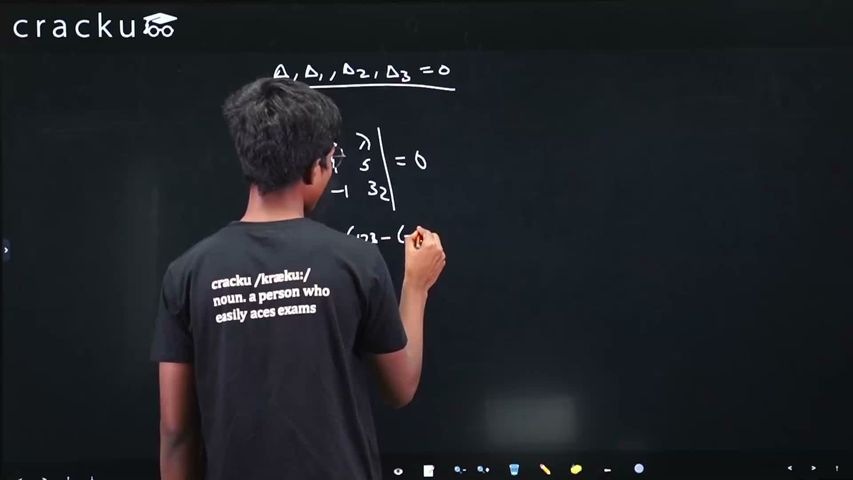
Click on the Email ☝️ to Watch the Video Solution
Create a FREE account and get:
_1.webp)

Educational materials for JEE preparation

Ask our AI anything

AI can make mistakes. Please verify important information.
AI can make mistakes. Please verify important information.
