
Join Our JEE Preparation Group
Prep with like-minded aspirants; Get access to free daily tests and study material.
Sign in
Please select an account to continue using cracku.in
↓ →
Join Our JEE Preparation Group
Prep with like-minded aspirants; Get access to free daily tests and study material.
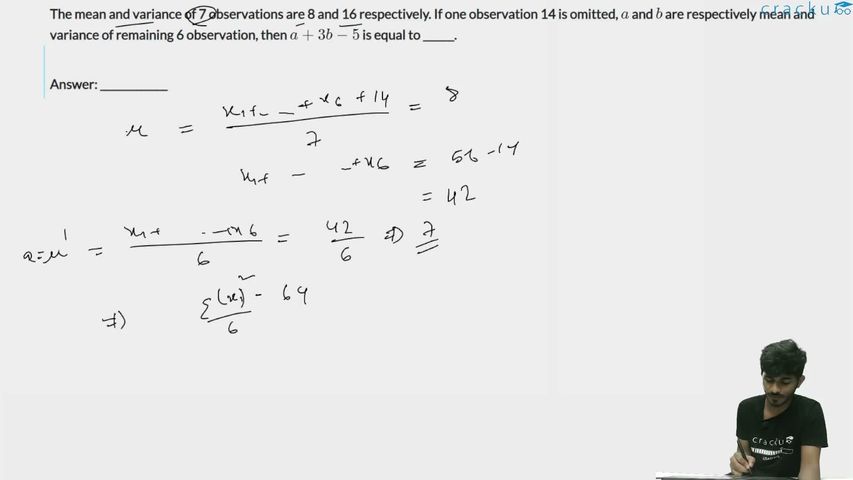
The mean and variance of 7 observations are 8 and 16 respectively. If one observation 14 is omitted, $$a$$ and $$b$$ are respectively mean and variance of remaining 6 observation, then $$a + 3b - 5$$ is equal to ______.
Correct Answer: 37
We have 7 observations with mean 8 and variance 16, and one observation, 14, is removed.
The sum of the 7 observations is $$7 \times 8 = 56$$. After removing 14, the sum of the remaining 6 observations becomes $$56 - 14 = 42$$, so their mean is $$a = \frac{42}{6} = 7$$.
Recall that variance is given by $$\frac{\sum x_i^2}{n} - \bar{x}^2$$. For the original 7 observations, $$16 = \frac{\sum x_i^2}{7} - 64$$ implies $$\sum x_i^2 = 7 \times 80 = 560$$. After removing 14, the sum of squares is $$560 - 14^2 = 560 - 196 = 364$$. Therefore, the variance of the remaining observations is $$b = \frac{364}{6} - 49 = \frac{364 - 294}{6} = \frac{70}{6} = \frac{35}{3}$$.
Finally, we compute $$a + 3b - 5 = 7 + 3 \times \frac{35}{3} - 5 = 7 + 35 - 5 = 37$$, so the answer is $$\boxed{37}$$.
Was this solution helpful?
Click on the Email ☝️ to Watch the Video Solution
Create a FREE account and get:
_1.webp)

Educational materials for JEE preparation

Ask our AI anything

AI can make mistakes. Please verify important information.
AI can make mistakes. Please verify important information.


