
Join Our JEE Preparation Group
Prep with like-minded aspirants; Get access to free daily tests and study material.
Sign in
Please select an account to continue using cracku.in
↓ →
Join Our JEE Preparation Group
Prep with like-minded aspirants; Get access to free daily tests and study material.
Let the domain of the function $$f(x) = \log_4(\log_5(\log_3(18x - x^2 - 77)))$$ be $$(a, b)$$. Then the value of the integral $$\int_a^b \frac{\sin^3 x}{\sin^3 x + \sin^3(a + b - x)}$$ is equal to _________.
Correct Answer: 1
We begin with the innermost expression of the given composite logarithmic function
$$f(x)=\log_{4}\!\bigl(\,\log_{5}\!\bigl(\,\log_{3}(18x-x^{2}-77)\bigr)\bigr).$$
For a logarithm to be defined, its argument must be strictly positive. We therefore impose the following conditions one after another.
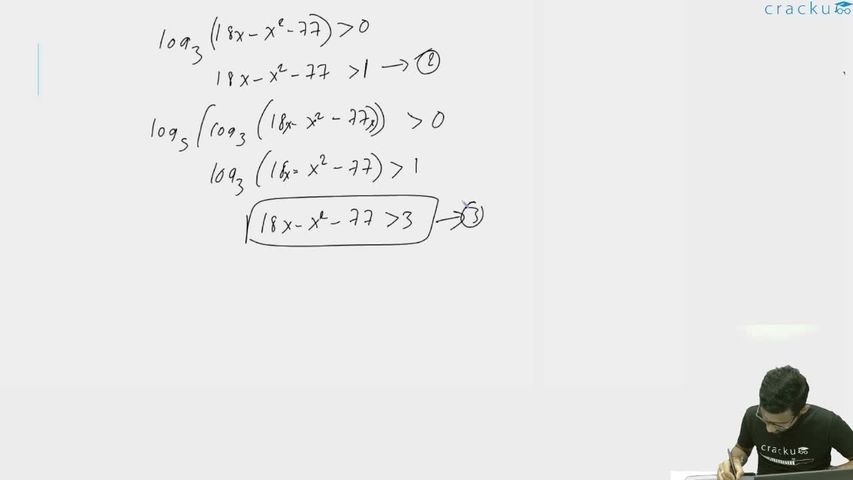
Step 1 : From the innermost logarithm we must have
$$18x-x^{2}-77 \;>\;0.$$
Step 2 : Because the result of that logarithm becomes the argument of the next one, the second condition is
$$\log_{3}(18x-x^{2}-77)\;>\;0.$$
Recall the basic fact: for any base greater than 1, we have $$\log_{b}(y)>0 \iff y>1.$$ Hence Step 2 is equivalent to
$$18x-x^{2}-77 \;>\;1.$$
Step 3 : The value of the second logarithm in turn becomes the argument of the outermost logarithm, so we also require
$$\log_{5}\!\bigl(\log_{3}(18x-x^{2}-77)\bigr)\;>\;0.$$
Using the same fact again, this means
$$\log_{3}(18x-x^{2}-77)\;>\;1,$$
which is equivalent to
$$18x-x^{2}-77\;>\;3.$$ This last inequality is the strongest, so it alone fixes the domain.
Re-arranging it, we write
$$18x-x^{2}-77-3 \;>\;0 \;\Longrightarrow\; -x^{2}+18x-80 \;>\;0.$$
Multiplying by −1 (and reversing the inequality sign) gives
$$x^{2}-18x+80\;<\;0.$$
Now we factor the quadratic:
$$x^{2}-18x+80 = x^{2}-10x-8x+80 = x(x-10)-8(x-10) = (x-8)(x-10).$$
Because the parabola opens upwards, the quadratic expression is negative strictly between its roots. Therefore
$$(x-8)(x-10)\;<\;0 \;\Longrightarrow\; 8\;<\;x\;<\;10.$$
Thus the domain of $$f(x)$$ is the open interval $$(a,b)=(8,10).$$
Next we must evaluate the integral
$$I \;=\;\int_{a}^{b}\! \frac{\sin^{3}x}{\sin^{3}x+\sin^{3}(a+b-x)} \,dx \;=\; \int_{8}^{10}\! \frac{\sin^{3}x}{\sin^{3}x+\sin^{3}(18-x)} \,dx.$$
Let us define for convenience
$$F(x)\;=\;\frac{\sin^{3}x}{\sin^{3}x+\sin^{3}(18-x)}, \qquad 8<x<10,$$
so that $$I=\int_{8}^{10} F(x)\,dx.$$
We now exploit the symmetry in the integrand. Compute $$F(18-x):$$
$$F(18-x) =\frac{\sin^{3}(18-x)}{\sin^{3}(18-x)+\sin^{3}(x)}.$$
Adding $$F(x)$$ and $$F(18-x)$$ we obtain
$$F(x)+F(18-x) =\frac{\sin^{3}x}{\sin^{3}x+\sin^{3}(18-x)} +\frac{\sin^{3}(18-x)}{\sin^{3}x+\sin^{3}(18-x)} =\frac{\sin^{3}x+\sin^{3}(18-x)}{\sin^{3}x+\sin^{3}(18-x)} =1.$$
Consequently, for every $$x$$ in $$(8,10)$$ we have
$$F(x)+F(18-x)=1.$$
We now perform the substitution $$t=18-x$$ in the integral for $$I$$:
For $$x=8, \; t=10$$ and for $$x=10, \; t=8,$$ while $$dx=-dt.$$ Hence
$$I =\int_{8}^{10}F(x)\,dx =\int_{10}^{8}F(18-t)\,(-dt) =\int_{8}^{10}F(18-t)\,dt =\int_{8}^{10}F(18-x)\,dx.$$
Adding this last equality to the original expression for $$I$$ gives
$$2I =\int_{8}^{10}\!\bigl(F(x)+F(18-x)\bigr)\,dx =\int_{8}^{10}1\,dx =10-8 =2.$$
Dividing by 2 we arrive at
$$I=1.$$
Hence, the correct answer is Option 1.
Was this solution helpful?
Click on the Email ☝️ to Watch the Video Solution
Create a FREE account and get:
_1.webp)

Educational materials for JEE preparation

Ask our AI anything

AI can make mistakes. Please verify important information.
AI can make mistakes. Please verify important information.
