
Join Our JEE Preparation Group
Prep with like-minded aspirants; Get access to free daily tests and study material.
Sign in
Please select an account to continue using cracku.in
↓ →
Join Our JEE Preparation Group
Prep with like-minded aspirants; Get access to free daily tests and study material.
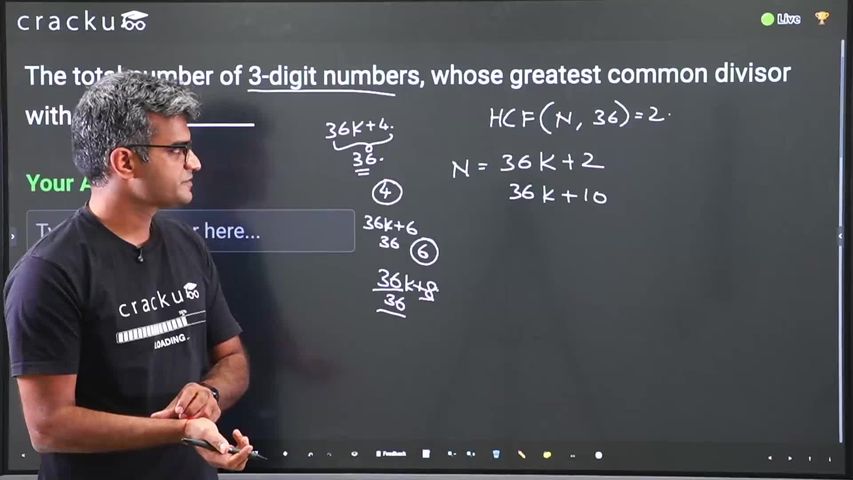
The total number of 3-digit numbers, whose greatest common divisor with 36 is 2, is ______
Correct Answer: 150
We need to find the total number of 3-digit numbers whose GCD with 36 is 2.
First, factorizing 36 gives $$36 = 2^2 \times 3^2$$.
Next, for $$\gcd(n, 36) = 2$$, we require $$n$$ to be even but not divisible by 4 (so that the highest power of 2 dividing the GCD is exactly $$2^1$$), and also not divisible by 3. In other words, $$n = 2m$$ where $$m$$ is odd and not divisible by 3.
Now, considering 3-digit numbers with $$100 \le 2m \le 999$$, we get $$50 \le m \le 499$$.
Since $$m$$ must be odd and not divisible by 3, we first count the odd integers from 51 to 499, which number $$\frac{499 - 51}{2} + 1 = 225$$.
Subsequently, we remove the odd multiples of 3 in the same range. These are numbers of the form $$3k$$ where $$k$$ is odd and $$51 \le 3k \le 499$$. The smallest such number is 51 ($$= 3 \times 17$$) and the largest is 495 ($$= 3 \times 165$$), giving the sequence $$3 \times 17, 3 \times 19, \dots, 3 \times 165$$, which has $$\frac{165 - 17}{2} + 1 = 75$$ terms.
Therefore, the total count is $$225 - 75 = 150$$, so the answer is $$150$$.
Was this solution helpful?
Click on the Email ☝️ to Watch the Video Solution
Create a FREE account and get:
_1.webp)

Educational materials for JEE preparation

Ask our AI anything

AI can make mistakes. Please verify important information.
AI can make mistakes. Please verify important information.
