
Join Our JEE Preparation Group
Prep with like-minded aspirants; Get access to free daily tests and study material.
Sign in
Please select an account to continue using cracku.in
↓ →
Join Our JEE Preparation Group
Prep with like-minded aspirants; Get access to free daily tests and study material.
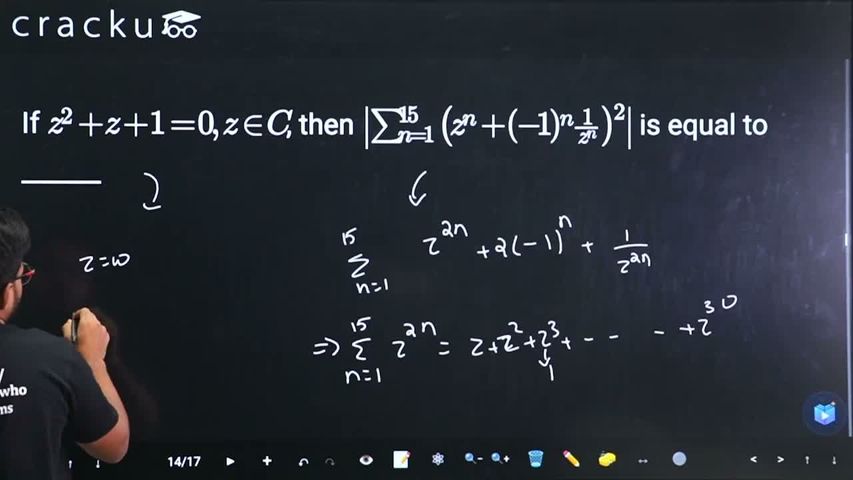
If $$z^2 + z + 1 = 0, z \in C$$, then $$\left|\sum_{n=1}^{15}\left(z^n + (-1)^n \frac{1}{z^n}\right)^2\right|$$ is equal to ______
Correct Answer: 2
Given $$z^2 + z + 1 = 0$$, find $$\left|\displaystyle\sum_{n=1}^{15}\left(z^n + (-1)^n \frac{1}{z^n}\right)^2\right|$$.
First, since $$z^2 + z + 1 = 0$$, $$z$$ is a primitive cube root of unity ($$z = \omega$$), so $$z^3 = 1$$ and $$|z| = 1$$, hence $$\frac{1}{z^n} = \bar{z}^n = z^{-n}$$.
Next, expanding the square gives $$\left(z^n + (-1)^n z^{-n}\right)^2 = z^{2n} + 2(-1)^n + z^{-2n}$$.
Now summing from $$n = 1$$ to $$15$$ yields $$ S = \sum_{n=1}^{15} z^{2n} + 2\sum_{n=1}^{15}(-1)^n + \sum_{n=1}^{15} z^{-2n}. $$
Since $$z^3 = 1$$, the terms $$z^{2n}$$ cycle every three values: $$z^2 + z^4 + z^6 + \cdots = (z^2 + z + 1) + (z^2 + z + 1) + \cdots$$. Each group sums to $$z^2 + z + 1 = 0$$ and with 15 terms (5 full cycles) one gets $$\sum_{n=1}^{15} z^{2n} = 0$$. Similarly, $$\sum_{n=1}^{15} z^{-2n} = 0$$.
For the alternating sum, one finds $$\sum_{n=1}^{15}(-1)^n = -1 + 1 - 1 + \cdots - 1 = -1$$ as there are 15 terms beginning with $$-1$$.
Therefore, $$ S = 0 + 2(-1) + 0 = -2, $$ so $$|S| = |-2| = 2$$.
Hence the answer is $$2$$.
Was this solution helpful?
Click on the Email ☝️ to Watch the Video Solution
Create a FREE account and get:
_1.webp)

Educational materials for JEE preparation

Ask our AI anything

AI can make mistakes. Please verify important information.
AI can make mistakes. Please verify important information.
