
Join Our JEE Preparation Group
Prep with like-minded aspirants; Get access to free daily tests and study material.
Sign in
Please select an account to continue using cracku.in
↓ →
Join Our JEE Preparation Group
Prep with like-minded aspirants; Get access to free daily tests and study material.
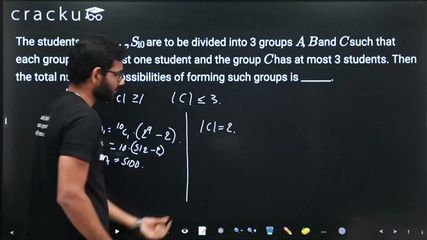
The students $$S_1, S_2, \ldots, S_{10}$$ are to be divided into 3 groups $$A$$, $$B$$ and $$C$$ such that each group has at least one student and the group $$C$$ has at most 3 students. Then the total number of possibilities of forming such groups is ______.
Correct Answer: 31650
We need to divide 10 students $$S_1, S_2, \ldots, S_{10}$$ into three groups $$A$$, $$B$$, and $$C$$ such that each group has at least one student and $$|C| \leq 3$$. We count by the size of group $$C$$.
When $$|C| = 1$$: We choose 1 student for $$C$$ in $$\binom{10}{1} = 10$$ ways. The remaining 9 students must be divided into non-empty groups $$A$$ and $$B$$, which can be done in $$2^9 - 2 = 510$$ ways (each student goes to $$A$$ or $$B$$, excluding the cases where all go to $$A$$ or all go to $$B$$). This gives $$10 \times 510 = 5100$$.
When $$|C| = 2$$: We choose 2 students for $$C$$ in $$\binom{10}{2} = 45$$ ways. The remaining 8 students are divided into non-empty $$A$$ and $$B$$ in $$2^8 - 2 = 254$$ ways. This gives $$45 \times 254 = 11430$$.
When $$|C| = 3$$: We choose 3 students for $$C$$ in $$\binom{10}{3} = 120$$ ways. The remaining 7 students are divided into non-empty $$A$$ and $$B$$ in $$2^7 - 2 = 126$$ ways. This gives $$120 \times 126 = 15120$$.
The total number of possibilities is $$5100 + 11430 + 15120 = 31650$$.
The correct answer is $$31650$$.
Was this solution helpful?
Click on the Email ☝️ to Watch the Video Solution
Create a FREE account and get:
_1.webp)

Educational materials for JEE preparation

Ask our AI anything

AI can make mistakes. Please verify important information.
AI can make mistakes. Please verify important information.


