
Join Our JEE Preparation Group
Prep with like-minded aspirants; Get access to free daily tests and study material.
Sign in
Please select an account to continue using cracku.in
↓ →
Join Our JEE Preparation Group
Prep with like-minded aspirants; Get access to free daily tests and study material.
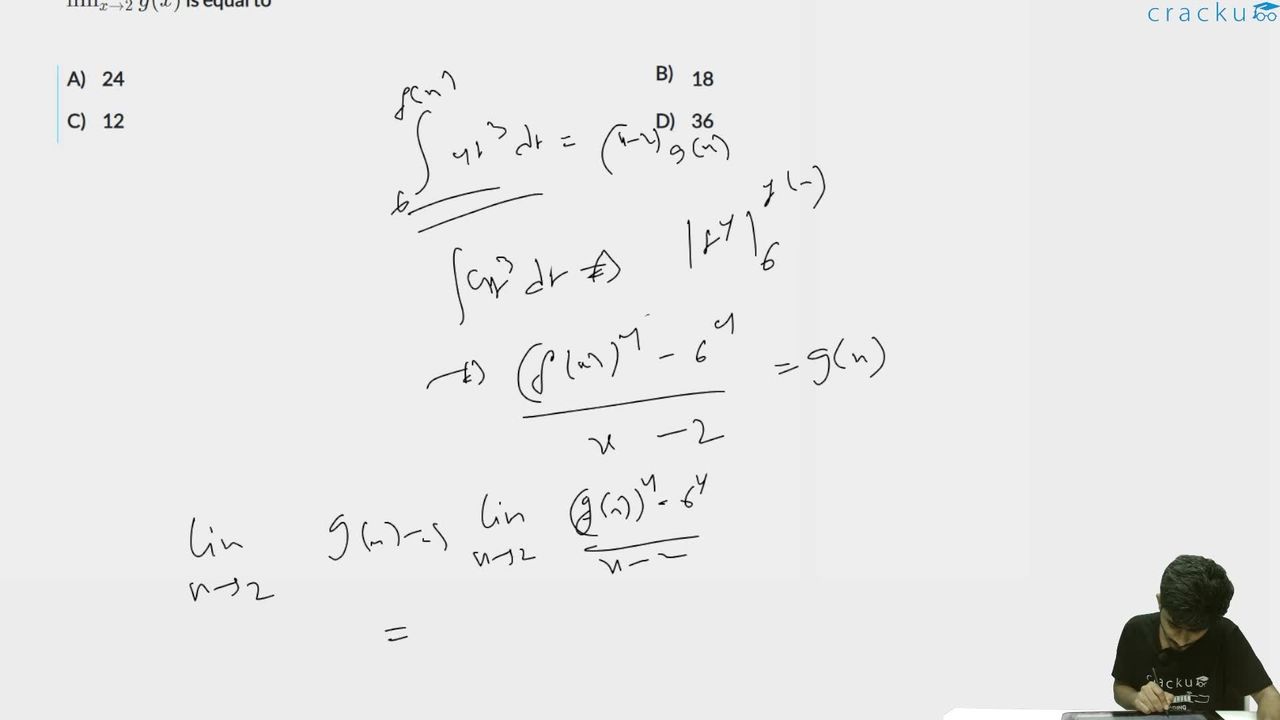
Let $$f: R \to R$$ be a continuous and differentiable function such that $$f(2) = 6$$ and $$f'(2) = \frac{1}{48}$$. If $$\int_6^{f(x)}4t^3dt=\left(x-2\right)g(x)$$, then $$\lim_{x \to 2} g(x)$$ is equal to
We are given that for every real number $$x$$
$$\displaystyle \int_{6}^{\,f(x)} 4t^{3}\,dt=(x-2)\,g(x)$$
The left-hand side is an integral of the form $$\int 4t^{3}\,dt$$. We first recall the elementary antiderivative formula
$$\int 4t^{3}\,dt = t^{4}+C,$$
because differentiating $$t^{4}$$ gives $$4t^{3}$$. Using this, the definite integral from $$6$$ to $$f(x)$$ can be evaluated as
$$\displaystyle \int_{6}^{\,f(x)} 4t^{3}\,dt =\bigl[t^{4}\bigr]_{6}^{f(x)} =f(x)^{4}-6^{4}.$$
Hence the given relation becomes
$$f(x)^{4}-6^{4}=(x-2)\,g(x). \quad -(1)$$
We also know the values of the function and its derivative at $$x=2$$:
$$f(2)=6,\qquad f'(2)=\dfrac{1}{48}.$$
Notice that when we substitute $$x=2$$ in (1), both sides are zero:
$$f(2)^{4}-6^{4}=6^{4}-6^{4}=0,\qquad (2-2)\,g(2)=0.$$
Thus equation (1) gives the indeterminate form $$0=0$$ at $$x=2$$. To extract information about $$g(x)$$ near $$x=2$$, we differentiate both sides of (1) with respect to $$x$$.
For the left side, we apply the chain rule:
$$\dfrac{d}{dx}\bigl[f(x)^{4}-6^{4}\bigr]=4f(x)^{3}\,f'(x).$$
For the right side, we use the product rule for $$\,(x-2)g(x)\,,$$ namely $$\dfrac{d}{dx}\bigl[(x-2)g(x)\bigr]=g(x)+(x-2)g'(x).$$
Differentiating (1) therefore gives
$$4f(x)^{3}\,f'(x)=g(x)+(x-2)g'(x). \quad -(2)$$
We now let $$x\to2$$ in (2). Because $$x-2\to0$$, the last term on the right vanishes:
$$\lim_{x\to2}\bigl[(x-2)g'(x)\bigr]=0.$$
Taking the limit of both sides of (2) as $$x\to2$$, we have
$$\lim_{x\to2}4f(x)^{3}f'(x)=\lim_{x\to2}g(x).$$
The left limit can be evaluated directly using the given values:
$$4f(2)^{3}f'(2)=4\bigl(6\bigr)^{3}\left(\dfrac{1}{48}\right) =4\cdot216\cdot\dfrac{1}{48}.$$
Performing the arithmetic step by step, we first multiply the numerator numbers:
$$4\times216=864,$$
and then divide by $$48$$:
$$\dfrac{864}{48}=18.$$
Hence
$$\lim_{x\to2}g(x)=18.$$
Therefore the required limit equals $$18$$.
Hence, the correct answer is Option B.
Was this solution helpful?
Click on the Email ☝️ to Watch the Video Solution
Create a FREE account and get:
_1.webp)

Educational materials for JEE preparation

Ask our AI anything

AI can make mistakes. Please verify important information.
AI can make mistakes. Please verify important information.
