
Join Our JEE Preparation Group
Prep with like-minded aspirants; Get access to free daily tests and study material.
Sign in
Please select an account to continue using cracku.in
↓ →
Join Our JEE Preparation Group
Prep with like-minded aspirants; Get access to free daily tests and study material.
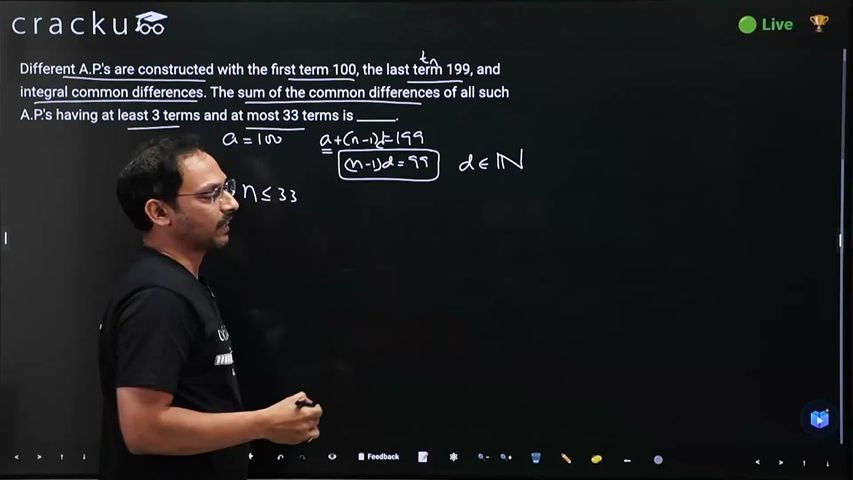
Different A.P.'s are constructed with the first term 100, the last term 199, and integral common differences. The sum of the common differences of all such A.P.'s having at least 3 terms and at most 33 terms is ______.
Correct Answer: 53
We need to find the sum of all integral common differences $$d$$ of A.P.'s with first term $$a = 100$$, last term $$l = 199$$, having at least 3 and at most 33 terms.
For an A.P. with $$n$$ terms: $$l = a + (n-1)d$$
$$199 = 100 + (n-1)d \implies (n-1)d = 99$$
We need $$d$$ to be a positive integer (since $$l > a$$) and $$(n-1) = \dfrac{99}{d}$$ must be a positive integer, so $$d$$ must divide 99.
Also, $$3 \leq n \leq 33$$, which means $$2 \leq n-1 \leq 32$$, so $$2 \leq \dfrac{99}{d} \leq 32$$.
$$99 = 9 \times 11 = 3^2 \times 11$$
Divisors of 99: 1, 3, 9, 11, 33, 99.
For each divisor $$d$$, compute $$n - 1 = 99/d$$:
$$d = 1$$: $$n-1 = 99$$, $$n = 100 > 33$$. Not valid.
$$d = 3$$: $$n-1 = 33$$, $$n = 34 > 33$$. Not valid.
$$d = 9$$: $$n-1 = 11$$, $$n = 12$$. Valid ($$3 \leq 12 \leq 33$$).
$$d = 11$$: $$n-1 = 9$$, $$n = 10$$. Valid.
$$d = 33$$: $$n-1 = 3$$, $$n = 4$$. Valid.
$$d = 99$$: $$n-1 = 1$$, $$n = 2 < 3$$. Not valid.
$$9 + 11 + 33 = 53$$
The correct answer is $$\boxed{53}$$.
Was this solution helpful?
Click on the Email ☝️ to Watch the Video Solution
Create a FREE account and get:
_1.webp)

Educational materials for JEE preparation

Ask our AI anything

AI can make mistakes. Please verify important information.
AI can make mistakes. Please verify important information.
