
Join Our JEE Preparation Group
Prep with like-minded aspirants; Get access to free daily tests and study material.
Sign in
Please select an account to continue using cracku.in
↓ →
Join Our JEE Preparation Group
Prep with like-minded aspirants; Get access to free daily tests and study material.
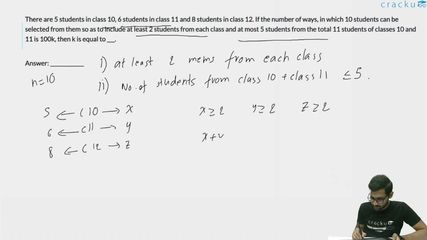
There are 5 students in class 10, 6 students in class 11 and 8 students in class 12. If the number of ways, in which 10 students can be selected from them so as to include at least 2 students from each class and at most 5 students from the total 11 students of classes 10 and 11 is 100k, then k is equal to ___.
Correct Answer: 238
We have three classes. Class 10 contains 5 students, Class 11 contains 6 students and Class 12 contains 8 students. We wish to form a group of 10 students that satisfies two simultaneous conditions: (i) at least 2 students must come from each individual class and (ii) from the combined 11 students of Classes 10 and 11, at most 5 may be chosen.
Let us introduce variables to count how many students are selected from each class:
$$x=\text{number chosen from Class 10},\qquad y=\text{number chosen from Class 11},\qquad z=\text{number chosen from Class 12}.$$
Because exactly 10 students are to be selected, we immediately have
$$x+y+z=10.$$
The phrase “at least 2 from each class” translates algebraically to
$$x\ge 2,\qquad y\ge 2,\qquad z\ge 2.$$
The second condition “at most 5 students from the total 11 students of Classes 10 and 11” means the combined number drawn from these two classes cannot exceed 5, that is
$$x+y\le 5.$$
Together, the three inequalities and the single equation determine the admissible ordered triples $$(x,y,z)$$. Because $$x\ge 2$$ and $$y\ge 2$$, their minimum sum is $$2+2=4$$. Since that sum must not exceed 5, we check the small integer possibilities one by one:
• If $$x=2$$ and $$y=2$$, then $$x+y=4\le 5$$. Using $$x+y+z=10$$ gives $$z=10-4=6$$, which also satisfies $$z\ge 2$$.
• If $$x=2$$ and $$y=3$$, then $$x+y=5\le 5$$. Thus $$z=10-5=5$$, still $$\ge 2$$.
• If $$x=3$$ and $$y=2$$, again $$x+y=5\le 5$$ and $$z=10-5=5$$.
• Any larger combination such as $$(2,4)$$, $$(3,3)$$ or $$(4,2)$$ would give $$x+y\ge 6$$, violating $$x+y\le 5$$, so they are excluded.
Hence only three distributions are possible:
$$$(x,y,z)=(2,2,6),\quad(2,3,5),\quad(3,2,5).$$$
For each permitted triple we now count how many ways the actual students can be chosen. We use the combination formula, which is
$$^nC_r=\frac{n!}{r!\,(n-r)!},$$
meaning “the number of ways of choosing $$r$$ objects from $$n$$ distinct objects.”
Case 1: $$(x,y,z)=(2,2,6)$$.
From Class 10 choose 2 out of 5: $$^5C_2=10.$$
From Class 11 choose 2 out of 6: $$^6C_2=15.$$
From Class 12 choose 6 out of 8: $$^8C_6=\;^8C_2=28.$$
Multiplying, total ways for this case are $$10\times15\times28=4200.$$
Case 2: $$(x,y,z)=(2,3,5)$$.
Class 10: $$^5C_2=10.$$
Class 11: $$^6C_3=20.$$
Class 12: $$^8C_5=\;^8C_3=56.$$
Thus $$10\times20\times56=11200.$$
Case 3: $$(x,y,z)=(3,2,5)$$.
Class 10: $$^5C_3=10.$$
Class 11: $$^6C_2=15.$$
Class 12: $$^8C_5=56.$$
Hence $$10\times15\times56=8400.$$
Adding the three mutually exclusive counts gives the grand total number of admissible selections:
$$4200+11200+8400=23800.$$
The question states that this total equals $$100k$$, that is
$$23800=100k\;\Longrightarrow\;k=\frac{23800}{100}=238.$$
So, the answer is $$238$$.
Was this solution helpful?
Click on the Email ☝️ to Watch the Video Solution
Create a FREE account and get:
_1.webp)

Educational materials for JEE preparation

Ask our AI anything

AI can make mistakes. Please verify important information.
AI can make mistakes. Please verify important information.
